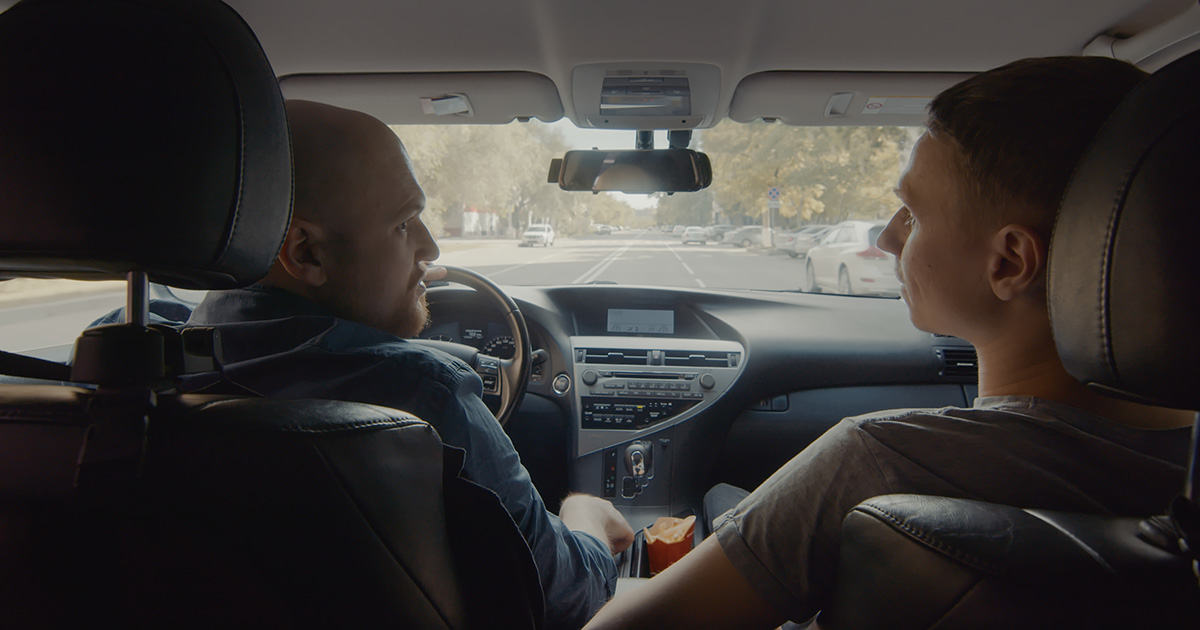

The car is where teens actually talk. Not at the dinner table, not in the “let’s catch up” conversation you try to engineer on a Sunday, and certainly not in response to the text you sent at 3pm asking how their day went. A teen who gave three-word answers at breakfast narrates their entire social life from the passenger seat. You arrive home, they get out, and it’s over. You stand in the kitchen wondering why the most real conversation you’ve had all month happened in a Honda Odyssey.
Parents across the board report the same thing. Psychologists have spent considerable time trying to explain why teens talking in the car produces what no other setting reliably does, and the answers reach into adolescent brain development, sensory experience, and the particular architecture of a conversation that has a guaranteed endpoint.
The car turns out to be less a coincidence and more a near-perfect condition for adolescent disclosure, built, without anyone designing it that way, to satisfy nearly every neurological and social requirement a teenager has for feeling safe enough to speak.
The Nervous System Has an Opinion About Eye Contact

According to the Center for Parent and Teen Communication, some teens get uncomfortable when you’re staring directly into their eyes and clam up. Talking side by side may help the conversation flow when the words won’t come face to face. The car solves this by design: you’re both looking forward, at the road, and talking side by side.
Direct eye contact during an emotionally loaded conversation can read as confrontational to an adolescent brain that is already on high alert. A face-to-face conversation, especially one initiated by a parent who clearly has something on their mind, carries implicit pressure: there’s nowhere to look, no shared external focus, and no easy exit. The car dismantles all of that. The combination of close physical proximity, diminished eye contact, and a shared focus on navigating the road helps lower emotional barriers and encourages more candid dialogue. The parent’s eyes are on the road. The teen’s eyes can be anywhere: the window, the dashboard, their hands. Nobody is performing vulnerability at anyone.
Researchers and child development specialists call this parallel conversation, or side-by-side talk, a low-pressure communication format for adolescents. Doing something else together gives the nervous system a sense of safety, and the car happens to be one of the most effective environments for creating exactly this condition, because the shared activity of getting somewhere is non-negotiable and non-threatening.
The Adolescent Brain Responds to Its Environment

Adolescence involves significant neurobiological changes that amplify how responsive teens are to their surroundings. A 2024 study found that puberty initiates processes like synaptic pruning, myelination, and neuronal reorganization that heighten adolescent neuroplasticity, and that this heightened responsiveness, combined with growing social curiosity, propels adolescents to engage more deeply across diverse environments. The environment a teen is in doesn’t just set the mood, it actually shapes what their brain is capable of in that moment. A low-threat, sensory-rich, gently stimulating environment like a moving car can prime the adolescent brain for connection in ways that a static, face-to-face setting does not.
The gentle movement of the vehicle, the background hum of the engine, the scenery moving past the window – all of it provides what psychologists call mild, ambient stimulation. It’s not distracting enough to hijack attention, but it’s just enough to occupy the region of the brain that would otherwise be scanning for social threat. With that scanning activity gently occupied, the region that processes and articulates experience gets more room to operate. The brain, in other words, relaxes its defenses and starts doing something else: processing the day.
A Built-In Off-Ramp

One of the less obvious reasons teens talk in the car is that they know it’s going to end. The conversation has a natural conclusion built in: the destination. For a teen, the appeal of a car ride is its clear parameters. They know this conversation can’t go on forever, so it feels safe. At some point, they’ll reach the destination, a figurative and literal off-ramp. They know there is a beginning and an end, which gives them a sense of control. For many teens, especially those who are working toward independence, feeling like they have an exit makes it easier to open up.
Adolescence is a developmental period organized around the pursuit of autonomy. A teen who feels cornered into a conversation with no clear end, who can see a parent settling in for a long, intentional discussion, is a teen who is already calculating how to exit, not what to say. The car reframes the whole dynamic. They got in. The car is moving. They’ll get out when you arrive. The conversation doesn’t have to go anywhere in particular, because it already is going somewhere in particular, and everyone knows when it stops.
This also works in your favor as the parent. You can say difficult things, or hear difficult things, without the implicit social pressure of deciding when the conversation is over. The road decides. Both of you have an exit, and both of you know it, and somehow that makes the middle of the drive the safest place in the house.
Boredom, Surprisingly, Is Part of the Pattern
There’s a third factor that parents tend to overlook because it sounds almost too simple: mild boredom. The car ride, especially a familiar route to school or soccer practice, doesn’t demand anything from a teenager. They’re not being asked to perform, contribute, or decide anything. They’re just along for the ride. That particular kind of mental unloading, where the brain isn’t under any specific demand, is exactly when previously unprocessed thoughts tend to surface.
When there’s nothing else competing for a teen’s attention in a low-stakes way, their mind tends to wander toward whatever has actually been on it. The thing they haven’t quite figured out how to say yet finds its way to the surface, because there’s nothing more urgent competing for the cognitive space.
This is also why the music matters. Background noise, a familiar playlist, even the radio, provides just enough ambient sound to keep the silence from feeling loaded. Silence in a face-to-face conversation is awkward. Silence in a car with music playing is just a moment between thoughts.
Why the Dinner Table Fails Where the Car Succeeds

If you’ve ever tried to engineer a meaningful conversation at the dinner table and gotten nothing but “fine” and “I don’t know,” you’ve experienced the opposite of the car dynamic. The dinner table is face to face. It’s stationary. Everyone arrived there on purpose, together. And there’s no shared external focus pulling attention away from the conversation itself. For an adolescent navigating the developmental work of separating from the family unit, that setup reads as a social performance with an audience and no exit.
According to the Cleveland Clinic, most teens begin to pull away during a time that often coincides with puberty, a period when their daily activities revolve more around peers, teachers, and coaches than parents. A pediatric psychologist there notes it’s sometimes helpful to start the conversation in the car. If home doesn’t feel emotionally accessible, teens will rely on other people for those conversations instead.
The car sidesteps nearly every structural problem with the dinner table. The seating is side by side, not face to face. The activity is shared but doesn’t require verbal participation. The timeline is fixed. The exit is already built in. In a car, both parties can look away, let a thought sit for a second before responding, in a way that a direct conversation across a table simply doesn’t allow.
This is also why children don’t always listen in the settings parents most expect them to: the context shapes the communication, not just the intent behind it.
How to Use This Without Ruining It

The car stops working the moment it becomes an agenda. Parents who climb into the driver’s seat with a topic they’ve been waiting to bring up tend to find the car produces nothing. The reason the car works is precisely because it doesn’t feel like a setup. The moment it does, the teen’s internal threat-detector goes back online and the window closes.
Child psychologist Dr. Anthony E. Wolf, who has written extensively on parent-teen communication, argues that parents should fight the urge to turn every interaction into a teachable moment and instead become good listeners. His consistent advice, listen without correcting or criticizing, matters especially in the car: correcting a teen while they’re talking can produce immediate silence and often prevents them from opening up in the future.
The practical implication is that your job in the car is almost entirely passive. Ask one question that doesn’t require a particular answer. Make a passing observation about something outside. Turn the music down slightly. Then wait. If they talk, do not react in a way that signals they’ve handed you an opening to make a point. Overreacting, even positively, even with the best intentions, is enough to make a teen recalibrate how much they’re willing to share. If a teen shares something surprising or difficult, responding calmly is what keeps the conversation going: overreacting may make them hesitant to share things in the future.
Not every car ride will produce a revelation. Some drives are going to be quiet, and that’s fine. The car that has reliably been a comfortable space across dozens of unremarkable trips is the car where something real eventually gets said. The investment is in the pattern, not in any single drive.
What If Your Teen Isn’t a Car Talker?

Not every teenager is wired for car conversation, and interpreting the silence as rejection misreads what’s happening. Some teens process out loud in the car; others use the exact same environment to decompress in silence, and both are legitimate uses of the space. The underlying principle, that low-pressure, side-by-side activity lowers a teen’s guard enough to allow real conversation, still holds. It just means the car might not be your specific teen’s version of it.
For the teen who stays quiet in the car no matter what, the same dynamic can be found in other shared activities. Walking the dog together. Sitting side by side while folding laundry. Cooking dinner with someone who isn’t staring at them waiting for a response. The car is the most consistent example, but it isn’t the only context where side-by-side, activity-anchored connection opens a door. What all these settings share is that the talking is not the main event, and removing the talking as the main event is the whole reason any of it works.
What You’re Actually Protecting

The car doesn’t turn your teenager into a different person. It just removes enough of the usual friction that the person they already are has a better chance of being audible. Understanding why teens talking in the car works so reliably isn’t about optimizing the carpool schedule. It’s about recognizing that a lot of what looks like teenage silence is actually environmental, a function of context, not character.
The teen who won’t talk at the table and who gives you nothing over dinner is often the same teen who, six minutes into the drive to rehearsal, tells you something true about their life. Both of those teens are real. You’re not getting a mask in one setting and a breakthrough in the other. You’re getting the same kid, in two different nervous system states, shaped by two different environments.
Some of this goes back further than the car does, it goes back to the developmental pressure of adolescence itself, which asks teenagers to move away from their parents while still needing them. That tension doesn’t resolve. What the car offers is a context where the tension can briefly relax. Neither of you has to perform connection. It’s just two people going somewhere, and sometimes, in the space between here and there, something real gets said.
Disclaimer: This information is not intended to be a substitute for professional medical advice, diagnosis, or treatment and is for information only. Always seek the advice of your physician or another qualified health provider with any questions about your medical condition and/or current medication. Do not disregard professional medical advice or delay seeking advice or treatment because of something you have read here.
AI Disclaimer: This article was created with the assistance of AI tools and reviewed by a human editor.