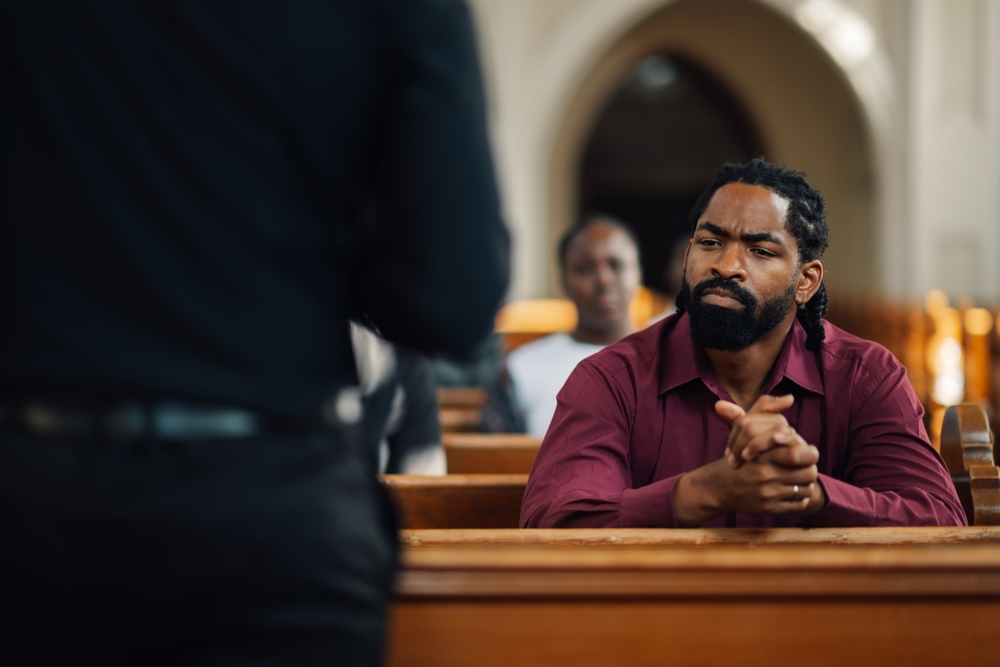

Church is supposed to be the one room where nobody judges you. That is, at least, the official position. The unofficial position – the one operating silently across every denomination, every Sunday, in every pew from the front row to the strategically chosen seat beside the emergency exit – is something else entirely. People absolutely notice. They notice what you wore, when you walked in, whether your phone buzzed during the scripture reading, and how enthusiastically (or conspicuously) you raised your hands during worship. They just don’t say so out loud. That’s what makes it so interesting.
On any given weekend, about 30% of U.S. adults attend religious services, down from 42% two decades ago. Which means the people who remain are, in some sense, a self-selected group of regulars who have built their own social ecosystem – with its own unspoken codes, its own hierarchy, and its own very long memory. Walk in and breach one of those codes, and you won’t hear a word about it. But someone noticed. Someone always notices.
That gap between the stated values of the congregation and the actual human behavior of its members is one of the great unspoken comedies of community life. It’s also one of the things that makes church, for all its warmth and genuine connection, a deeply recognizable social arena. These are the 12 behaviors that people notice, file away, and – if they’re being honest over coffee in the parking lot afterward – absolutely judge.
1. Arriving Late Every Single Sunday
Everyone is late once in a while. Children forget how to locate their left shoe. Coffee gets spilled on the shirt that was already a backup shirt. Traffic exists. That’s not what we’re talking about. We’re talking about the person who arrives ten minutes into the opening prayer every single week, works their way down the center aisle with audible apologies and jingling keys, and then expresses genuine surprise at finding no seats in the middle section. The congregation absorbs this disruption with the patience of saints, which is technically their job, but you can watch the exact moment each person decides to stop making eye contact.
The problem isn’t the lateness itself – it’s the scale of the arrival. One person walking in late can pull two dozen people out of whatever quiet, reflective moment they were attempting to inhabit. The hymn, the opening prayer, the moment the pastor says the thing everyone has been carrying all week – all of it gets bracketed by the sound of someone shuffling past three seated people in a narrow row while whispering “sorry, sorry, sorry.” The congregation forgives it every time. The congregation also remembers it every time.
There’s a particular version of chronic late arrival that involves a large coffee and zero apparent awareness that this is a pattern. This version is genuinely impressive in its confidence.
2. The Phone That Just Won’t Stay Silent
A ringing phone interrupts almost every sermon, and a vibrating phone against a hard wooden pew can be just as loud and distracting as a full-volume ringtone. Everyone in the room knows the source immediately. The person responsible then performs an elaborate pantomime of surprise – as though the phone rang itself, as though they had no idea it was even in their pocket, as though the concept of “silent mode” is something they are hearing about for the first time today, in church, at the exact wrong moment.
The follow-up behavior is equally studied. There’s the slow excavation from the bag or pocket, the theatrical silencing, the look of sincere apology directed at no one in particular. The pastor, to their eternal credit, usually pauses for exactly the right amount of time and then continues without a word. This is arguably one of the more impressive pastoral skills. The congregation, meanwhile, spends the next four minutes not quite listening because they’re still running the disruption on a loop.
What makes this a repeated behavior rather than a one-time mistake is that the same person tends to do it multiple Sundays in a row, each time performing equal surprise. At some point, it becomes a kind of tradition.
3. What You Wore – and What They Said About It
The official position of virtually every church is that everyone is welcome as they are, and the spiritual condition of a person has nothing whatsoever to do with their wardrobe. The unofficial position, circulating in whispers from the foyer to the parking lot, is considerably more detailed. People notice outfits that are too flashy, revealing, or casual for church. Even if no one says it, those judgments are happening.
The dress code conversation is complicated because it genuinely varies by congregation. What reads as inappropriately casual in one church is Tuesday at another. What one community considers appropriately modest, a neighboring congregation finds faintly theatrical. This is the kind of institutional inconsistency that makes it nearly impossible to get it right on your first visit, and the people who have been attending for twenty years know exactly what the consensus is and will not tell you directly. They’ll just look. Briefly. Carefully. In a way that communicates everything. None of this reflects especially well on anyone. But it happens, which puts it firmly on this list.
4. Whispering During the Sermon
The acoustics in most sanctuaries were designed for singing and for the projection of a single speaking voice. They were not designed to make whispered side conversations disappear quietly into the atmosphere. Whispering in church is never as quiet as people think. Every small conversation seems louder when the room is silent, and people are often surprised when others can hear them discussing lunch plans during the sermon.
The content of the whispers matters less than their existence. It doesn’t make much difference whether someone is debating where to eat after service or passing along a genuinely urgent piece of information – the effect on the people seated nearby is identical. There’s a particular quality to the distraction of a nearby whisper during a sermon, where you can’t quite make out the words, so your brain keeps trying to parse them instead of listening to the speaker. You end up knowing neither the sermon nor the whispered conversation, which is the worst possible outcome.
The whisperers themselves are often visibly unbothered, which only adds to the social weight of it. They’ve made a decision that their conversation is worth the interruption and they seem at peace with it, which the people around them absolutely are not.
5. The Unmanaged Children
This is the most complicated item on the list, and worth saying clearly upfront: children in church are a sign of a living congregation, and parents bringing small children to a service while managing nap schedules, snack requirements, and the unpredictable emotional weather of toddlers deserve a certain amount of structural grace. All of this is true. Also true is that there is a meaningful difference between a child who is quietly fussing and being tended to, and a child who has been running laps down the side aisle for the past fifteen minutes while their parents look straight ahead.
Allowing a child to cry, scream, or run amok for an extended period is a major distraction for everyone trying to worship. The consensus on church etiquette is clear: the most considerate and respectful thing to do is to quickly and quietly take your child to the back of the church, the foyer, or a designated cry room. Most churches have this infrastructure specifically so that no parent has to choose between participation and disruption. The exit is not a failure; it’s the move. The congregation will be relieved, and the parent will stop sweating through their cardigan, which is a win for everyone.
What earns genuine silent judgment is not the child’s behavior – it’s the sustained absence of adult intervention in a setting where everyone around you is trying to concentrate. The child isn’t doing anything wrong. They’re a child. The adult management of that situation is what people are actually watching.
6. Performing Your Faith a Little Too Hard
Genuine worship takes a lot of forms, and most of them are entirely appropriate. Some people cry during songs. Some people sit very still with their eyes closed. Some people raise their hands. All of this is normal, recognizable, and accepted. The behavior that draws a different kind of attention is the version that reads less like private spiritual expression and more like a production designed for the room – the wide arms, the swaying, the very loud sustained vocal agreement with the pastor, the timing that always aligns with maximum visibility.
People can usually tell the difference between genuine worship and somebody auditioning for a Christian music documentary. Emotional worship itself is not the issue, because people express their faith differently. The issue is when the expression starts to feel calibrated – when it happens at the exact moments most likely to be observed, or when the intensity tracks with the size of the audience rather than the content of the message. Congregations have spent enough time together to develop a fairly accurate read on this, and most of them do not vocalize what they’re reading. They don’t need to.
7. Treating Newcomers Like Suspects
There is a version of welcoming a new person to your church that functions, in practice, as surveillance. The interrogation-disguised-as-friendliness that catalogues where they came from, who sent them, whether they’ve been to other churches in the area, and what their specific theological positions are within the first four minutes of conversation. The newcomer arrived hoping to find community. They are instead being processed.
Research behind the Great Dechurching found that about 40 million adults in America used to go to church but no longer do, and that for the first time in eight decades of Gallup tracking, more U.S. adults do not attend church than attend. One of the recurring reasons former churchgoers give for leaving is that they didn’t feel much love in the congregation. Not hostility – just the cold absence of genuine warmth from people who were technically performing friendliness. There’s a real difference, and newcomers pick it up within minutes. The people who’ve been in the building for years are often the last to notice they’re doing it.
8. Leaving Before the Final “Amen”
Slipping out before the closing prayer or the final song is a choice that registers with every person who watches it happen, and a surprising number of people watch it happen. There is a specific choreography to the early exit: the gathering of the coat, the careful folding of the bulletin, the low crouch-walk through the pew, the door opened as quietly as a door with a hydraulic closer can be opened. All of this takes place at roughly the same volume as the actual service. Nobody says anything. Everyone sees it.
Leaving during the closing prayer or the final song is noticeable and can be demoralizing for the leadership. The pastor has just delivered forty minutes of careful thought about forgiveness or hope or grace, and the last image they see before the benediction is three families doing a coordinated exit. Whatever their reason – a child’s nap schedule, a parking situation, a roast in the oven – it communicates a particular kind of prioritization that the room absorbs and files away without comment. The people who do this regularly often believe they’re being subtle. They are not being subtle.
9. Hoarding the Entire Pew
Church pews are communal seating. This is, architecturally, the whole point of them. They are long benches designed to seat a row of humans shoulder-to-shoulder in service of a shared experience. What they are not designed for is one family of four spreading coats, bags, Bibles, and an assortment of small personal items across the center of an eight-person pew, then making a face of mild inconvenience when someone asks to sit down.
Sitting right on the aisle blocks others from finding a seat, especially if they arrive a bit late. This particular behavior tends to operate on two separate tracks simultaneously: the person doing it is genuinely not thinking about it, and everyone standing in the aisle looking for a seat is thinking about nothing else. The resolution usually involves an exchange of apologetic body language from both parties, the removal of one jacket and a water bottle from the claimed territory, and a general lowering of the ambient spiritual mood for about four minutes. The sermon continues. The mild resentment does not entirely dissipate.
10. Praying Out Loud at Full Volume During Silent Prayer
Most congregations have moments of silent or personal prayer, which are generally understood to be silent or personal. The person who uses this moment to audibly and at some length narrate their conversation with God – not quietly, not as a whisper, but as a full-voice address – represents a specific category of church behavior that is simultaneously sincere and enormously disruptive.
It is possible to do this without any self-awareness whatsoever, and the people who do it typically have none to speak of. The challenge for everyone around them is that there is no graceful social mechanism for interrupting a person who is, technically, praying. You cannot tap someone on the shoulder and ask them to pray more quietly. The room is in silent prayer. You, too, are supposed to be in silent prayer. Instead you are acutely aware of the prayer happening two rows back, every word of which you can hear with perfect clarity, and none of which you were meant to hear. The congregation manages this by collectively pretending it isn’t happening, which is its own kind of spiritual discipline.
11. Being the Visible Hypocrite
People quickly judge someone who acts very spiritual on Sunday but is rude everywhere else. People notice when someone raises their hands during worship, but then treats restaurant workers poorly after church. This is the behavior that earns the longest memory and the least charity, and it’s the one people are most reluctant to name directly, because naming it requires a level of self-awareness about their own inconsistencies that, respectfully, most people prefer to avoid.
The visibility of hypocrisy has expanded considerably in the age of social media. The person who posts an inspirational verse on Sunday morning and then, within the hour, is arguing in comment sections about something petty and unrelated – the congregation sees it. They follow each other. They scroll the same feeds. Church may end at noon, but the performance of one’s character continues twenty-four hours a day, seven days a week, and the gap between Sunday identity and Tuesday behavior is something people in a close community track closely even when they’re not trying to.
This one earns the most judgment because it touches the most directly on what church is supposed to be. Nobody expects perfection. They do notice when the gap is wide and the self-awareness about it is absent.
12. Refusing to Participate at All
There’s a difference between someone who is shy, new, overwhelmed, or just doesn’t express faith outwardly, and someone who has made a deliberate display of disengagement the centerpiece of their Sunday morning. Arms crossed, eyes elsewhere, refusing to stand for congregational singing while maintaining a visible expression that communicates that they could be anywhere right now and almost any of those places would be preferable. The congregation’s read on this shifts entirely depending on why the person is there – dragged by a partner, attending for the kids’ sake, processing a loss or a doubt – and that context shapes everything.
A 2025 report from Barna Group found that Gen Z churchgoers now attend 1.9 weekends per month, leading a resurgence in attendance. That figure matters because it suggests a lot of people are arriving who aren’t yet certain whether they belong there. Visible disengagement in that context reads differently than the person who has been attending for three decades and is visibly checking out during the sermon. The congregation notices both, but judges them differently. One looks like someone finding their way. The other looks like someone who has misplaced their reason for being in the room in the first place.
Here’s the Thing
What sits underneath all twelve of these is that church is a community, and communities run on unwritten social codes. Every one of these behaviors draws judgment not because the congregation is uniquely petty or unkind, but because every human community builds norms across years together and registers deviations from them. The office does this. The neighborhood does this. The school pickup line absolutely does this. Church is not exempt just because the stated values include grace.
What’s worth holding onto is the tension between the ideals of the space and the very human reality of the people in it. The congregation noticing your late arrival and the congregation genuinely wanting you there can both be true at the same time. The person who shoots a look at the distracted phone-checker may also be the first one at your door when something goes wrong. Communities are like that. The judgments are real, the belonging is real, and you don’t have to have perfect Sunday morning behavior to earn a place in either one. The archive of what people have noticed never quite empties – but neither does the capacity to keep letting people back in anyway. That’s the part nobody writes a list about.
AI Disclaimer: This article was created with the assistance of AI tools and reviewed by a human editor.