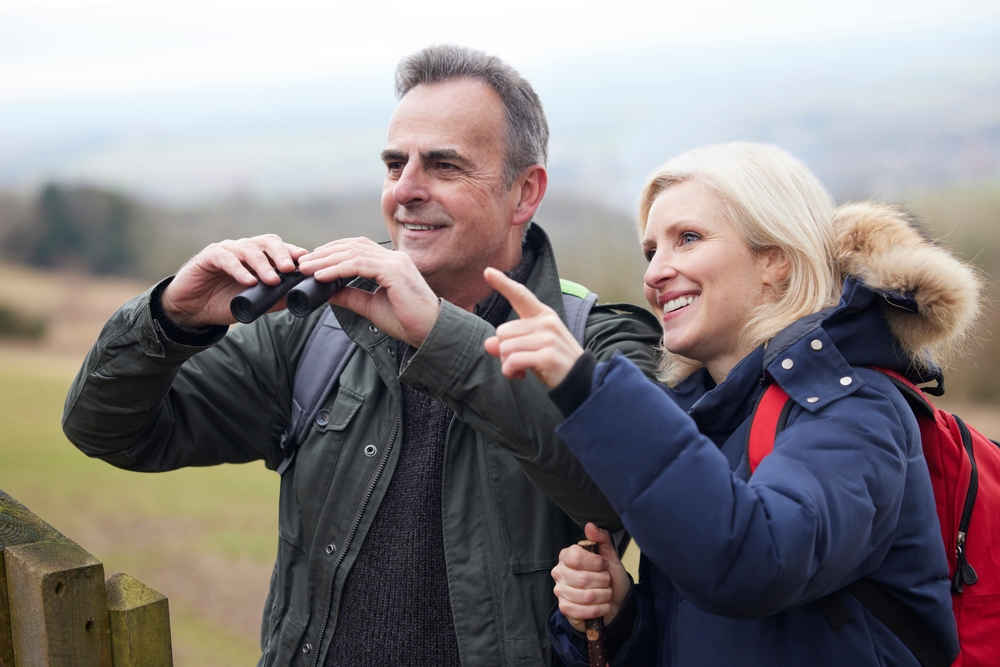

I believe the bird-watching hobby is the most underrated thing happening in American culture right now, and you should give it a serious look before writing it off as something your retired neighbor does on Tuesday mornings with a thermos and a pair of old binoculars.
Bird-watching is everywhere. It’s in city parks and apartment windows and group chats and on the feeds of people who don’t think of themselves as outdoorsy. The stereotype of the solo retiree in khaki, standing silently at the edge of a marsh with a worn field guide, still exists. It is also a narrow slice of a much larger picture, and if it is the main reason you haven’t taken the hobby seriously, it is worth setting aside. The people who watch birds in 2026 are not a type. They are a third of the country.
The numbers say it has become one of the most widely practiced outdoor activities in the United States, and the research on what it does for your mental health is hard to dismiss. If you have been vaguely curious and haven’t yet taken it seriously, consider this your invitation.
The Bird-Watching Hobby Is Bigger Than You Think
According to the U.S. Fish & Wildlife Service’s 2022 National Survey, 96 million people in the United States engage in birding – that’s 37 percent of the population aged 16 and older. To put that in perspective, that is more Americans than play golf, tennis, and basketball combined. Backyard birding accounts for the vast majority of that participation, with 95 percent of birders watching from home, while 44 percent have traveled a mile or more specifically to see birds.
The demographic picture is also broader than the stereotype suggests. While birders skew older, with an average age of 49, the survey found that birding crosses racial, ethnic, and generational lines in ways that surprised researchers. Asian Americans report the highest participation rate of any group, with nearly half identifying as birders, and about 30 percent of young people ages 16 to 34 take part.
Outside the U.S., the trend is even more dramatic among younger people. In Britain, birdwatching among 16-to-29-year-olds has surged by 1,088 percent since 2018, with the number of regular young birdwatchers rising to nearly 750,000. These are not casual numbers. This is a generation that grew up on TikTok and is now logging bird sightings on apps, posting puffin photos, and talking about migration patterns with the same energy they bring to anything else they care about.
The Apps Changed Everything
A significant part of why this took off – and why it has stayed – is technology. The old entry barrier to birding was real: you needed patience, a decent field guide, and either an experienced mentor or the willingness to spend hours being confused by shorebirds. A hobby that asks you to sit with extended uncertainty while you’re still learning it will lose most people before the end of the first month.
The Cornell Lab of Ornithology’s Merlin Bird ID app effectively dissolved that barrier. The app has surpassed 10 million active users worldwide, with American usage up 40 percent in just one recent spring season, and European usage up 70 percent in the same period. Merlin can identify a bird from a photograph in seconds. More impressively, its Sound ID feature listens to the ambient audio around you and names every bird it hears in real time. You can be standing in a park, hold up your phone, and watch the species list populate live as the birds call around you. It is, functionally, Shazam for birds, and it turns every walk outside into something that suddenly has a layer of information you never had before.
This accessibility has real consequences. When identifying a bird requires nothing more than opening an app you already have on your phone, the hobby stops being exclusive. Birding generally doesn’t require permits, licenses, or expensive gear – unlike most outdoor activities with a comparable following. You can start in your own backyard on a Tuesday morning, or in a city park on your lunch break, or through a window while your coffee brews. The cost of entry is effectively zero.
If you want to take the first step toward bringing birds closer to you at home, building a simple backyard feeding station is one of the most direct ways to do it – and it costs less than you might expect.
What the Research Actually Says About Mental Health

Here is where I want to be clear, because wellness claims get inflated fast and I don’t want to tell you that watching a chickadee will cure your anxiety. The evidence is more specific and more interesting than that.
A 2024 study from North Carolina State University found that people who have nature-based experiences report better well-being and lower psychological distress than those who do not – and birdwatching in particular yielded higher gains in subjective well-being and more reduction in distress than more generic nature exposure, such as walks. That second part is the finding that stood out to researchers. It is not simply that being outside is good for you, though it is. Something about the specific act of watching birds – the active attention it requires, the way it pulls your focus outward – appears to do more than simply being in a park.
The leading hypothesis is that birdwatching creates a particular kind of directed attention. You are not passively sitting in a garden; you are actively scanning, listening, tracking. That engagement keeps the mind occupied in a way that interrupts the ruminative loop many of us live in. You cannot catastrophize about a work email while you are trying to figure out whether that brown bird on the fence is a House Wren or a Carolina Wren. The birds, bless them, demand your full attention.
A 2025 review published in the journal Ecopsychology confirmed that while the specific research on birding as a mental health tool has lagged behind broader nature research, the preliminary clinical evidence points to a range of benefits including reduced anxiety and stress, increased memory and attention, and opportunities for social and community engagement. The caveat is that most studies are small and self-reported, so the science is promising rather than definitive. But the direction is consistent, and the cost of trying it is, again, zero.
The Economic Weight Behind the Feathers
The counterargument I hear most often is something like: “That’s sweet, but it’s just a hobby. It’s not a big deal.” The economic numbers suggest otherwise.
More than six out of every ten dollars spent in 2022 on wildlife-related recreation in the U.S. came from wildlife watching, with birds cited as the greatest focus – and wildlife watchers spent more than $250 billion that year, including more than $24 billion on equipment like binoculars, cameras, and bird food. That is not a niche hobby. That is an industry.
The local economic effects are vivid. During a six-week period of spring migration in 2024, around 70,000 people visited Magee Marsh Wildlife Area in Ohio alone, and festival co-founder Kimberly Kaufman estimates birders spent roughly $53 million in the region – up from $37 million in 2013. A single rare bird can move the needle in meaningful ways, too. A Steller’s Sea-Eagle that appeared along the New England coast in the winter of 2021-22 pulled birders from across the country, pumping more than $750,000 into the economies of Maine and Massachusetts. For a bird that normally lives in northeast Asia, that is a remarkable return on investment for a species that had no idea it was doing anyone any favors.
The Strongest Objection, Taken Seriously
The most honest pushback I can offer against my own argument is this: birdwatching requires a kind of stillness and patience that is genuinely hard to manufacture, especially when your life is already scheduled down to the hour. Sitting quietly and watching for something that may or may not appear is a skill, and in 2026, it is one that many of us have partially lost. The same culture that made the Merlin app necessary – the one that wants immediate identification, immediate feedback, immediate gratification – is also the culture that makes sustained, quiet watching genuinely effortful.
There is also the consumerism trap. A hobby that starts free has a way of developing expensive tastes quickly. Good binoculars run from $200 to well over $2,000. Dedicated birding travel – trips to Costa Rica, to Alaska, to Texas during warbler migration – can cost considerably more. As one writer put it, a hobby born partly as relief from modern excess can easily become another shopping identity: the perfect jacket, the perfect binoculars, the perfect trip. That tension is real and worth naming.
But neither objection is actually fatal. You don’t need patience you don’t have; you build it in small increments, starting with ten minutes at a feeder before the rest of the household is awake. And you don’t need expensive gear to begin. A phone with Merlin installed and a window that faces a tree is a sufficient setup for the first six months.
Read More: 9 Incredible Night-Sky Events to See This Summer 2026
The Part That Surprised Me
I went into this expecting to make a practical argument and found myself making a slightly different one. The research on what bird-watching does for attention, for stress, for the particular kind of mental stillness that most of us are running a chronic deficit of – that research points toward something that is hard to get from most hobbies that promise the same thing.
Yoga classes and meditation apps require you to set aside time, arrive somewhere, perform wellness. Bird-watching requires none of that performance. It asks only that you pay attention to what is already outside your window. There is something almost subversive about that in a world that wants to monetize every form of rest and package every form of calm into a subscription.
I’m not telling you this will change your life. I’m telling you that 96 million Americans are doing it, the research on its mental health effects is the most consistent I’ve seen for any free outdoor activity, and the barrier to trying it is lower than almost anything else you could pick up this year. Whether you start by downloading an app, filling a feeder, or just actually looking at the birds at the park you already walk through – the hobby is there waiting for you. It has been there the whole time. You just weren’t looking.
AI Disclaimer: This article was created with the assistance of AI tools and reviewed by a human editor.