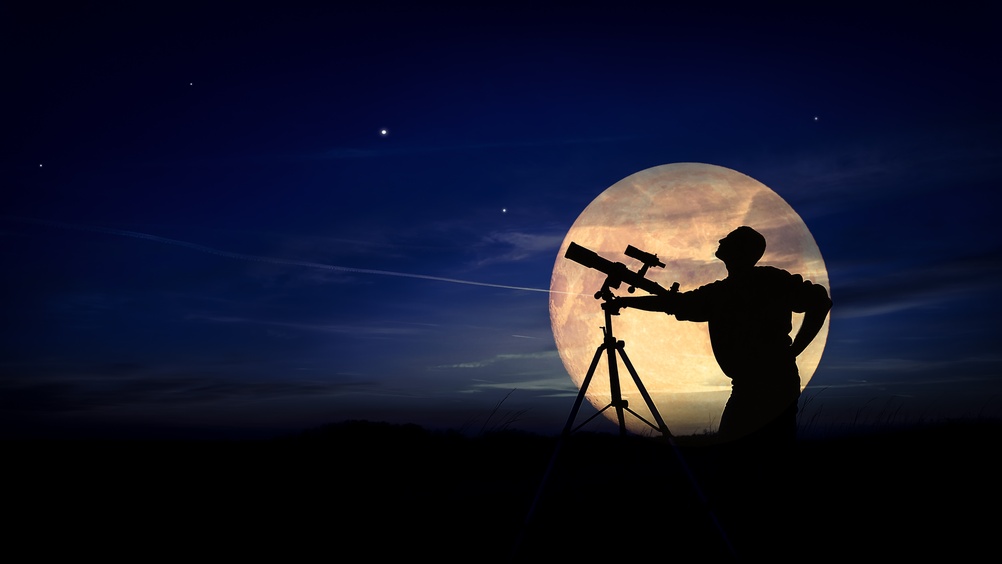

The night sky puts on the same basic show every summer: the Big Dipper overhead, a few planets hanging in the west, the occasional slow-moving streak. Most summers, that’s enough. This summer is different. Between June and August 2026, the sky is stacked with events that range from genuinely easy, step-outside-and-look-up moments to a once-in-a-generation total solar eclipse over Europe that eclipse chasers have been circling on their calendars for years. Some of these events require zero planning. Others reward a little effort – a darker location, a night the kids are at a sleepover, a blanket and a phone with a sky-mapping app. All of them are real, happening now, and most won’t come back around in the same configuration for a long time.
You don’t need a telescope, a degree, or a particularly late bedtime for most of what’s on this list. Some of these are naked-eye events so bright that you’d have to actively try to miss them. Others reward patience: the kind of thing you watch build over several weeks, the gap between two planets narrowing night by night until they’re practically on top of each other. The point isn’t to become an amateur astronomer overnight. The point is that this summer’s sky is genuinely extraordinary, and a decade from now you’ll either remember that you looked up or you won’t.
Here are nine night-sky events worth knowing about, organized roughly in the order they happen from now through the end of summer.
1. The Venus-Jupiter Conjunction – June 9
Right now, if you step outside in the hour after sunset and look toward the west-northwest, you’ll find two uncommonly bright “stars” hanging above the horizon. They aren’t stars. On June 9, Jupiter and Venus – the two brightest planets in the night sky – appear close together in the evening sky above the northwestern horizon, with Jupiter at magnitude -1.8 and Venus blazing at magnitude -4, making the pair impossible to overlook. According to NASA’s 2026 astronomical events overview, this kind of planetary pairing is one of the most visually striking events of the year.
What makes this particular conjunction worth circling on the calendar is how dramatic the approach has been. On June 9, Venus and Jupiter will appear so close together in the sky that they’ll be separated by roughly the width of your little finger held out at arm’s length. If you’ve been watching the western sky over the last few weeks, you’ve already seen the gap narrowing night by night – one of those rare slow-motion celestial events that rewards patience.
Venus and Jupiter will be low in the west just after sunset, giving you around an hour between the Sun setting and the two planets setting. You don’t need equipment, but a pair of binoculars will let you see Jupiter’s four largest moons as tiny pinprick companions beside the planet’s disk. Move quickly after sunset – this one doesn’t wait.
2. Mercury at Greatest Eastern Elongation – June 15
Mercury is the planet most people have technically never seen, not because it’s faint but because it’s perpetually buried in the glow near the horizon and easy to overlook. On June 15, Mercury reaches its greatest eastern elongation of 24.5 degrees from the Sun, making this the best time to view Mercury since it will be at its highest point above the horizon in the evening sky. Look for the planet low in the western sky just after sunset.
The window is brief – Mercury sets not long after the Sun – so timing matters more here than with most events. The good news is that Venus will still be blazing in the same general area of sky, making it easy to orient yourself. Mercury sits to Venus’s lower right and is noticeably dimmer, but once your eyes find it, there’s a particular satisfaction in finally checking this one off. If you missed the spring morning showing, this is Mercury’s evening encore.
Give your eyes at least fifteen minutes after sunset before trying to locate Mercury, and get as clear a western horizon as possible. A hilltop, a beach, or an open field all work far better than a backyard hemmed in by trees.
3. The Summer Solstice – June 21
The June solstice occurs at 08:25 UTC on June 21. The North Pole of the Earth will be tilted toward the Sun, which will have reached its northernmost position in the sky and will be directly over the Tropic of Cancer at 23.44 degrees north latitude. This is the first day of summer in the Northern Hemisphere and the first day of winter in the Southern Hemisphere.
For practical stargazing purposes, the solstice marks the official opening of the best season. The warm nights stay warm past midnight. Kids who have been threatened with “school night” all year are finally free. And critically, summer is when the core of the Milky Way – the dense, glowing band of our own galaxy’s center – is visible in the sky for the longest stretch of night, rising in the southeast after dark and arcing across toward morning. Summer is the prime time to see the Milky Way core because it’s visible for most of the night. In spring, it’s only out in the early morning. Come fall, you’ll see the center for just a few hours after dark.
The solstice night itself – long on warmth and short on astronomical darkness – is as much symbolic as practical. But it’s worth stepping outside for a few minutes on June 21 just to mark the turning. The sky obligingly puts on a full show.
4. The Strawberry Full Moon – June 24
The full Moon in June is often called the Strawberry Full Moon, after the berries that grow in the Northern Hemisphere around this time of year. The name comes from Algonquin tradition, passed down through generations of farmers and foragers who used the full Moon as a seasonal clock. It has nothing to do with the Moon’s color – though on nights when it rises low on the horizon through summer haze, it can take on a warm amber or orange tint that earns the name by accident.
The full Moon is the one sky event that requires absolutely no planning, no equipment, and no special location. It rises at sunset, hangs in the sky all night, and sets at dawn. What it does require – if you want to make it an actual experience rather than just something you glance at from the driveway – is intention. The Strawberry Full Moon is worth watching rise. Find your eastern horizon, be there about twenty minutes before moonrise time for your location, and watch something the size of the horizon slowly pull itself up out of the dark.
It’s also, practically speaking, a terrible night for seeing faint objects like the Milky Way. The light wipes them out. Use the nights on either side of the full Moon for deep-sky looking, and save the full Moon night itself for the show of the Moon.
5. The Milky Way Core Window – All Summer
This one isn’t a single-night event; it’s a season-long opportunity, and one that’s genuinely endangered. Light pollution is increasing by about 10 percent every year, making starry skies rapidly more difficult to find. The Milky Way that people photographed thirty years ago from suburban backyards has, in many parts of the country, effectively vanished. Seeing it now requires a deliberate trip away from city and suburb glow.
The payoff justifies the effort. The galactic core – a dense, luminous band that bisects the summer sky from south to north – is not the thin wisp of light you sometimes see from a neighborhood park. From a genuinely dark location, it’s a three-dimensional structure: bright enough to cast faint shadows, detailed enough to see darker lanes of cosmic dust threading through the glow, and disorienting in the best way. Looking up at the Milky Way on a moonless night is one of those experiences that resets something.
The best nights for Milky Way viewing cluster around new Moon, when there’s no competing light. In July and August, the galactic core is highest in the sky around midnight. Plan around the lunar calendar, get at least fifty miles from the nearest major city, and give your eyes a full thirty minutes to dark-adapt before writing the experience off as underwhelming.
6. The Southern Delta Aquariid Meteor Shower – July 31
The Perseids get all the press, but July ends with its own respectable meteor display. The Southern Delta Aquariid meteor shower peaks on July 31. It’s a slower-burning shower than the Perseids – producing a modest but consistent stream of meteors, visible from late July into mid-August – and it runs concurrently with the opening of Perseid activity, so the two showers overlap and between them keep the late-July and early-August sky interesting.
The Southern Delta Aquariids are best viewed from the Southern Hemisphere and from mid-latitudes in the Northern Hemisphere, where the radiant point – the part of the sky the meteors seem to emerge from – climbs to a workable height. From a dark location, expect roughly fifteen to twenty meteors per hour around the peak. The Moon’s phase in late July 2026 is favorable for viewing, without the bright moonlight that washes out fainter meteors.
This shower tends to produce slower, more graceful meteors than the fast-streaking Perseids – the kind that arc across a significant stretch of sky and leave a brief glowing train behind them. Worth being awake for, especially since you’ll likely be outside anyway watching the Milky Way.
7. The Perseid Meteor Shower – August 12-13
The Perseid meteor shower was pretty much a washout in 2025, with the peak night blighted by moonlight. Happily, the Northern Hemisphere’s favorite display of “shooting stars” will fare much better in 2026. The peak night of August 12-13 will occur just hours after a total solar eclipse, which by definition can happen only during a new moon. A new moon means no competing moonlight – the single most important factor for a successful meteor shower. The sky will be as dark as it gets. According to Space.com’s 2026 Perseid guide, some lucky viewers of the August 12 total solar eclipse may even spot a few Perseid meteors during totality.
About 60 to 100 Perseid meteors are expected per hour under ideal conditions, radiating from the constellation Perseus but appearing anywhere in the night sky from late night to predawn. The Perseids are fast, bright, and frequently leave glowing trails. They’re the meteor shower people mean when they say they saw a meteor shower and it was actually spectacular, not just three faint streaks and a disappointing drive home.
The practical advice is simple: get somewhere dark, lie on your back, look at as much sky as you can, and wait. The shower builds through the night, peaking in the hours before dawn when Earth is rotating directly into the stream of debris left by Comet Swift-Tuttle. The best view is not through binoculars or a telescope – a wide-angle human eye is exactly the right instrument.
8. The Total Solar Eclipse – August 12
This is the event of the summer. Of the decade, honestly. The first total solar eclipse for mainland Europe since 1999 is visible from parts of Russia, Greenland, Iceland, and Spain, and for anyone within the narrow path of totality, this is the kind of event that gets remembered for the rest of a life.
According to the National Solar Observatory’s 2026 eclipse map, the eclipse will pass over the Arctic Ocean, Greenland, Iceland, the Atlantic Ocean, Portugal, and northern Spain. Spanish cities including A Coruña, Zaragoza, and Bilbao fall within the path. Reykjavík, Iceland, experiences totality in the late afternoon local time. For most of North America, Europe, and northwestern Africa, the eclipse is partial – still worth watching, but not the full effect. The NSO notes that during totality you may view the Sun without eye protection, but during all other phases you should only look when your eyes are protected by eclipse glasses certified to the ISO 12312-2 standard.
The temperature drops, birds go quiet, and the Sun’s corona – the pearlescent outer atmosphere normally invisible against the solar glare – blazes into view. People who have experienced totality consistently describe it as genuinely disorienting in a way that photographs cannot prepare you for. The drive to Spain or Iceland is not a small commitment. It’s also the kind of thing you’ll think about for twenty years if you don’t go.
9. Venus as the Evening Star – All Summer
Venus will dominate evening skies throughout summer 2026. Because it’s an inner planet as seen from Earth, Venus alternates between being visible before sunrise and after sunset. In 2026, it appears as the “evening star,” reaching its farthest apparent distance from the Sun in August. This is Venus at its most visible and most dramatic – blazing low in the western sky after sunset, bright enough to be mistaken for a plane on approach, often the first point of light to appear in the twilight.
After the close June 9 conjunction with Jupiter, Venus will appear each evening a little farther from the sunset point. Its greatest elongation – its greatest apparent distance from the Sun in the twilight sky – falls on August 14-15, 2026. Through a small telescope or even binoculars, Venus near greatest elongation shows a half-lit disk, the same phases that Galileo used to argue, in 1610, that Venus must orbit the Sun rather than the Earth. As BBC Sky at Night Magazine notes, a good smartphone astronomy app can help you pinpoint Venus each evening and track its position against the background sky as the season progresses. That observation helped rewrite cosmology. You can replicate it on a summer evening with a pair of binoculars and a porch chair.
Venus doesn’t ask much of you. It’s there every clear evening between now and late summer, burning in the west while dinner is being made or the kids are being corralled to bed. All you have to do is look.
Read More: 15 Best Beach Towns in The U.S. That Will Have You Feeling Laid Back, Relaxed, and Enjoying The View
The Best Night Is a Clear One
The whole calendar above is subject to the one condition no one controls: cloud cover. An eclipse chaser who flies to Spain and sees twenty seconds of totality through a brief break in the clouds will tell you it was worth every moment. A Perseid peak under a thick marine layer will send you back inside by 11 p.m. This is the part of astronomy that gets left out of the articles – you plan, you pack the blanket, you drive the forty minutes to somewhere actually dark, and then you wait on the weather. Sometimes it cooperates. Sometimes it doesn’t.
What the schedule does is give you reasons to be outside at night, looking up, over the course of an entire summer. Some of those nights will be extraordinary. Some will be unremarkable. All of them will be cleaner than staring at a screen. The universe has been putting on this particular version of the show for exactly this window – the June conjunction, the August eclipse, the moonless Perseids all stacking on top of each other in the same season – for the first time in years, and it won’t arrange itself quite this way again for a long time. You don’t have to catch every event on the list. But it’s worth knowing they’re there, and worth stepping outside every now and then to let the scale of everything above you do what it does – which is make the rest of it feel briefly, usefully small.
AI Disclaimer: This article was created with the assistance of AI tools and reviewed by a human editor.