
Inca was two years old and in the middle of obedience training when she stopped being interested in obedience. She became interested in Colleen Ferguson’s breath. Not in a fleeting, distracted way – she would wait for Colleen to exhale, position her nose a millimeter from her face, sniff, and then pull back with what Colleen described as a look of concern. This went on for weeks. Colleen had her teeth checked. She had tests done for her gluten intolerance. Everything came back clear. Inca did not stop.
Most of us would have written it off. Written it off, maybe laughed about it at dinner, and moved on. Colleen Ferguson nearly did. She was a 70-year-old former science teacher living in Headcorn, Kent, England, not someone who was primed to take medical cues from her German Shepherd. But Inca’s behavior was so specific, so persistent, and so strange that Colleen eventually paid privately for a full-body scan – because she could not shake the feeling that her dog was trying to tell her something. The scan found a golf ball-sized tumor in her left lung. It was stage one cancer.
Medical staff told Colleen it is virtually impossible to catch cancer that early unless a scan is already happening for another reason – and as a result, she did not need radiotherapy or chemotherapy. Her surgeon’s parting words were: “That dog saved you, now go live your life.” She did. And in the years since, researchers around the world have been working to understand what Inca already knew.
What a Dog Actually Smells
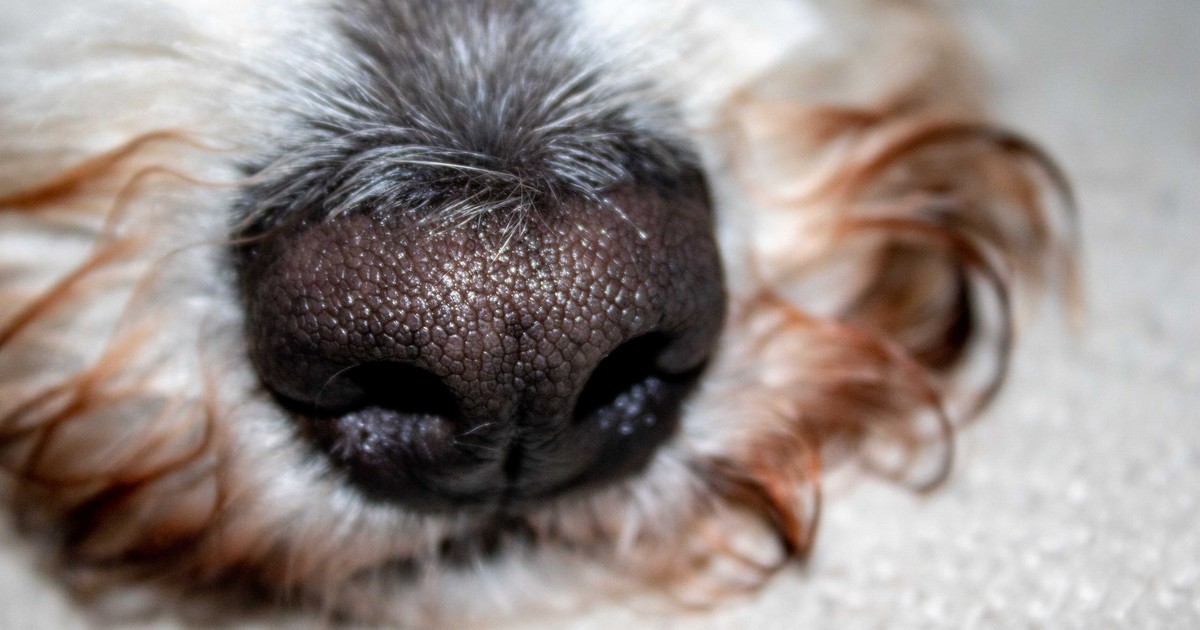
A dog’s nose is not just a better version of a human nose. It is a categorically different instrument. According to the Good News Network, dogs have up to 300 million olfactory receptors – tens of thousands more than humans. But it is not only about quantity. The portion of the canine brain dedicated to analyzing scent is proportionally enormous compared to ours, and dogs process smell with a depth and specificity that researchers are still working to fully map.
Trained dogs can detect some substances in concentrations as low as parts per trillion, which makes their noses sensitive enough to detect cancer markers in a person’s breath, urine, and blood. What they are picking up, in the case of cancer, is a category of molecules called volatile organic compounds, or VOCs – small chemical signals that are released by the body and exhaled in breath. Cancer cells metabolize differently from healthy cells. That different metabolism produces a different chemical signature. Cancers leave specific traces, or odor signatures, in a person’s body and bodily secretions. A dog like Inca responds to those signatures with a specificity that researchers are still working to replicate using laboratory equipment.
The PDSA, which honored Inca with a commendation for her role in saving Colleen’s life, noted that in the breath of patients with lung cancer, there are likely to be different chemicals to normal breath samples and the dogs’ keen sense of smell can detect this difference at an early stage of the disease. What Inca was doing in Colleen’s living room – pressing her nose close, frowning, refusing to be pushed away – was likely her response to exactly that chemical difference.
Inca’s Story, in Full
Inca’s behavior changed suddenly in January 2015. She went from a fun-loving young dog to being very subdued almost overnight, and she became extremely interested in Colleen’s mouth – waiting for her owner to breathe out before moving, refusing to be pushed away.
Colleen had been doing obedience training with Inca when the behavior began. All of a sudden, Inca kept trying to sniff her mouth and looked concerned. Colleen simply could not push her away.
Colleen visited her GP. She had blood work done. She was too embarrassed to ask directly for a cancer check – after all, her chest infection had cleared and she had no symptoms. Could she really walk into a doctor’s office and say her dog was behaving strangely around her? But she decided to take action and paid for a full-body life scan, which included intensive blood tests.
The private medical team called her doctor within three days to report that they had found a golf ball-sized lump in her left lung. It was cancer. As a non-smoker, she was stunned. Further tests confirmed the diagnosis, and in June she was admitted to hospital for surgery to remove the tumor, half of her lung, and her lymph nodes.
She had no symptoms at all other than being a bit tired, and had never been a smoker. She had no reason to suspect anything was wrong. The only data point she had was a two-year-old German Shepherd who would not leave her face alone.
Inca, now 13 years old, has since been trained as a recovery assistance dog to help Colleen, who developed panic attacks and anxiety following the health scare. Having since studied creative writing, Ferguson is now a self-published author – and she makes sure Inca knows what a good girl she is every single day.
This Is Not a One-Off

The scientific literature suggests this is not a coincidence – it is a pattern that researchers have been documenting for decades.
A 2024 review published in the American Journal of Veterinary Research found that 226 dogs have participated in various disease-detection research projects, and of those studies, 68 percent focused on cancer detection. The top three cancers examined were lung, prostate, and breast. Multiple sample types have been used, ranging from exhaled breath and sweat to saliva, urine, fecal material, and blood. The range of cancers sniffer dogs have been tested against includes primary lung tumors, breast cancer, ovarian cancer, colorectal cancer, and prostate cancer – conditions that, when caught early, are dramatically more survivable than when caught late.
One of the most cited studies in this space involved trained dogs working with breath samples from patients with confirmed lung cancer. Researchers trained four household dogs – two German shepherds, one Australian shepherd, and one Labrador retriever – to distinguish between breath samples from lung cancer patients and those from healthy people, based on scent alone. The dogs successfully identified 71 samples with lung cancer out of a possible 100, and they could do this independently of tobacco smoke or other respiratory conditions. The dogs did not know they were doing medical diagnostics. They were doing what dogs do: following a scent because it was there and impossible to ignore.
For those navigating their own health scares – or supporting someone who is – rare cancer symptoms are often the ones that are easiest to dismiss, which makes early detection, by any means available, genuinely consequential.
Where the Science Is Heading
Researchers are no longer asking whether dogs can detect cancer. That question has been answered, repeatedly, across multiple study types and cancer categories. The question now is how to translate what dogs do instinctively into something scalable, repeatable, and deployable in clinical settings.
A double-blind study published in November 2024 in Scientific Reports evaluated a non-invasive multi-cancer screening method for detecting breast, lung, prostate, and colorectal cancer using breath samples. The study included 1,386 participants who had undergone cancer screening or biopsies. Their breath samples were analyzed using a bio-hybrid platform combining trained detection dogs with artificial intelligence tools.
The study achieved 94 percent sensitivity and specificity across all four cancer types. To put that in plain language: the dogs, working alongside AI, correctly identified cancer in 94 out of every 100 samples that had it, and correctly cleared 94 out of every 100 samples that did not. That is accuracy that rivals or exceeds many conventional single-cancer screening tools – and the test required nothing more than breathing into a mask.
SpotitEarly, the company behind the study, uses a bio-AI hybrid platform that combines trained detection dogs with machine learning algorithms to identify cancer odor signatures in breath samples. Researchers and nonprofits are combining canine training with artificial intelligence to build tools that could bring rapid, non-invasive cancer screening into clinics and even personal devices. The long-term ambition is a breath test you could take at a pharmacy or receive at a routine checkup – something inexpensive, immediate, and requiring no blood draw, no imaging, no radiation.
When Your Dog Won’t Leave You Alone
Dogs have shown they can detect colon cancer, prostate cancer, breast cancer, and melanoma by sniffing people’s skin, bodily fluids, or breath. None of this is trained behavior in the average household dog. Inca had not been trained as a medical detection dog. She was a pet who had been enrolled in obedience classes, a dog who loved scent-based games and was, by her owner’s account, extremely nose-oriented by nature. What she did was not learned – it was instinctive. The VOCs coming from Colleen’s lungs were different, and Inca could not stop trying to communicate that.
You cannot take your German Shepherd’s persistent interest in your face as a medical diagnosis. But you can take it as a reason to ask questions, and Colleen Ferguson’s story is a pointed reminder of what happens when you do. She had no symptoms. She had normal blood work. She had a clean chest X-ray from a recent infection. The only anomaly was her dog, and she listened.
Dog detecting health problems is documented across hundreds of studies, tested across dozens of cancer types, and now being used to build clinical tools that may one day reach a doctor’s office near you. Clinical trials are underway. Studies are being published. The gap between “my dog keeps sniffing me” and “there is a diagnostic tool that works on the same principle” is narrowing to a point where the two ideas no longer feel unrelated.
The Part You Can’t Dismiss
Ferguson went on to study creative writing after her diagnosis and became a self-published author. The dog who saved her life is now 13, slower than she used to be, trained as a recovery dog rather than a competition dog. Colleen still tells her what a good girl she is every chance she gets. That detail – the daily thank-you to a dog who could not understand the thank-you but who somehow gave everything that mattered – is the part of this story that is hardest to set aside.
Dog detecting health problems is not a folk tale or a feel-good internet story about loyal pets. It is a scientific phenomenon documented across hundreds of studies, tested across dozens of cancer types, and now being used to build clinical tools that may one day reach a doctor’s office near you. The fact that it also happens to look like an ordinary Tuesday in Colleen Ferguson’s living room – a woman doing obedience training, a dog who refused to cooperate – does not make it less real. If anything, it makes it harder to dismiss, because it means it could be happening in your living room too, and you might be writing it off as a quirky habit.
The science does not require you to believe your dog has psychic abilities, or even extraordinary gifts. It only asks you to accept that a dog’s nose is built to detect chemical changes that are invisible to every other sense – and that cancer produces exactly those changes. Inca was not being mysterious. She was doing what her biology told her to do in the presence of something that smelled different from everything that had smelled right before. Stage one lung cancer almost never announces itself. It does not hurt. It does not cause a cough, or not necessarily. Catching it is everything, and the window for catching it is narrow. In Colleen’s case, the only instrument sensitive enough to find it was a two-year-old German Shepherd who had not yet mastered “sit.” Some signals are not quirky. Some of them are the whole story.
Disclaimer: This information is not intended to be a substitute for professional medical advice, diagnosis, or treatment and is for information only. Always seek the advice of your physician or another qualified health provider with any questions about your medical condition and/or current medication. Do not disregard professional medical advice or delay seeking advice or treatment because of something you have read here.
AI Disclaimer: This article was created with the assistance of AI tools and reviewed by a human editor.