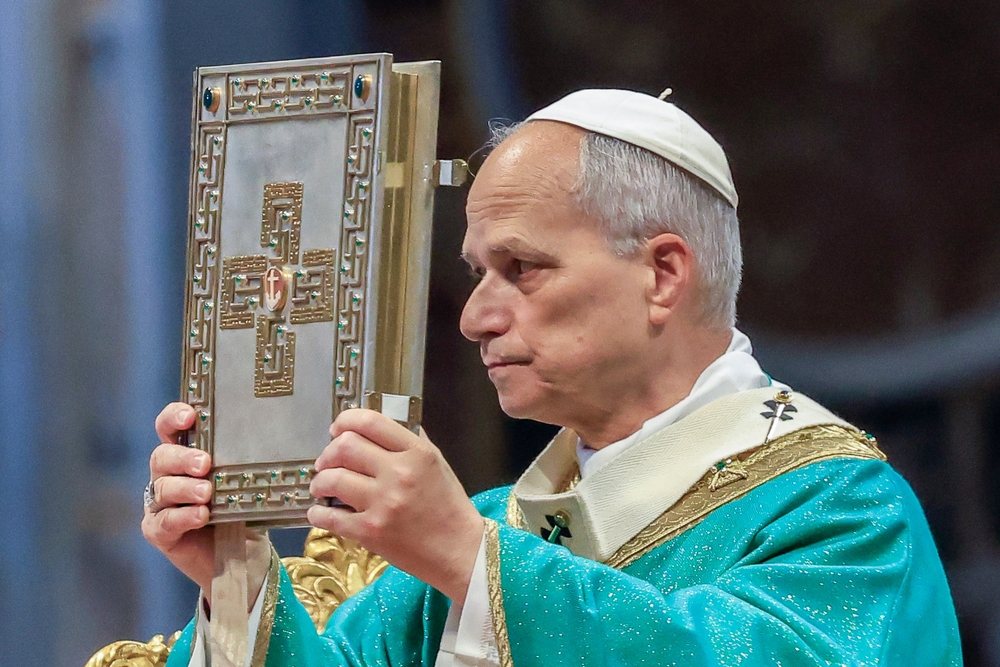

Most people think of faith and science as rivals who’ve been circling each other for centuries, occasionally throwing punches, pausing for truces, never quite working it out. That framing is so familiar it’s become background noise. What’s harder to account for, and stranger to sit with, is the possibility that the more pressing problem isn’t the conflict between them at all. The possibility that both of them, at this particular moment, are facing the same opponent.
That opponent is not materialism, or atheism, or fundamentalism. It’s something more corrosive and harder to argue with: the widespread refusal to accept that objective truth exists in the first place. Not people who disagree about what is true. People who treat the entire category of “true” as a social construct, a rhetorical weapon, or simply someone else’s problem. When a new pope sat down with the scientists and benefactors who keep one of the world’s oldest active astronomical observatories running and delivered a diagnosis of this moment rather than a homily, it deserved more than a paragraph in the news cycle. That’s the kind of sentence that sounds simple on the surface and gets heavier the longer you hold it.
The Old Battle and the New One
When Pope Leo XIII refounded the Vatican Observatory in 1891, the intellectual battlefield looked entirely different. He did so precisely because science was increasingly presented as a rival source of truth to religion, with the Church feeling an urgent need to counter the growing perception that faith and science were enemies.
That was a real and consequential conflict. It produced some of the most interesting intellectual history of the modern era – the kind of debate you could actually follow, two sides arguing over competing claims about the nature of the universe, each convinced the other was wrong. Disagreement of that kind, as frustrating as it is, still rests on a shared foundation: both parties believe something true can be known. Both are making truth claims. Both are playing the same game, just on opposite sides of the net.
Pope Leo XIV’s point, delivered in a May 2026 address to the Vatican Observatory Foundation, was that today, both science and religion face a different and perhaps more dangerous threat: those who deny the very existence of objective truth. Not people who disagree about what is true. People who deny that the category of “true” is real in the first place. The distinction matters more than it might seem.
A Five-Century-Old Institution and Why It’s Still Here
The Vatican Observatory is one of the oldest active astronomical observatories in the world, with roots going back to 1582 and the Gregorian reform of the calendar. That is not a small thing to absorb. It means the Church has been formally engaged in astronomical observation for over four centuries, through the Enlightenment, through Darwin, through the discovery of galaxies beyond the Milky Way, through the Apollo missions, and now through the era of the James Webb Space Telescope.
Today, headquartered at the papal summer residence in Castel Gandolfo outside Rome, the Observatory employs a dozen Jesuit and diocesan priests and brothers from four continents, all studying the universe with modern scientific methods. The Vatican Observatory also works with its Foundation to promote education and public engagement in astronomy, and to foster constructive dialogue between faith and science.
By the 1930s, the smoke and sky-glow of Rome had made useful astronomical observation in the city impossible, so Pope Pius XI relocated the Observatory to Castel Gandolfo, about 25 kilometers southeast of Rome. But even there, light pollution eventually made observing difficult by 1961. The Observatory has since expanded to include a telescope at Mount Graham in Arizona, one of the finest astronomical sites on the North American continent. The institution has been outrunning artificial light for nearly a century.
That detail matters for what came next in Leo’s address.
When the Sky Goes Dark for the Wrong Reasons
Pope Leo did not just make a philosophical argument. He also made an environmental one, and the two are more connected than they might appear. Paraphrasing Pope Benedict XVI’s 2012 Easter Vigil homily, Leo said the Church has filled its skies with artificial light that blinds humanity to the lights God placed in the heavens – an image, he said, of sin itself. He was turning the metaphor of light pollution into something theological: we have generated so much noise that we can no longer hear the signal we were always meant to receive.
The metaphor is striking enough on its own, but the underlying science backs it up more bluntly than any poetry could. A 2023 study published in the journal Science, drawing on more than 51,000 citizen science observations, found that the average night sky grew brighter by 9.6 percent per year between 2011 and 2022, equivalent to doubling sky brightness every eight years. Today, a city like New York typically offers only about 80 stars visible to the naked eye, compared to more than 2,500 in a genuinely dark rural sky.
The Milky Way is not something most children who grow up in cities will ever see. It used to be the backdrop of every human life, every culture, every civilization’s attempt to understand where it came from and where it was going. The sky full of stars that prompted the first questions about existence is now a privilege, available only to those with the means and the distance to escape what we have built. This, Pope Leo suggested, is not a minor inconvenience. It’s a spiritual loss with measurable coordinates.
You can find thoughtful pieces on faith and meaning in everyday life that touch on similar questions of what we lose when we stop looking up – and why it keeps mattering to so many of us.
The Claim About Responsibility
What makes the address unusual is that Leo did not stop at a defence of astronomy or a lament for lost starlight. He moved directly from questions about truth into questions about what we owe each other.
According to Vatican News coverage of the address, he said that too many people refuse to acknowledge what both science and the Church clearly teach: “that we bear a solemn responsibility for the care of our planet and for the well-being of those who inhabit it, especially the most vulnerable, whose lives are threatened by the irresponsible exploitation of both people and the natural world.” He also made explicit that the Church’s commitment to “rigorous and honest science remains not only valuable but essential.”
The structural move here is deliberate. He is not saying science confirms religion, or that religion completes science. He is saying both disciplines, at their honest core, arrive at the same obligation: to care for the world and the people in it. The denial of objective truth, in his reading, is not a harmless philosophical position. It’s the conceptual door through which irresponsibility walks. If there is no truth, there is no stewardship. If nothing can be known, nothing can be required. It is the kind of argument that deserves more than a news cycle.
On Wonder, and What It’s Actually For
The most personal part of the address came near the end, when Leo spoke about astronomy’s peculiar power to reorient a person. He said the Observatory’s telescopes should remain “places where the glory of God’s Creation is encountered with reverence, depth, and joy,” and that the hunger to understand creation more fully “is nothing less than a reflection of that restless longing for God, which lies at the heart of every human soul.”
This is not a new idea in Catholic theology. Augustine’s “our heart is restless until it rests in Thee” has been the scaffolding for it since the fourth century. But Leo XIV phrased it in a way that reaches past the explicitly religious. The desire to understand creation, to look at something vast and ask why it is the way it is, is not just permissible for a person of faith. It’s an expression of the same impulse that makes faith possible in the first place.
He urged the members of the Foundation never to lose sight of the theological vision animating their work, saying, “It’s not surprising that people of deep faith feel called to explore the origins and workings of the universe.” He was addressing a roomful of scientists and their supporters, but he could just as easily have been describing anyone who has ever stood outside on a clear night away from the city and felt, for a moment, very small and inexplicably glad about it.
That response – smallness meeting something like gratitude – is not irrational. It’s one of the most consistent human experiences across cultures and centuries. The pope was essentially saying it deserves to be taken seriously, not explained away.
Who Is Leo XIV, and Why This Address Reads Differently
Context matters for all of this. Pope Leo XIV, born Robert Prevost, is the first U.S. citizen to lead the Roman Catholic Church. He chose the name Leo following Pope Leo XIII, whose encyclical Rerum Novarum established modern Catholic social teaching and promoted labor rights – and according to the Holy See Press Office, this choice is “clearly a reference to the lives of men and women, to their work, even in an age marked by artificial intelligence.”
He chose a papal name specifically to signal that he intends to grapple with what is happening to human life, human work, and human meaning in this particular historical moment. The May 2026 address to the Vatican Observatory Foundation was entirely consistent with that intention. He is not a pope who appears inclined to look away from hard things.
His argument about truth denial is, at its core, a concern about what happens to communities, to care, and to accountability when the very ground floor of shared reality gets kicked out. It’s a concern that people of many different beliefs and none share right now, even if they’re naming it differently. Scientists worried about the retreat from empirical evidence. Journalists worried about the collapse of information commons. Philosophers worried about the rise of motivated reasoning dressed up as epistemology. Leo XIV simply made the argument from where he stands, with the full weight of an institution that has been watching the sky for centuries.
What This Is Really About
There is something worth naming in the strangeness of this moment: a pope addressing a room full of astronomers and their donors to make a philosophical argument about the nature of truth. The setting is almost theatrical in its precision. Telescopes in the background. A 135-year-old institution founded specifically to prove that looking honestly at the universe does not require choosing between the rational and the sacred.
Leo XIV’s address will not resolve the culture wars. It will not convince anyone who has already decided that facts are tribal and evidence is optional. But it does something more modest and maybe more durable: it articulates, with clarity and conviction, why the fight for shared truth matters to people whose concerns go far beyond any particular political moment. The pope of the Catholic Church and the scientists at the Observatory are, in his framing, on the same side – not because faith and science agree on everything, but because both depend on a world where honest inquiry is possible, where evidence counts, and where what we owe to the most vulnerable among us cannot simply be reasoned away.
The stars are getting harder to see. The Milky Way is now hidden from more than one-third of humanity due to artificial light. A pope stood in a room full of people trying to keep the telescopes on, and told them that was a symptom, not just a statistic. The question of what we have filled our skies with, and why, and at what cost, is not going away. Neither, apparently, is the institution asking it.
AI Disclaimer: This article was created with the assistance of AI tools and reviewed by a human editor.