
People love an excuse to be right, and a viral math question is one of the easiest ways to get that fix. Someone posts a short equation, and within minutes the comments turn into a scoreboard, who got it, who didn’t, who “understands math,” and who needs to go back to school. Screenshots start flying, calculators get treated like judges, and people start quoting school rules like they’re courtroom statutes. You’ll see the same moves every time, someone drops a confident answer with no steps, someone else responds with “PEMDAS,” and then a third person shows up to tell everyone their teacher taught it differently. The fun part for a lot of people is not the math itself, it’s the chance to correct someone in public and rack up likes while doing it.
These posts travel fast because they are bite sized and easy to share, and because you can pick a side without reading anything longer than a sentence. Even if you were never interested in math, you can still join in, because the format is basically “choose a number and defend your pride.” And once a few confident answers land, the thread becomes less about solving and more about winning, with people arguing long after the actual steps have been explained. If you have ever watched strangers fight in circles over a basic expression, you’ve seen how quickly it turns into a contest where nobody wants to be the one who backs down first.
Why the same question can land differently in different brains
Two people can look at the same math problem and start from different “rules,” based on how they were taught in school. Some people were drilled on acronyms like PEMDAS, others learned BIDMAS or BODMAS, and some learned the idea without the acronym and just remember “parentheses first, then multiply and divide, then add and subtract.” On top of that, teachers and textbooks sometimes lean on shortcuts that work for most homework problems but fall apart when the notation gets a little messy. Many people also carry habits from mental math, where you instinctively add first because it feels natural to “simplify” before you multiply. None of this means anyone is bad at math, it means people are bringing different rules-of-thumb to a line of symbols that leaves too much room for interpretation. And when the expression is posted with no context, no fraction bar, and no extra parentheses, it practically invites two camps to form.
The viral math question that set the comments on fire
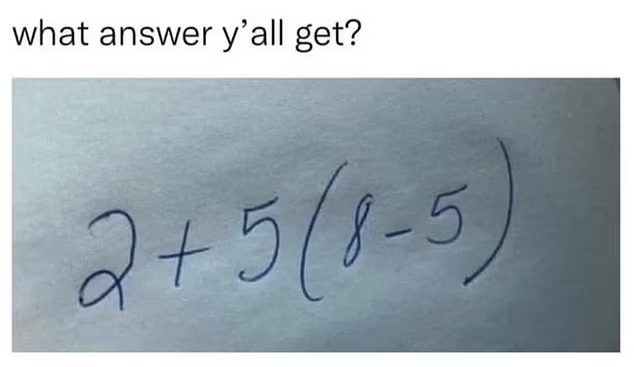
This one has been bouncing around social media because it looks simple, yet it still manages to split people into two very enthusiastic camps. The expression is written as: 2 + 5(8 – 5). Before you read any steps, take a second and decide what you think the answer is, then notice how confident you feel about it. If you have already seen the argument online, you know the two numbers people keep throwing around are 21 and 17. That split happens because people are not only solving, they’re also interpreting what the symbols are telling them to do first.
One group treats the front part like it should be combined early, almost like the expression is setting up a single multiplication problem. The other group treats 5( ) as a clear multiplication that has to be handled before you do any addition outside the parentheses. Once those two instincts kick in, everyone starts defending their method like there is only one acceptable way to read the line. It turns into a fast lesson in order of operations, but it also shows how easily a loosely written expression can invite two different “obvious” answers.
How people end up with 21
The 21 path usually starts when someone simplifies the left side first, before working through the parentheses and the multiplication. They look at 2 + 5(8 – 5) and treat the beginning as if it should be handled right away, so they add 2 + 5 = 7. Next they compute the parentheses: 8 – 5 = 3. Then they multiply the results: 7 × 3 = 21.
Where that approach shifts the original problem is in the grouping it assumes. For 2 + 5 to be combined before the multiplication, the expression would need to be written as (2 + 5)(8 – 5). Those parentheses around 2 + 5 are what would force that addition to happen first, turning the entire thing into a straightforward multiplication of two grouped terms. In the posted version, the only explicit grouping is (8 – 5), and the 5( ) indicates multiplication between 5 and the parentheses result, not between 2 + 5 and the parentheses result. So when people get 21, they are usually solving a revised interpretation where 2 + 5 is treated as a grouped unit even though it was not written that way.
How people end up with 17

Image credit: Pexels
The 17 path is the one most teachers mean when they write a problem like 2 + 5(8 – 5). A basic way to think about it is: “Do what’s inside the parentheses first, because the problem is telling me that part goes together.” So you start there: 8 – 5 = 3. Now the problem is 2 + 5(3).
Next, notice what 5(3) means. A lot of people read it as: “That 5 is stuck to the parentheses, so it means 5 times whatever is in there.” In other words, 5(3) is the same as 5 × 3. So you multiply: 5 × 3 = 15. Now the problem becomes 2 + 15.
Only after the multiplication is done do you add the 2. Someone solving it this way is usually thinking: “I’m not allowed to add 2 and 5 first, because the 5 is busy multiplying the parentheses result.” So the last step is simple: 2 + 15 = 17.
If the original problem had wanted you to add 2 + 5 first, it would have shown that by putting (2 + 5) in parentheses. Since it didn’t, the most common classroom reading leads to 17.
PEMDAS, BIDMAS, BODMAS, and what they really mean
The acronym is useful, but the details matter more than the letters. PEMDAS stands for Parentheses, Exponents, Multiplication, Division, Addition, Subtraction. BIDMAS is Brackets, Indices, Division, Multiplication, Addition, Subtraction. BODMAS is Brackets, Orders, Division, Multiplication, Addition, Subtraction. These are three ways of pointing at the same hierarchy, and the biggest misunderstanding is thinking “M comes before D” or “D comes before M” as if those letters are a ranking. Multiplication and division live on the same level, and you work left to right when they appear in a row. Addition and subtraction also live on the same level, and you work left to right there too. So the practical rule set is: do parentheses or brackets first, handle exponents or indices next, then move across the line doing multiplication and division in the order they appear, then move across doing addition and subtraction in the order they appear. If you apply that to 2 + 5(8 – 5), the parentheses happen first, then the multiplication, then the addition, which is why 17 lines up with the standard convention.
Why this keeps happening, and how to write these problems better
Most of these arguments happen because people are not all solving the same question, even when they think they are. On a phone screen, you read fast, you fill in missing structure without noticing, and you rely on whatever rule you remember best. Someone might be thinking, “I always handle the part in parentheses first,” while someone else is thinking, “I always simplify the left side before I multiply.” Both people believe they are following the rules, and neither one pauses to ask, “Did the problem actually tell me to group it that way?” That is why the comment section gets stuck, they are debating an assumption, not just an answer. There is also a social media effect where the shortest explanation wins attention, even if it skips the one step that matters. “It’s 21” or “It’s 17” is easy to post, but showing the steps takes longer, and longer posts get ignored. Then someone replies with a rule acronym, someone else replies with a different acronym, and suddenly it turns into a fight about whose schooling counts. If the goal was to teach instead of provoke, the simplest fix would be to write the expression in a way that leaves no room for the reader to add their own grouping.
Read More: Exercise Your Eyes! How Many Dogs Do You See?
Why these puzzles are built to start fights

A lot of viral math debates are set up for engagement, not for learning. The question is short, it is written in a way that leaves room for assumptions, and the caption usually dares people to prove they are right. That setup leads to the same pattern every time: quick answers with no steps, then a pile of replies focused on correcting strangers instead of checking the symbols on the screen. After that, it turns into a status contest. People defend their number like it reflects how competent they are, so backing down feels personal even though it is just arithmetic. There is also a comment section imbalance: the people who know the rules well often give one short line and move on, while the people who are most invested keep arguing, so the thread gets dominated by confidence, not clarity.
If you want to avoid getting pulled into the mess, do one simple thing before you commit to an answer. Rewrite the question in a clearer form, using a multiplication sign where it is implied and adding parentheses only where the question truly requires grouping. Then solve the rewritten version step by step. When you do that, you stop debating what the post “meant,” and you start solving the actual math that is written. Now, let’s try a couple more math questions for your brain to enjoy!
Extra question 1, where people usually slip up
Try this math question: 18 ÷ 3 × (2 + 4). Start with the parentheses because that part is grouped on purpose: 2 + 4 = 6. Now rewrite the math question as 18 ÷ 3 × 6. At this point, remember that division and multiplication are handled at the same stage, so you do them in the order they appear from left to right. First: 18 ÷ 3 = 6. Then: 6 × 6 = 36. The answer is 36.
Where people go wrong is when they treat the middle and the end as if they belong together. They see 3 × 6 sitting next to each other and multiply them first, even though the question did not put parentheses around them. If you do that, you get 3 × 6 = 18, and the math question turns into 18 ÷ 18, which equals 1. That is a different problem created by adding grouping that was never written. A helpful check is to rewrite the question once more with a visible multiplication sign: 18 ÷ 3 × 6. Nothing in that version suggests multiplying 3 × 6 before dividing 18 ÷ 3. Stick to the order shown on the page, and you will consistently end at 36.
Extra question 2, the order matters more than speed
Try this math question: 40 – 6 × (5 – 2) + 8. Start with the parentheses, because that is the only part the question groups for you: 5 – 2 = 3. Rewrite the math question with that result: 40 – 6 × 3 + 8. Next handle the multiplication, since multiplication comes before addition and subtraction: 6 × 3 = 18. Now the math question is 40 – 18 + 8.
At this stage, subtraction and addition are treated at the same level, so you work left to right. Do the subtraction first because it appears first: 40 – 18 = 22. Then add the 8: 22 + 8 = 30. The answer is 30.
A common wrong turn is mixing the last two steps. Some people add 8 to 18 first because it looks convenient, turning it into 40 – 26, which gives 14. Others subtract 6 from 40 early, as if the “- 6” is a standalone subtraction, even though the 6 is tied to the multiplication. Both of those moves change the problem by ignoring the multiplication step. If you keep rewriting the math question after each step, it becomes harder to skip ahead or rearrange terms, and the final result stays consistent at 30.
Why people like to be right

People like being right because it feels good to have a clear win, especially in front of other people. In most conversations, you can argue forever and still not settle anything, because it comes down to opinion, memory, or who talks louder. Math feels like a break from that. There are rules, there’s a set order, and you can point to the steps and say, “This is how I got here.” That’s why strangers get weirdly intense about it, the answer starts standing in for intelligence, and nobody wants to look like the one who missed something obvious.
That’s the whole reason a math question like 2 + 5(8 – 5) turns into a comment section brawl. People pick 21 or 17 fast, then defend it like it’s a personality trait. But the only way out is to slow down and read what the symbols actually say. Do the parentheses first, treat 5( ) as multiplication, then add the 2 at the end, and you reach 17. Once you write the steps, the argument stops being a flex and starts being math again.
Disclaimer: This article was written by the author with the assistance of AI and reviewed by an editor for accuracy and clarity.
Read More: A Viral ‘Harvard University’ Puzzle Has People Completely Confused