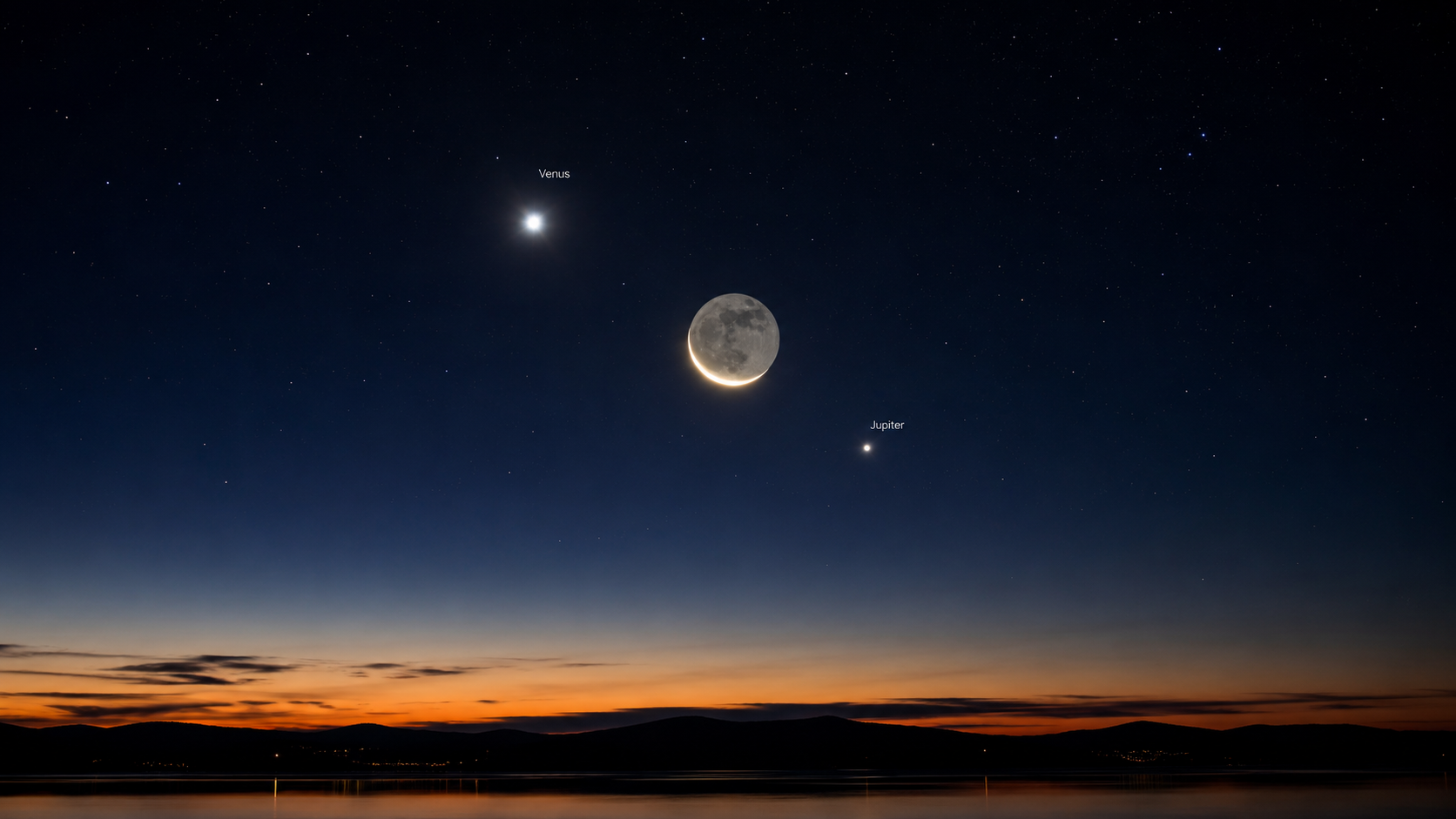

Two of the brightest objects in the night sky – objects bright enough to pierce city light pollution, bright enough to appear before the stars do, bright enough that your kids will point at them and insist they’re airplanes – are converging in the western sky right now, and they’re bringing the crescent Moon along with them for one of the most visually dramatic celestial combinations June has produced in years.
This is not a once-in-a-generation event requiring a remote field, a red flashlight, and a star chart you printed off the internet at 11 p.m. This is a step-outside-after-dinner, look-toward-where-the-sun-just-set event, and it’s happening all month. The close conjunction of Venus and Jupiter peaked on June 8 and 9, but the “Holy Grail” alignment that arrives mid-June is the real payoff – the kind of sky arrangement that makes you stop mid-sentence, forget what you were saying, and just stare. Here is everything you need to know, from what is actually happening up there to exactly when to walk out your front door.
What a Conjunction Actually Is (and Why This One Is Unusual)
A planetary conjunction is when two planets appear near each other from our point of view on Earth, even though they’re still millions of miles apart in space. The closeness is entirely a matter of perspective – a trick of alignment from our particular vantage point on this planet. The pairing is an illusion of perspective. In early June, Venus sits roughly 80 million kilometres from Earth. Jupiter lies around 900 million kilometres away – more than ten times farther. The two worlds are nowhere near each other in space. We simply happen to be looking along nearly the same line of sight, with the inner planet and the outer giant stacked one behind the other.
What makes the June 2026 conjunction stand out from the run-of-the-mill planetary close approaches is the combination of which planets are involved and how close they actually got. Venus and Jupiter – the brightest planets in the sky – moved closer together in the weeks leading up to an impressive conjunction around June 8-9. This conjunction is the best Jupiter-Venus approach we’ll see in the Northern Hemisphere until late 2028. So if you missed the peak on June 9, you are not looking at another two-year wait for something this good in the evening sky.
A similar conjunction of Venus and Jupiter occurs once every 3 years and 3 months. But “similar” is doing some work in that sentence. Not every conjunction puts both planets this high, this bright, and this accessible after sunset. This one does all three.
The Planets Themselves: A Quick Introduction
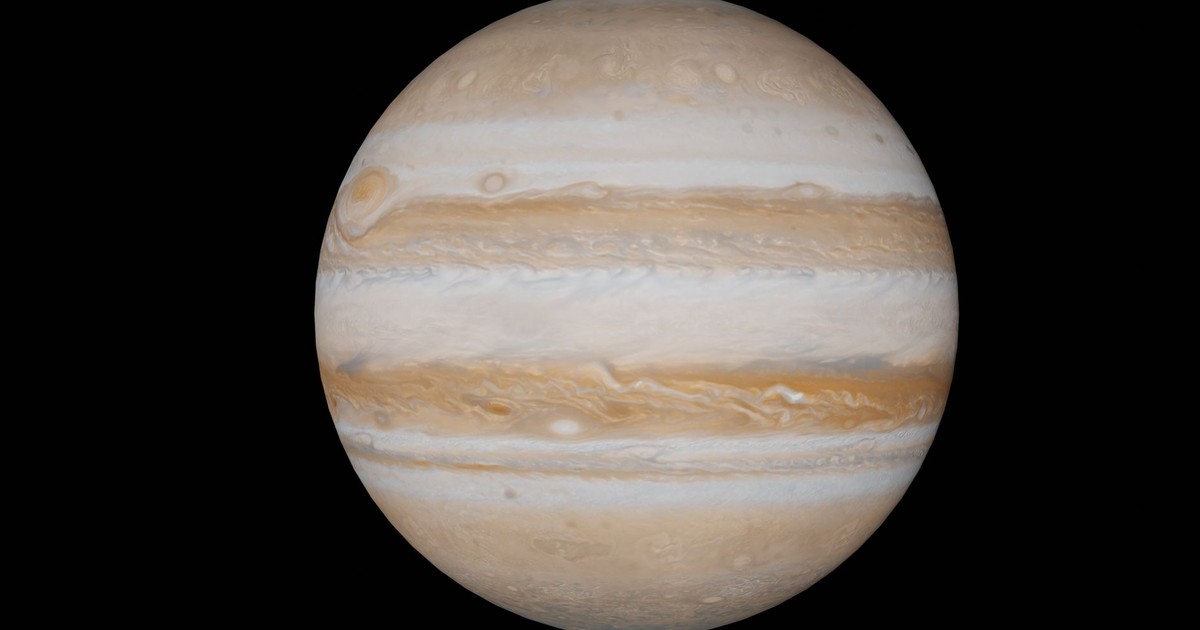
Venus has a reputation, and it earns it every time. Venus is the brightest planet in the night sky and Jupiter is close behind it, making it easy to spot both planets with the naked eye, weather permitting. On any given clear evening, Venus is the first point of light to appear after sunset, blazing white against the pale blue of the fading sky, and Jupiter follows close behind with a slightly warmer, creamier glow. There is a subtle color difference between them, with Venus piercing white and Jupiter slightly creamier or yellowish.
The size difference between them, as you’d experience it through a telescope, is genuinely startling. Jupiter and Venus look roughly the same size in our sky. But if you could see them side by side in space, you would find Jupiter about 12 times wider than Venus. What you’re seeing when you look at them together is not a fair comparison – it’s a small, relatively close neighbor and an enormous gas giant so far away that the distance compresses it to nearly the same apparent width. Distance has a way of doing that.
Venus is currently in a gibbous phase – between half and fully lit. Not everyone knows that Venus shows phases, but it does, exactly as the Moon does, because it orbits the Sun inside Earth’s own orbit and we see varying fractions of its sunlit side depending on where it sits in that circuit.
The Peak Conjunction: June 8 and 9
When June 8 and 9 arrived – their evenings of closest approach – these two blazing worlds were only about 1.5 degrees apart. Your pinky held at arm’s length should just fit between them. That is extraordinarily close for two planets. When closest, Venus and Jupiter easily fit into binoculars’ field of view together, which means any pair of standard binoculars sitting in a junk drawer somewhere in your house will give you a genuinely remarkable view. Both planets in the same circle of magnified light, side by side.
From June 11 through June 15, Mercury joined the scene, creating a mini parade of planets low in the western sky. This happens because the planets orbit the sun along nearly the same path in our sky, called the ecliptic. Mercury is the difficult one in this arrangement – it sits lower toward the horizon, so you need a clear view to the west to catch it in the glow of twilight. But the payoff for spotting it is a diagonal chain of three planets stretching across the evening sky, which skywatchers have taken to calling the “planetary skewer” – a name that is accurate enough to stick.
June 15 is when Mercury reaches its greatest eastern elongation, appearing at its farthest apparent distance from the Sun – 24 degrees and 31 minutes – in the evening sky, making mid-June one of the best times to catch elusive Mercury.
The Main Event: June 16 and 17
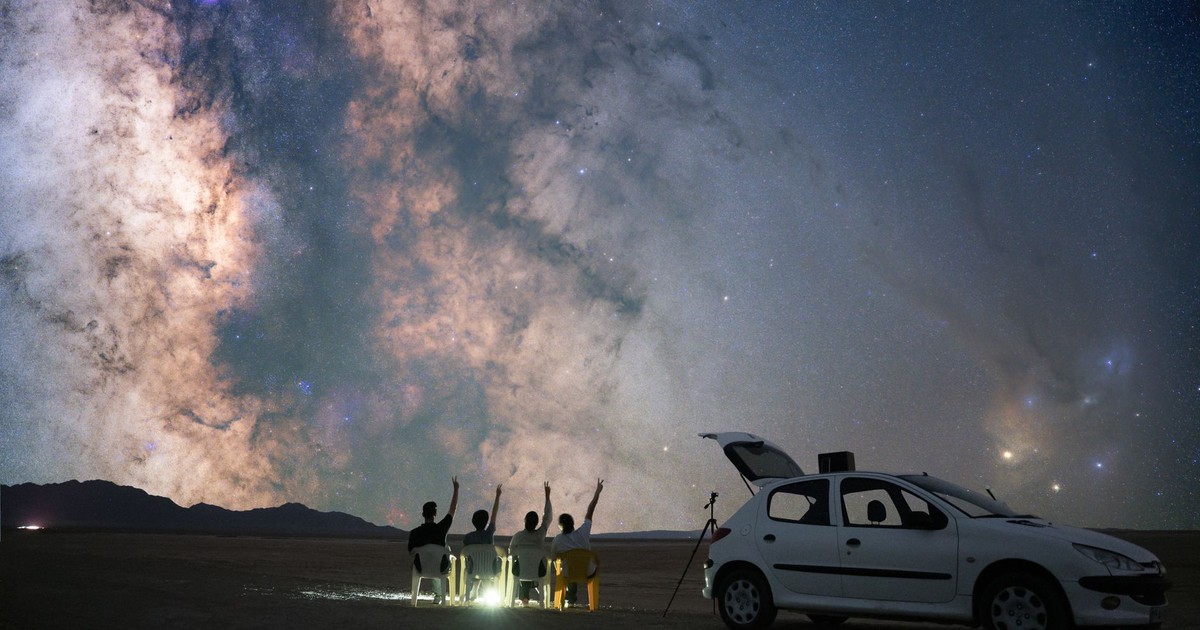
If the June 9 conjunction was the first act, June 16 and 17 is the curtain call, and it has the Moon in it. A thin crescent Moon joins the view on June 16 and 17, creating a beautiful Moon-and-planets scene shortly after sunset.
The two evenings play out differently. On June 16, a thin crescent Moon makes a triangle with Jupiter and Mercury. On June 17, the Moon is just a bit higher than Venus. Together, these two nights constitute the “Holy Grail” alignment that gives June its “holy grail” reputation among skywatchers – three of the brightest objects in the night sky clustered together in the west, visible to everyone on Earth with a clear horizon and thirty spare minutes.
There is also an additional event on June 17 that is worth knowing about, particularly if you are watching from certain parts of North America. On June 17, from some locations, the Moon will pass in front of Venus – a lunar occultation, where Venus will look like it disappears behind the Moon and then reappears later. The event will be visible from parts of the United States, Canada, Brazil, and Venezuela. Outside of the exact viewing path, many skywatchers may still see a close pairing of the Moon and Venus, but there is an important safety note: for many viewers this event will happen during the daytime. If you are trying to observe the occultation, do not point binoculars, a telescope, or a camera near the sun unless you are using proper solar safety equipment.
How to Watch It: The Practical Details
The setup is straightforward. Start looking about 30 minutes after local sunset. You can begin earlier if the sky is very clear, but Mercury may be difficult in bright twilight. Don’t wait too long, because Mercury will be low and will set first.
Look low in the west-northwest, toward the sunset direction. Venus will be the brightest planet and the easiest starting point. Jupiter will be near Venus, and Mercury will be closer to the horizon. If you have any trouble, the setting sun is your navigation guide – everything you are looking for will be in roughly the same part of the sky where it just disappeared below the horizon.
You do not need equipment. All three planets are naked-eye objects during this alignment. Mercury is the only challenging one because it appears low in the twilight sky. That said, binoculars genuinely improve the experience. With a braced or supported hold, binoculars might show you one or two of Jupiter’s four largest moons – the famous Galilean satellites: Io, Europa, Ganymede, and Callisto. They’ll look like tiny pinpricks of light in a line bisecting the planet. Seeing the moons of Jupiter with your own eyes, from your own backyard, with binoculars you borrowed from your husband’s camping bag – it never gets old.
If you use binoculars to look between the Moon and Venus on June 17, you may also be able to spot a pretty star cluster known as the Beehive, a cluster buzzing with stars in the constellation Cancer the Crab. Bonus material, free with purchase.
If you are in a northern city where June twilight lingers past 10 p.m., lower your expectations slightly for Mercury but not for the main show. The most challenging locations are high northern cities such as London and Berlin, where June twilight lasts longer and Mercury is already low by the time the sky gets dark enough. Observers there should start looking shortly after sunset and choose a place with a completely clear western or west-northwestern horizon.
What You’ll Also Find in the Neighborhood
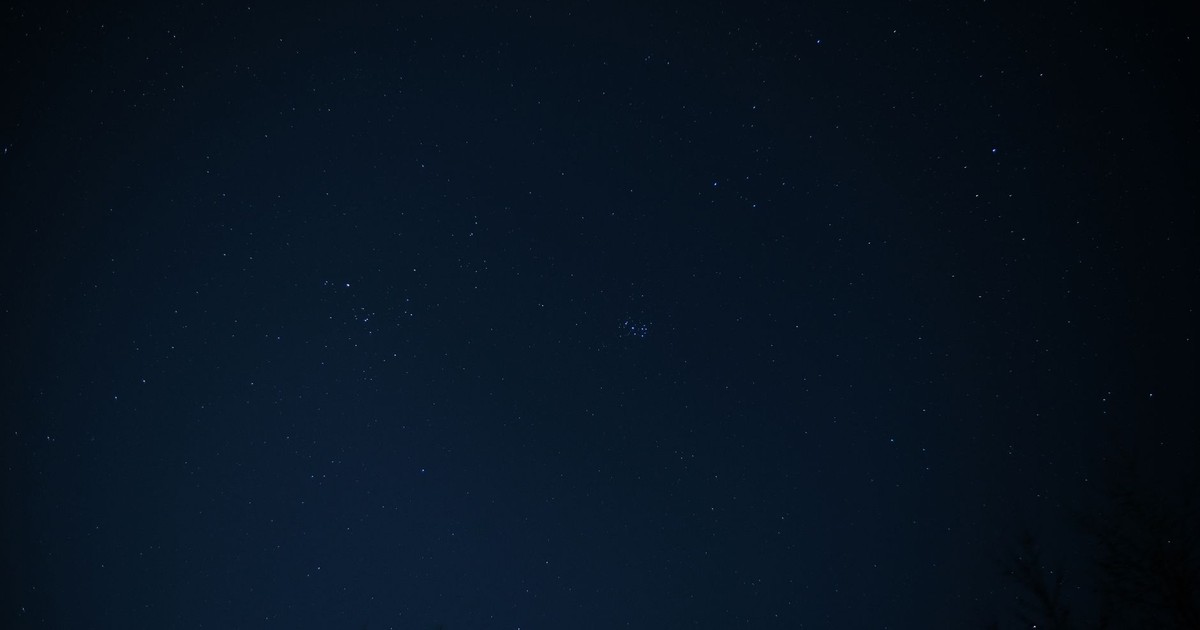
While Venus and Jupiter are the obvious anchors of this display, they are sitting in a particularly rich patch of sky. The Venus-Jupiter conjunction can also help you pinpoint the Gemini constellation. During the conjunction, the duo appears just beside Gemini’s easily noticeable twin stars, Pollux and Castor. While it can be tough to see the entire constellation under light pollution, Pollux and Castor do get vivid enough to spot from cities and suburbs – though this winter constellation gets tougher to see as June wears on.
After June 17, the display does not simply switch off. Venus and Jupiter will remain aligned through the rest of the month, though they’ll spread apart. Jupiter will move increasingly near Mercury toward the horizon, and Venus will appear slightly higher skyward. By the end of June – from the 23rd through the 26th – Jupiter and Mercury will appear within around 4 degrees of each other.
And if you find yourself thoroughly hooked on this sort of thing: Venus will travel close to Leo the lion – best known for its signature sickle, which resembles a backward question mark – setting up the next summer conjunction to watch for: the early July meeting of Venus and Leo’s brightest star, Regulus. The sky, once you start paying attention to it, has a habit of giving you reasons to keep looking.
One Thing Worth Knowing About Jupiter
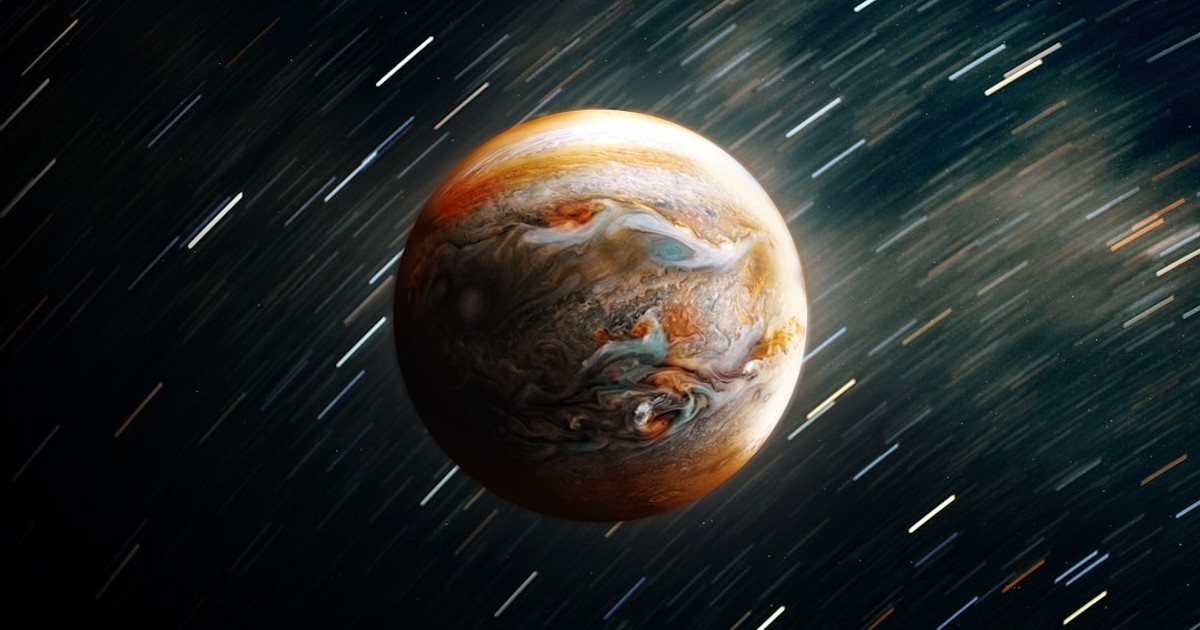
Jupiter’s window in the evening sky is closing. Jupiter is heading slowly into the Sun’s glare and will eventually be lost from view by mid-June, before emerging as a morning planet in autumn 2026. That’s part of why this whole sequence feels like a send-off – Jupiter is on its way out of easy evening visibility, and it is going out in style, spending its last accessible nights paired with the sky’s brightest planet and framed by a crescent Moon.
After the evening conjunction on June 9, 2026, the next Venus-Jupiter conjunction will occur about 2 years and 5 months later, on November 10, 2028, and it will be a morning conjunction. Morning conjunctions require you to be awake at 5 a.m. and willing to stand outside in the cold. Evening conjunctions are a different proposition entirely – they happen at a civilized hour, they require no planning beyond stepping outside, and they cost nothing.
Read More: NASA Just Revealed the Most Ambitious Moon Base Plan in History
Look Up While You Still Can

There is a particular kind of sky event that asks nothing of you. No alarm set for 3 a.m., no driving somewhere dark, no app required. This is one of those. The crescent Moon and the two brightest planets will be sitting right there in the western sky after dinner, as available to you as they are to anyone with eyes and clear weather – from your driveway, from your back porch, from a parking lot after picking up takeout.
The arrangement keeps changing night by night: the gap between Venus and Jupiter widens, the Moon swings through, Mercury dips toward the horizon, and then Jupiter begins its slow fade into the sun’s glow until autumn. The whole choreography plays out over a few weeks, and the best remaining nights – June 16 and 17 – are still ahead. It’s the kind of thing that happens in the sky whether you look or not. This month, it is worth looking.
AI Disclaimer: This article was created with the assistance of AI tools and reviewed by a human editor.