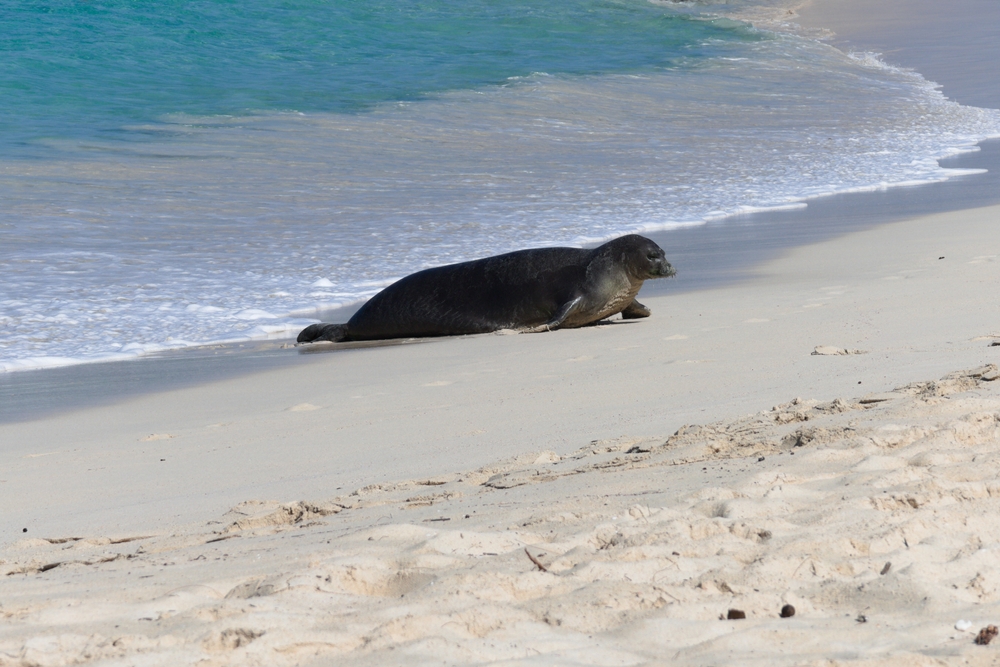

A vacation to Maui is supposed to be the postcard version of a good time. You book the flight, you find the beach, and somewhere between the sunscreen and the shave ice you stumble across one of the rarest animals on the planet resting in the shallows. Most people reach for their phones. Most people back up slowly and gape in quiet awe. Most people, encountering a Hawaiian monk seal, go home and tell the story for the rest of their lives with a kind of reverence reserved for things that felt almost sacred.
And then there is the other kind of tourist.
The seal rock throwing incident that unfolded on a Maui beach in Lahaina on May 5, 2026, was captured on cellphone video: a man picked up a rock, aimed it, and threw it directly at the head of an endangered Hawaiian monk seal. The rock narrowly missed. The seal reared out of the water. What started as a video of a tourist and a rock has turned into a federal criminal case, a viral outrage cycle, a physical assault, death threats, and a legal defense that has left wildlife advocates somewhere between bewildered and incandescent.
What the Video Showed
According to the criminal complaint, the man, later identified as Igor Mykhaylovych Lytvynchuk, 38, of Covington, Washington, was seen walking along the shoreline in the Lahaina area of Maui, tracking the movements of a Hawaiian monk seal. Prosecutors say the seal, known locally as Lani, was pushing a floating log close to the shoreline at the time.
Lytvynchuk then picked up a large rock and threw it directly at Lani’s head. The rock narrowly missed her nose, causing her to rear up out of the water. Witnesses told investigators the rock was “the size of a coconut,” according to court documents. Another witness told investigators the seal “clearly seemed hurt,” but Lytvynchuk did not check on the welfare of the animal before walking away.
Witnesses confronted Lytvynchuk and told him they had contacted law enforcement. According to the complaint, he responded that he was “rich enough to pay the fines” before leaving the area. The video drew widespread condemnation and demands for prosecution in Hawaii, including from Maui’s mayor. The seal rock throwing incident spread rapidly across social media, and federal investigators moved quickly.
The Arrest and the Charges
NBC News reports that Lytvynchuk is charged with harassing a protected animal, according to the U.S. attorney’s office in Honolulu, and that National Oceanic and Atmospheric Administration special agents arrested him near Seattle. He had made arrangements to surrender in the Seattle area as special agents were seeking to arrest him.
He is charged with harassing and attempting to harass an endangered Hawaiian monk seal by throwing a large rock at the seal’s head, in violation of the Endangered Species Act and the Marine Mammal Protection Act. If convicted, Lytvynchuk faces up to one year in prison on each charge, as well as fines of up to $50,000 under the Endangered Species Act and $20,000 under the Marine Mammal Protection Act.
KOMO News reports that Lytvynchuk pleaded not guilty to the charges in U.S. District Court in Honolulu. U.S. Magistrate Judge Rom Trader allowed him to remain free pending the criminal case but ordered him to stay away from beaches and marine wildlife while in Hawaii.
Scientists identified the seal involved as an adult male known as “R404,” NOAA said – though he is also called “Lani” by the community that has watched over him for years. That the seal has a name, and that people know it, tells you something about how Hawaii thinks about these animals. He is not background scenery. He is a neighbor.
The Lawyer’s Explanation
Here is where the story takes its particular turn. After Lytvynchuk’s arrest, his defense attorney Myles Breiner spoke to the press and offered a justification for his client’s actions that, to put it gently, the public received poorly.
Breiner explained that his client had been to Hawaii previously and was familiar with sea turtles, but not Hawaiian monk seals. Lytvynchuk is a fisherman and thought the seal was an aggressive sea lion, the lawyer said. “So his response was not to hurt this monk seal, but to get it away from the turtles,” Breiner said.
That is the argument. A man saw what he believed to be a sea lion threatening sea turtles, and his solution was to throw a coconut-sized rock at its head from the shore. The sea lion he was so concerned about turned out to be one of the most protected marine mammals on Earth. The turtles, presumably, were fine.
Breiner also said his client is being treated unfairly because he’s a white outsider, adding that “the vast majority of attacks on monk seal and turtle are by locals.” That claim landed about as well as you’d expect. It did not substantially alter the public conversation, which remained firmly focused on the video.
The Fallout Beyond the Courtroom
The legal consequences Lytvynchuk faces are substantial, but the consequences that landed first were not administered by a judge. The video’s virality, and the public’s reaction to it, moved faster than any federal charging timeline.
A man “brutally assaulted” Lytvynchuk after the incident, defense attorney Myles Breiner told The Associated Press. Lytvynchuk declined to file a police report on the assault. Since the video surfaced, Lytvynchuk has faced death threats and doxing, including receiving a package at his home containing what appeared to be feces, Breiner said.
The internet, faced with a video of a man throwing a rock at an endangered seal and saying he was “rich enough to pay the fines,” did what the internet does. This is not an endorsement of physical assault or targeted harassment. It is simply an observation that the public has developed a very particular and very fast response to viral animal cruelty footage, one that operates entirely outside the legal system and at a speed the courts cannot match. You can find a similar dynamic playing out in just about any viral story where someone’s behavior toward an animal gets captured on camera, from a Bangkok cat who went viral for a run-in with police to beachside confrontations in Hawaii. The camera and the crowd are always watching.
U.S. Senator Brian Schatz of Hawaii pointed the accountability in a different direction entirely. The incident shows NOAA must do more to educate the public about protecting Hawaiian monk seals, Schatz said in a statement. The argument being that a fisherman from Washington state who visits Hawaii and does not know what a Hawaiian monk seal looks like is a failure of public education as much as it is a failure of individual judgment – though those two things are not mutually exclusive.
The Seal at the Center of All of This
It is easy for the actual animal to get lost in the legal proceedings and the media cycle. R404 is worth a moment.
According to NOAA Fisheries, the Hawaiian monk seal is one of the most endangered seal species in the world and is one of NOAA Fisheries’ Species in the Spotlight. Its population had been declining for approximately six decades. Today, the population is increasing, but it is still only about a third of its historic size. Hawaiian monk seals are endemic to the Hawaiian archipelago, occurring nowhere else in the world.
The Hawaiian monk seal is the last surviving species in its genus. That is not a minor detail. When a species loses its last genus member, the word that follows is “extinct.” The Caribbean monk seal went that way, last confirmed in the 1950s. The Hawaiian monk seal is all that remains of that particular branch of life. Only about 1,600 Hawaiian monk seals are left in the world, and their population is about one-third of historical levels. With numbers that small, the life of every seal can impact the population growth or decline.
R404, resting in the shallows of Lahaina on a May afternoon, was not a prop in a tourist’s theory about sea turtles. He was one of 1,600.
The Wider Legal Stakes
The case has drawn attention not just for the video but for what it clarifies about federal wildlife law and what it costs to ignore it. The federal statute’s definition of “taking” includes harassing, harming, pursuing, hunting, wounding, and killing a protected species, or “attempting to do so.” Attorney Myles Breiner has said Lytvynchuk intends to plead not guilty and had no intention of harming the marine mammal.
Intent, under these statutes, is not the only thing being examined. The law is written broadly enough that a person does not need to successfully harm an animal to face federal charges. Throwing a rock at one and missing is still, legally speaking, an attempt to harass or harm a protected species. The argument that you thought it was a sea lion, or that you were trying to help turtles, goes to motive – but motive does not erase the conduct captured on video.
NOAA’s marine wildlife viewing guidelines recommend maintaining a distance of at least 50 feet from Hawaiian monk seals resting on shore or in the water. When mother monk seals are nursing their pups, NOAA advises staying at least 150 feet away. Standing at the water’s edge, picking up a rock, aiming it, and throwing it would appear to fall somewhat outside those guidelines.
What This Is Really About
It would be easy to reduce this entire story to its most absurd notes: the rock, the “rich enough to pay the fines,” the sea lion misidentification defense, the feces in the mail. Those details are real and they are extraordinary, and you are allowed to find them darkly funny, because the alternative is just pure frustration.
But underneath the viral moment is something that does not go away when the news cycle moves on. R404 is still out there, in the waters off Maui, one of 1,600 animals who make up the entire remaining population of a species that has existed in those islands for millions of years. The NOAA volunteers who monitor these seals, the scientists who name them and track them and celebrate when the population ticks upward, were watching that video too. The people of Hawaii who grew up alongside these animals, who report sightings and clean the beaches and take the distance guidelines seriously, were watching it too.
Federal charges can take a year or more to resolve. The seal rock throwing incident will likely be litigated well into 2026 and beyond. Whether Lytvynchuk’s defense holds up in court, whether the “protecting turtles” argument gains any legal traction, whether the sentence matches the moment, none of that is settled yet. What is settled is that the camera was there, the rock was thrown, and the seal was one of 1,600. You can hold the absurdity of the defense and the weight of that number in the same moment. They are both entirely real.
AI Disclaimer: This article was created with the assistance of AI tools and reviewed by a human editor.