
Heart disease is the leading cause of death for women in the United States. Most people know that – it’s a statistic that has been repeated enough times that it almost loses its weight. What is spoken about far less is what happens in those specific minutes when a woman collapses in public and a stranger is standing over her, knowing CPR, and pausing anyway. That pause has a name now. It has data behind it. And a growing number of researchers, legislators, and at least one high school student in Illinois think they know part of the reason why it keeps happening.
The problem is not a lack of training. Forty states and the District of Columbia already require CPR training in schools before high school graduation. Millions of people have been through those classes. They sat at a desk, watched a video, knelt beside a plastic torso, and pressed down. They got certified. They went home. And when the moment actually came, in a park or a grocery store or a parking lot, the person on the ground in front of them was a woman – and something stopped them.
That something, it turns out, may have been built right into the training itself.
The Manikin in the Room
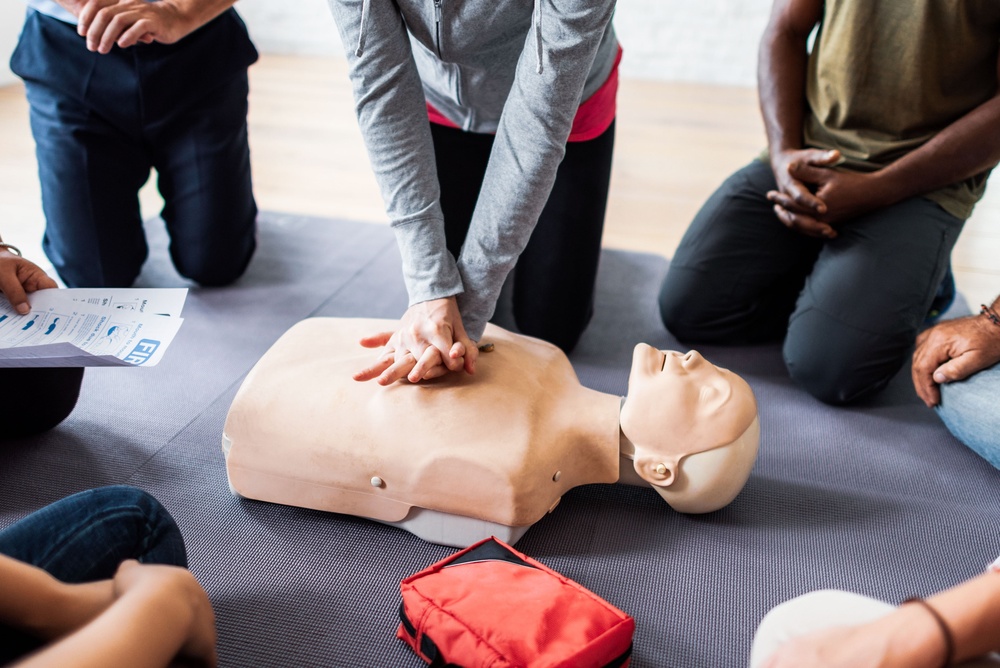
Walk into almost any CPR class in the country and the training manikin waiting on the table looks the same: flat-chested, neutral, unmistakably designed around a male body. A 2024 global review found that 95 percent of CPR manikins on the market are flat-chested and do not represent female anatomy, limiting trainees’ exposure to realistic female chest structure. This has been the default for decades, so long that most people who have been through CPR training never stopped to register it as a gap.
The researchers paying close attention to cardiac arrest outcomes started to notice what that gap produces. A 2024 scoping review published in the Journal of the American Heart Association found that the general reluctance to perform bystander CPR on women in Western countries was attributed to a cluster of factors: perceived frailty of women, fears around chest exposure, concerns about pregnancy, gender stereotypes, the oversexualization of women’s bodies, and the belief that women are simply unlikely to experience cardiac arrest. Consider that for a moment. The belief that women don’t have cardiac arrests – while simultaneously, heart disease is their number-one killer.
The consequence of that hesitation is measurable. Research from the Duke University School of Medicine, published in the Journal of the American Heart Association, found a consistent pattern across the country: women are less likely than men to receive a life-saving bystander intervention if they collapse in public. The Duke team found women were 14 percent less likely to receive bystander CPR and defibrillation than men. Their dataset covered more than 309,000 cardiac arrest cases across 47 states over six years. It was not a fluke, and it was not confined to one region.
What Hesitation Actually Costs
According to the American Heart Association, if performed immediately, CPR can double or triple the chance of survival from an out-of-hospital cardiac arrest. Read that again. Double or triple. The intervention is not complicated – hands, chest, compression rate – and it is available to anyone standing nearby. But only if they do it.
A scoping review of 58 studies found that 59 percent of the relevant studies indicated that women are less likely to receive bystander CPR than men. In other studies, women were found to be less likely to receive it in public specifically, while being equally or more likely to receive it in residential settings. The public-versus-private split matters because it tells you something about what is actually happening in people’s minds. At home, with a family member, the social calculus is different. In a coffee shop, with a stranger who is a woman, the fear of being perceived as inappropriate overrides the instinct to help. That dynamic – present in one setting and almost entirely absent in the other – is not an accident.
This is not a comfortable thing to say out loud. Most people who hesitate would not describe themselves as doing anything other than being cautious. But caution in cardiac arrest is not neutral – it is, in statistical terms, lethal. According to Duke researchers, one documented reason for the disparity is the fear that performing CPR on a woman in cardiac arrest will result in inappropriate touching or harm to the victim. That fear is real. It is also being passed on, semester after semester, every time a CPR class ends and the only body anyone practiced on was a flat, featureless, male-coded torso.
The Training Gap and How It Travels
There is a logic to how repeated practice builds confidence. You do something enough times in a low-stakes setting, and the moment the real thing arrives, your hands know what to do before your brain fully catches up. CPR training works exactly this way – except that when the only body you ever practiced on looks nothing like half the population, the confidence does not transfer cleanly.
A 2025 study published in ScienceDirect examining anatomical manikins in basic life support training found that the anatomical design of manikins influences the technical, emotional, and attitudinal performance of students. In other words, training with a realistic female torso changes not just what someone knows, but how ready they feel and how willing they are to act. The emotional component of the hesitation is trainable. It responds to practice. And yet the tool for that practice has been missing from almost every classroom.
A woman-led company called JOAN Creative took steps to address this gap by creating the “Womanikin,” a breast attachment that fits over any standard CPR mannequin. The company developed it after reviewing research on the topic, including studies documenting that women are less likely to receive CPR in public spaces. It is not a full replacement manikin – it is an add-on, a retrofit, a workaround for a problem the industry had not bothered to solve on its own. The fact that a breast attachment to a training dummy became a minor news story says a great deal about how low the baseline was.
For readers thinking about their own heart health alongside this, the recent research on how cholesterol is absorbed at a cellular level is worth understanding – because women’s cardiovascular risk tends to be under-recognized at every level, from how it is treated in an emergency to how it is discussed in a doctor’s office.
The Illinois Bill and the High School Senior Who Started It
In March 2026, the Illinois state legislature took up a bill that would require, beginning in the 2028-2029 school year, CPR instruction in schools to include at least one female manikin for every two male ones. House Bill 4788, filed by Representative Maura Hirschauer, updates the School Code to mandate that beginning in the 2028-2029 school year, CPR instruction must include at least one female manikin for every two male mannequins, either through new mannequins or by adding female chest-cover attachments to existing models. Whenever students practice CPR, both male and female models must be present.
The idea for the legislation began with a Naperville High School student, senior Ashlynn Goldstein. “I had been CPR certified a lot of times – never in my life had I ever encountered a female manikin,” Goldstein said. Her capstone project examined why disparities exist in the performance of CPR between men and women, and how those policies are handled in schools. She drafted the bill with her teacher, and Representative Hirschauer took up the case.
A high school senior, sitting in her capstone class, doing the thing that adults with research budgets and professional platforms had not quite managed: she noticed the gap, named it specifically, and then did something about it. The detail that she had been CPR certified “a lot of times” without ever seeing a female manikin is more telling than any statistic.
A 2024 study from the American Heart Association Journal, surveying 112 participants who received CPR instruction on both male and female manikins, found that the training increased confidence in performing CPR on women. Although 28.4 percent of participants initially reported feeling either slightly or very uncomfortable using the female manikin, 81.6 percent said they felt more confident performing CPR on women after practicing with it. The discomfort, in other words, is not permanent. It is a product of unfamiliarity. And unfamiliarity is exactly what a training manikin exists to dissolve.
Illinois-based company WorldPoint and the organization Illinois Heart Rescue have already taken steps to address the gender disparity in training by producing and supplying female manikins across state-led education programs. The infrastructure exists. The evidence exists. The hesitation has been documented, its source identified, and its solution tested. The question is whether a high school student’s capstone project will accomplish what decades of resuscitation guidelines did not.
What Still Needs to Change
There are currently no laws embedding the use of female manikins in school training curriculums nationally. Illinois, if its bill passes, would be the first state to mandate it for schools. That is one state out of fifty. And while the legislative conversation tends to focus on schools, most adults who will ever be in a position to give bystander CPR got their training years ago, in whatever format their workplace or community offered – which almost certainly did not include a female torso.
The broader research picture adds another layer. A researcher at Duke University School of Medicine is contributing to the education section of the updated 2025 CPR guidelines, with the effort aimed at reducing disparities, in ways that might lead to changes in the training curriculum. Guidelines revisions are slow. They involve consensus committees, evidence thresholds, and institutional caution. But when guidelines change, training programs change with them – and that is where the real scale of adoption lives.
There is also the question of what training does not cover: the cultural messaging around who is likely to need help, who is safe to touch, and what cardiac arrest actually looks like in a woman’s body. A 2026 American Heart Association forecast projected that cardiovascular disease will become increasingly prevalent among women over the coming decades – meaning that more women in more public spaces will be at risk of exactly this kind of emergency. The gap between who needs CPR and who receives it is not going to close itself.
What This Is Really About
There is a version of progress that looks like a checklist: add a female manikin, update a guideline, pass a bill. All of those things are worth doing. But underneath the logistics is something that doesn’t get solved by a new piece of equipment. It is the accumulated, largely unexamined assumption that a woman’s body is more complicated to touch in an emergency – more fraught, more socially risky, more likely to land you in trouble – than a man’s. That assumption has been trained into people so thoroughly that it operates faster than conscious thought. It does not announce itself. It just makes someone’s hands move more slowly, or not at all, over a woman who is dying.
A plastic torso with anatomically female features will not fix that entirely. But it will do something a flat, featureless manikin never could: it will make the hesitation visible, give people a chance to confront their discomfort in a room where the stakes are rubber and foam, and let practice accomplish what social conditioning currently undoes. The students who go through CPR training with a female manikin present will have practiced something no previous generation of trainees was asked to practice. That is a small correction. The gap it is trying to close is not small at all.
And that distinction – between the simplicity of the fix and the scale of what caused the problem – is the part that stays with you. A breast attachment to a training dummy. An open-source vest made of neoprene and silicone. A capstone project from a high school senior who noticed something the adults in the room had stopped seeing. The tools were never the hard part. The hard part is the set of assumptions the tools are pushing back against, one training session at a time.
AI Disclaimer: This article was created with the assistance of AI tools and reviewed by a human editor.