
Most of the time, a good deed just gets to be a good deed. Someone’s stuck, you have the means to help, you pull them out, everyone goes home a little muddy and a lot grateful, and the story gets told at dinner for maybe a year. The rescuer gets the credit. That’s how it’s supposed to work.
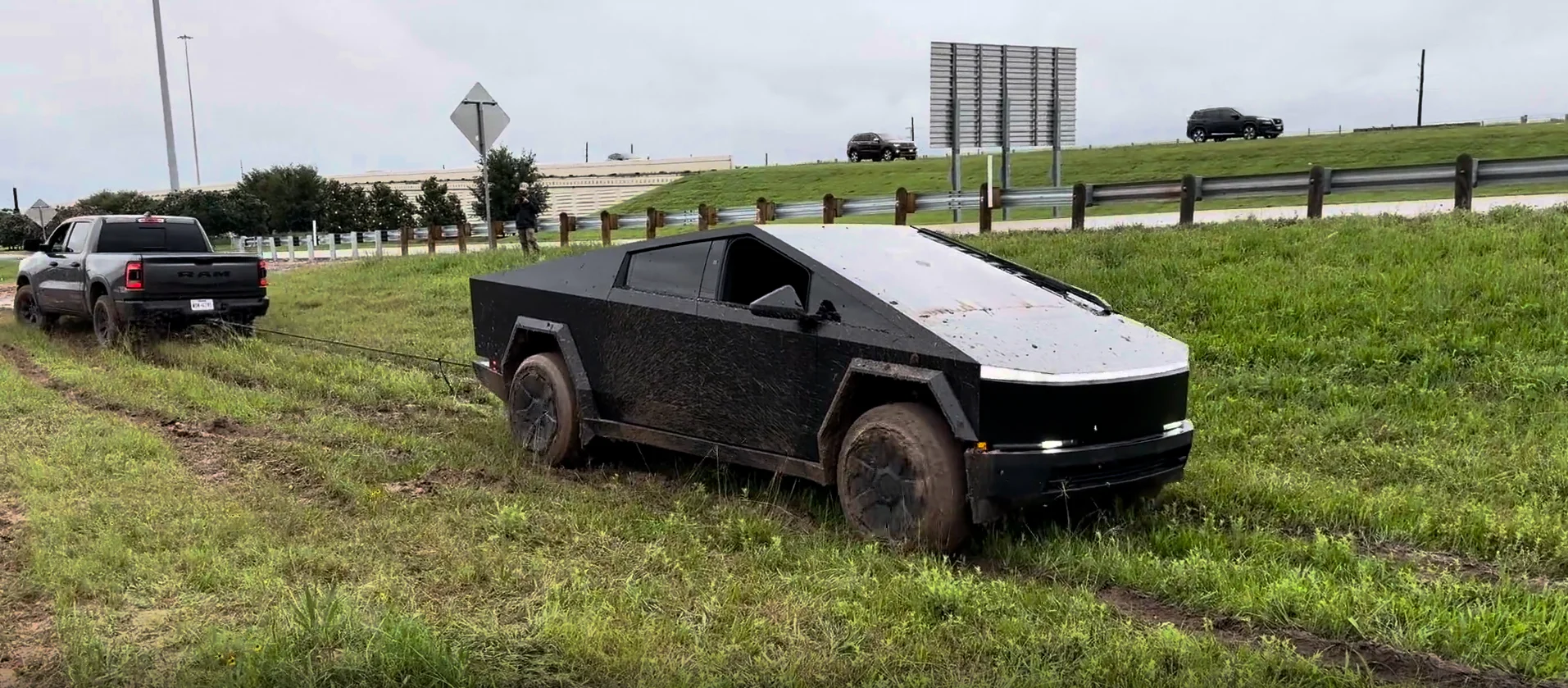
Then there’s the version that unfolds in Houston in the rain, on a muddy field, with three vehicles involved before it’s all over, and a matte-black Cybertruck that started the day as the hero and ended it needing its own rescue from a Ram truck. The internet, predictably, had a lot of thoughts.
What makes this story so watchable, and so deeply, specifically human, is not that the rescue failed. It’s that it succeeded, completely, and then immediately created a new and equal problem. That’s not bad luck. That’s a certain kind of overconfidence meeting Texas mud in real time. Let’s walk through exactly what happened.
A Plan to Skip Traffic Goes Immediately Wrong
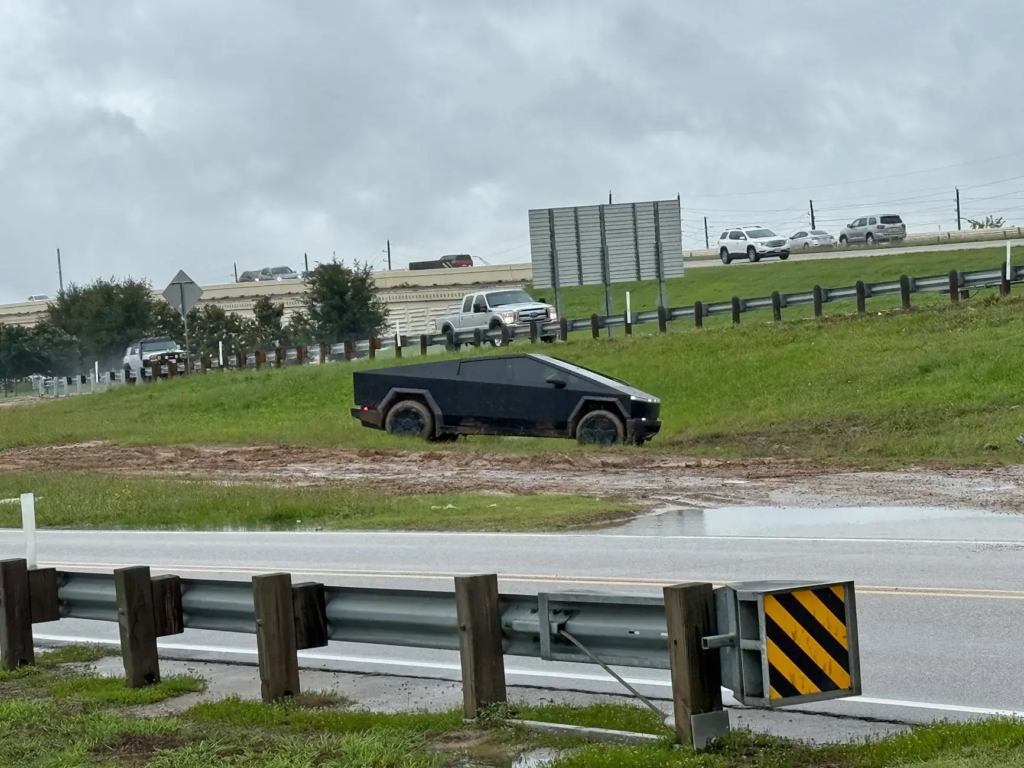
A man decided to get creative and cut off the freeway through a muddy trail to avoid traffic. That plan went about as well as you’d expect, and he got himself stuck in a Range Rover Defender. To be fair to the Defender, this is a legitimate off-road vehicle. It has real credentials. It is not supposed to be embarrassed by a Houston muddy shortcut. And yet.
When the Defender became stuck, his friend in a Cybertruck saw an opportunity and decided to come to the rescue. The Cybertruck is, on paper, a vehicle built for exactly this kind of moment. With adjustable air suspension, the Cybertruck has approach and departure angles of 35 and 28 degrees respectively, up to 16 inches of ground clearance in Extract mode, and 12 inches of suspension travel. It also has locking rear differentials and steer-by-wire. It has, in other words, the hardware to make a compelling argument for itself in conditions like these.
The rescue worked. The Cybertruck pulled the Defender out. One vehicle free, mission accomplished, hero moment secured. And then, almost immediately, the Tesla ended up in the exact same predicament as the Range Rover. The good news was that he got his friend out of a pickle, but he had gotten himself into that exact same predicament.
When the Rescuer Becomes the Rescued
In the video, you can see the matte-black-wrapped Cybertruck spinning its wheels and getting stuck in the mud, before a Ram pickup truck comes to the rescue and pulls it out. The whole area was quite muddy, and it took a few people working together to help free the boxy elecrtic car, leaving everyone covered in mud.
The Cybertruck owner posted about the ordeal on the Cybertruck Owners Club forum, which is about as honest an account as the internet tends to produce, posted by someone in the middle of processing what just happened, while probably still covered in Houston clay. “The mighty Cybertruck came to the rescue. I was able to pull him out, but then I managed to get myself stuck and had to be rescued by an ICE truck. Overall, I was actually pretty impressed with how the truck handled it, even with the ending.”
That last sentence is doing a lot of work. “Even with the ending” is a phrase a person uses when the ending involved needing a conventional gas-powered Ram truck to come drag them out of a field. ICE, for the uninitiated, stands for Internal Combustion Engine, the kind of truck that has been getting mocked by EV enthusiasts for years as the old, dumb, inefficient way to do things. The kind of truck that, on this particular rainy day in Houston, was the only one going home under its own power.
The Weight Problem Nobody Wants to Talk About
One thing the forum commenters were quick to bring up, and the owner himself acknowledged: the Cybertruck is heavy. Genuinely, significantly heavy. The AWD model has a curb weight of 6,603 pounds, while the Cyberbeast is even heavier at 6,842 pounds. For reference, a standard Ford F-150 weighs somewhere in the neighborhood of 4,000 to 5,000 pounds depending on configuration. The Tesla vehicle is hauling around nearly a ton more just in its own chassis before you put a single person in it.
Weight is not a minor issue in mud. Heavy machines sink. It kills momentum, and there isn’t much you can do about it once you’re committed. This is physics that does not care what the truck cost or how many impressive off-road specs it has on paper. Mud doesn’t read spec sheets. Mud is just wet and heavy and indifferent.
The Cybertruck does have real off-road engineering built in, and that’s worth acknowledging honestly. Locking rear differentials, steer-by-wire, and rear-wheel steering are confirmed features. The issue in Houston was not that the hardware was missing. It was, by the owner’s own account, that the software settings weren’t dialed in at the right moment.
“I Definitely Need a Refresher”
The owner’s post-incident analysis is genuinely worth reading, because it’s exactly the kind of honest self-assessment that tends to get lost when the internet turns a video into a culture war. “I definitely need a refresher on the Off-Road app and settings. When you’re in the middle of mud and rain, you quickly forget all the stuff you read. I’m sure I could have chosen better settings, locked the diff when needed, etc.”
This is a fair point, and it’s the kind of thing experienced off-roaders have been saying about the Cybertruck since it launched: the capability is real, but it’s buried inside a software interface that requires preparation before you’re already knee-deep in a muddy field making split-second decisions. A few Cybertruck owners also offered tips on what the owner could have done to get out on his own. One suggested raising the height, locking the diffs, and dropping air pressure. In response, the owner said he followed two of the three recommendations, but he still got stuck.
Two out of three in a muddy field during a surprise rescue operation is, genuinely, not bad. It is also, genuinely, not enough.
The Internet Reacts (Predictably)
Looking at the comments, fellow Cybertruck owners largely blamed the driver, not the truck, for getting stuck. This is a consistent pattern in the Cybertruck community, which has developed a particular kind of loyalty to the vehicle that manifests most clearly when something goes wrong with it. One fellow owner from Colorado wrote: “The old saying: bad carpenter blames the tool.”
This is not an unfair observation, but it does contain a small irony: the owner himself never blamed the truck. He was the one who said he needed a refresher on the settings. He was the one who said he was actually impressed with the truck’s performance despite the outcome. The people defending the truck from criticism were, in at least this case, defending it from criticism no one was actually making.
There is a broader version of this dynamic that plays out every time a Cybertruck appears in an unflattering context online. The truck has accumulated enough cultural baggage at this point, it was launched during a period when Tesla’s public image was, to put it gently, complicated, that any footage of one struggling gets weaponized well beyond what the footage actually shows. A guy got stuck in a muddy field. This happens to every truck, made by every manufacturer, in every era of automotive history. It happened to the Range Rover first, and nobody wrote a think piece about Land Rover.
What the Truck Can Actually Do
To keep this honest: the Cybertruck’s off-road story is not simply “it gets stuck.” Even in this incident, the owner said he was impressed by the Cybertruck’s off-road capabilities until he became the one needing to be rescued. That’s meaningful, because he was there, in the mud, watching both vehicles respond to the same conditions.
There are plenty of other documented moments on the same Cybertruck Owners Club forum where the truck has demonstrated genuine capability, pulling vehicles out of conditions that defeated other trucks and navigating terrain that gave lifted Jeeps pause. In 2024, Car and Driver gave the Cybertruck a score of 8.5 out of 10, saying it “leads with show-pony party tricks and high-tech features, but it’s also a capable workhorse with a practical side.” The picture is complicated, as it usually is with vehicles that generate this much attention.
What the Houston incident illustrates, specifically, is the gap between spec-sheet capability and real-world readiness. A large number of people get stuck in sand or mud, and it’s usually the driver’s fault, often due to poor terrain assessment and inexperience. That applies equally to every truck on the market. The Cybertruck is not uniquely vulnerable to mud; it is uniquely visible when it ends up in it.
Read More: Viral Moments That Divided the Internet
Here’s the Thing
The actual story here, past the dunking and the forum drama and the jokes about a gas-powered Ram truck saving the day, is just a guy who tried to help a friend, succeeded at the hard part, and then got caught in the same trap himself. That’s a very old and very human sequence of events. It has nothing to do with Tesla specifically, and everything to do with the fact that mud is an equal-opportunity problem and overconfidence is contagious.
The owner posted about it openly, acknowledged his own role in what happened, said he was still impressed with the truck, and presumably went home and dried off. That’s pretty much how this was supposed to go. The three-vehicle mud disaster became a story because it was funny and the truck is a cultural lightning rod, not because it revealed anything particularly damning about either the technology or the people involved. Sometimes you pull the Defender out and then immediately get stuck yourself. The ICE truck goes home clean. The internet screams. Life continues.
AI Disclaimer: This article was created with the assistance of AI tools and reviewed by a human editor.