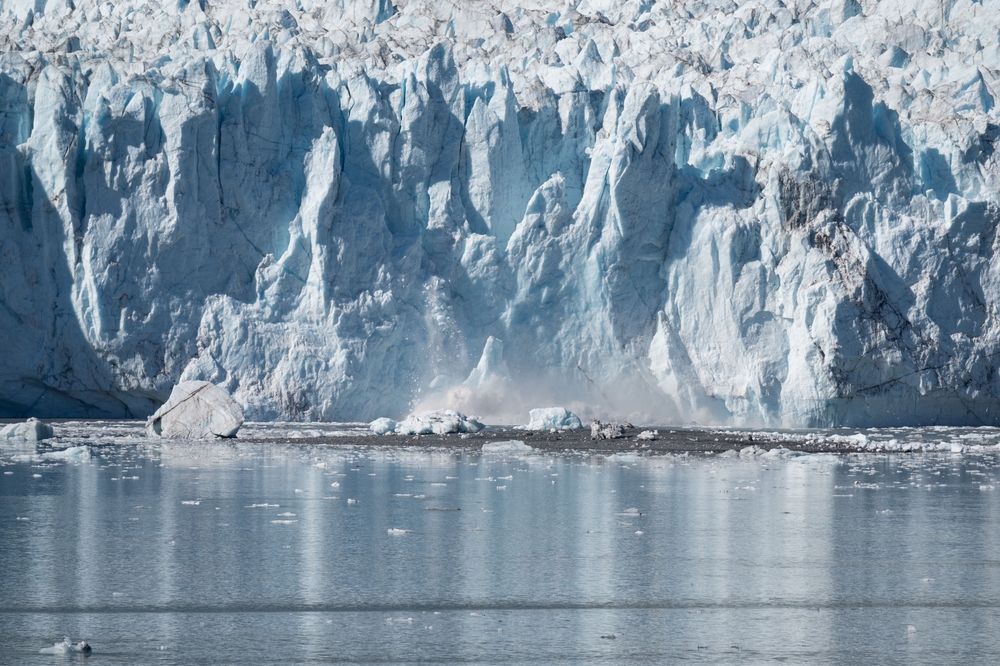

Some news arrives and immediately reorders everything else on your mental list. Not the local-council story or the celebrity filing, but the geographically remote, scientifically dense kind – the kind that takes up residence in the back of your mind while you are making dinner and refuses to leave. The Thwaites Glacier has been occupying that particular real estate for years. And right now, the scientists watching it most closely are not offering cautious, measured reassurances. One researcher at the University of Innsbruck, looking at satellite images of the eastern ice shelf, described what he was seeing as large areas suddenly falling to pieces. Another, from the British Antarctic Survey, has already written the glacier’s obituary. They’re just waiting to publish it.
Scientists, who by professional instinct reach for measured language and hedged timelines, have drafted a press release in advance to announce the collapse of the Thwaites Eastern Ice Shelf, because “its final demise could happen suddenly, and to avoid being caught on the hop, we have already prepared an ‘obituary’ press release,” according to Rob Larter of the British Antarctic Survey. That is not the language of scientists who think they have decades to figure this out.
To understand why anyone who doesn’t live near a coastline should care, it helps to understand what Thwaites actually is. The surface area of the Thwaites Glacier is comparable to that of Great Britain, accounting for 8.7 percent of the ice sheet in West Antarctica, fed by snowfall from the vast Antarctic interior, and ending at the sea with a floating ice shelf 120 kilometers wide, 50 kilometers long, and up to 1,200 meters thick. It is a mass of ice so large that its behavior writes the future of coastlines worldwide, including the one your kids might live near.
What Is Actually Happening Right Now
Thwaites Glacier in West Antarctica is changing more quickly than almost any other ice-ocean system on the planet, and its future behavior remains one of the biggest unknowns in forecasts of global sea-level rise. The specific mechanism now alarming scientists is not simply that Thwaites is melting. Ice melts. What is alarming is the internal fracturing of the eastern ice shelf, a floating extension of the glacier that has, for decades, acted as a brake on how fast the glacier behind it slides into the sea.
One part of this system, the Thwaites Eastern Ice Shelf, floats on the ocean and is partly held in place by a pinning point at its northern edge. Over the past twenty years, this shelf has developed increasing fractures around a major shear zone located upstream of that pinning point. A study published in the Journal of Geophysical Research: Earth Surface in 2025 offers the most detailed account yet of how this slow breakdown has unfolded.
What makes this feedback loop particularly hard to halt is its self-reinforcing nature. The study shows that once enough fractures had formed, the ice shelf in this region began to speed up, and that faster motion in turn created even more cracks. Scientists call this a positive feedback loop. Think of it less like a glacier melting and more like a windshield that develops one crack in a winter freeze, and then another, and then suddenly the whole thing goes at once. One striking result from the study is that crack growth in the center of the Thwaites Eastern Ice Shelf is now outpacing the ice loss caused by melting at its base. The ice is not just warming away. It is breaking from within.
The speed at which this is happening has genuinely startled researchers. The velocity at which the ice shelf moves has increased threefold between January 2020 and January 2026, now exceeding 2,000 meters annually. To translate that: in the span of six years, an ice shelf the size of a small country has gone from moving at one pace to moving three times faster. Christian Wild, the University of Innsbruck researcher tracking the shelf’s motion, described the situation plainly: “It’s essentially in free fall now.”
The Chain Reaction Nobody Wants to Think About
The ice shelf itself, if it collapses, does not directly flood any coastline. Scientists are careful to make this clear – floating ice displacing ocean water is not the same as land ice entering the ocean. But the shelf’s role is to act as a dam. Without it, the glacier behind it accelerates into the sea, adding to sea-level rise immediately and, critically, destabilizing the broader West Antarctic Ice Sheet across the coming centuries.
The glacier currently contributes four percent of global sea-level rise, and its potential collapse threatens to trigger a chain reaction throughout the West Antarctic Ice Sheet, which could ultimately push sea levels up by 3.3 meters worldwide. For context, a one-meter rise in sea level is already enough to cause widespread coastal flooding across multiple continents. Three meters is a different order of problem entirely.
The fear is not Thwaites in isolation. If the shelves weaken or break, more land-based ice can flow into the ocean, adding to sea-level rise that is already registering in higher insurance costs and bigger repair bills after coastal storms. The International Thwaites Glacier Collaboration, a joint effort between U.S. and U.K. scientists, has warned that continued retreat of Thwaites and nearby ice could eventually lead to several meters of global sea-level rise across the coming centuries.
The Reason Scientists Are Cautious, and the Reason That Doesn’t Fully Reassure
Not every climate scientist is sounding the alarm at the same pitch. A 2024 study conducted by the International Thwaites Glacier Collaboration offered a more tempered projection. According to the Dartmouth College research team led by Professor Mathieu Morlighem, “The new models show that Thwaites will likely continue to lose ice at a rapid rate but its retreat will not turn into a catastrophic collapse during the 21st century,” with Morlighem cautioning, “We’re not saying the Antarctic is safe.”
That is the honest middle of where science sits right now: not imminent catastrophe by 2050, but not reassurance either. Thwaites’ retreat has accelerated considerably over the past 40 years. Although a full collapse is unlikely to occur in the next few decades, the International Thwaites Glacier Collaboration’s findings indicate it is set to retreat further, and faster, through the 21st and 22nd centuries, and general collapse of the West Antarctic Ice Sheet across this timeframe cannot be ruled out.
The honest thing to acknowledge is that the uncertainty itself is part of the problem. Research indicates the glacier’s flow behind the shelf has surged by approximately 33 percent since 2020, demonstrating the buttressing effect has largely vanished. Researchers emphasize this represents a gradually developing crisis rather than an immediate emergency, with consequences likely to materialize over coming decades. A gradually developing crisis still requires someone to be paying attention, and right now, the people paid to pay attention are worried.
Who Is Most at Risk and When
The honest answer to “who is at risk” is: coastal populations everywhere, eventually, and some specific places sooner than others. For American readers, the picture drawn by current projections is not abstract. Scientists are warning that the collapse of Antarctica’s massive glacier could eventually redraw large parts of America’s coastline, threatening major cities from Florida to California with severe flooding and rising seas. While the glacier itself could add around 65 centimetres to global sea levels, some scientists worry it could destabilize much larger sections of the West Antarctic Ice Sheet, potentially contributing to sea-level rise approaching 3 meters before the end of the next two centuries.
Using NOAA’s Sea Level Rise Viewer, in Florida, a large southern portion of the state would be swallowed by seawater, including Miami and the Everglades National Park. A large portion of Louisiana would be engulfed, as would parts of the Texas coastline. Along the East Coast, major cities including Brunswick and Savannah in Georgia, Charleston in South Carolina, and Norfolk and Virginia Beach in Virginia would be impacted. Atlantic City and parts of New York City would also see impact.
For those in the UK, the picture is equally direct. According to Climate Central’s Coastal Risk Screening Tool, even with a 1.5-degree temperature increase, the United Kingdom will feel the impact of sea-level rise. Areas in Lincolnshire, the East Riding of Yorkshire, and Cambridgeshire, including the city of Hull, would be among the worst affected. Parts of central London would already be below the tideline by 2100.
Further afield, as a rule of thumb, for every centimeter of sea-level rise, an additional 6 million people are at risk of coastal flooding. There are no remote coastal communities in this equation. There is only proximity and timing.
Why the Fracturing Inside the Ice Matters More Than the Melting
For most of the last decade, the dominant concern about Thwaites was the warm ocean water eating away at its underside. That process is still happening. But 2025 research from the University of Manitoba’s Centre for Earth Observation Science, published in the Journal of Geophysical Research, introduced a second and more urgent problem: the fractures are now growing faster than the melting. That reorders the threat.
Using twenty years of satellite observations, ice-flow speed measurements, and in-situ GPS data, the team documented how fractures within the Thwaites Eastern Ice Shelf shear zone formed and evolved, with their analysis showing that the gradual growth of these fractures weakened the shelf’s connection to the pinning point. When the shelf loses its grip on the pinning point, it loses its ability to hold itself, and the glacier behind it, in place.
New research published in May 2026 added another dimension to the concern. Antarctic ice shelves may be melting much faster than scientists thought because hidden channels underneath them can trap warm ocean water, with new research suggesting global sea levels could rise more quickly than previously expected as a result. The researchers found that even ice shelves in East Antarctica, long considered relatively stable, may be more vulnerable than previously understood. Current climate models may be missing this dangerous process entirely, meaning future sea-level rise could be underestimated.
What the Glacier Is Actually Telling Us
There is a version of hope worth naming here. Scientists at the International Thwaites Glacier Collaboration are clear that the choices made in the next few decades will influence the pace and scale of what happens after. Sustained decarbonization offers the best chance of delaying this ice loss and avoiding the initiation of similar unstable retreat in marine-based sectors of East Antarctica. That is not a vague call to feel bad and recycle more. It is a statement from the scientists who know this system best, saying that what happens in the next 30 years of emissions policy will determine how fast the next 200 years unfold.
The scale of what Thwaites represents is genuinely hard to hold in your head at once. A glacier the size of Britain, losing its grip on the seafloor it has been anchored to for centuries, watched by researchers who have already written its obituary. The consequences are not a movie scenario. They are a geological timeline that is, in human terms, moving fast. Miami’s street-level flooding during high tides is already documented and ongoing. Hull is already among the most flood-prone cities in Britain. These are not future problems wearing future-problem clothing. They are present problems with a long runway.
The scientists are not asking anyone to panic. They are asking anyone in a position of influence, from household to policy, to understand what is at stake and to stop treating an accelerating ice shelf as someone else’s concern. The coastal communities most at risk from what happens at Thwaites did not cause this. Many of them don’t yet know their zip code is in the conversation. The glacier doesn’t care. It is moving, and right now it is moving fast.
AI Disclaimer: This article was created with the assistance of AI tools and reviewed by a human editor.