

Those three lines wrapped around a plastic cup have been living rent-free in people’s heads for years. You’ve probably passed a stack of them at a backyard party, or fished one from the cabinet before a school event, and if you’re the kind of person who notices small design details, you’ve wondered about those horizontal ridges – what they’re for, who put them there, and whether that viral post you half-read years ago was actually right. It wasn’t, by the way. But the real story is better.
The plastic cup fill lines became one of the internet’s most enduring pieces of trivia because the explanation that spread felt so satisfying: each line measures a standard drink. Neat, self-contained, secretly brilliant. It’s the kind of detail that makes people feel they’ve unlocked something that was always hiding in plain sight. The only problem is that Solo, the company that made the original cup, has said clearly and repeatedly that this is not true. The lines were never intended as measuring guides. Not even a little bit.
So what are they actually for? That question turns out to touch engineering, American social history, and one man who built a cultural icon by accident.
The Man Who Built the Cup That Ate America
According to NPR, in the 1970s, Robert Hulseman invented the red Solo Cup for families to use at picnics. He was not trying to create a party staple or a pop culture moment. He was solving a practical problem. Hulseman joined the staff of the Solo Cup Company, which had been founded in 1936 by his father Leo Hulseman, when he was 18 years old. He worked his way up through a company that had started with paper cone cups for water coolers and grown into disposable plates, bowls, and drinkware. By the time Robert led the plastics division, the challenge was simple: make a plastic cup that didn’t stick, didn’t crack, and didn’t fall apart in someone’s hand when it was full.
The Solo cup’s design actually involved a surprising amount of engineering. Before the cup’s invention, manufacturers had been trying to solve a costly problem: how to prevent disposable cups from sticking to the production molds and how to prevent stacks of disposable cups from getting stuck together. Hulseman’s design solved these problems with two different innovations. First, the curved lip of his cups prevented them from stacking too tightly. And second, he added small indents at the bottom of the cup that strengthened the base and allowed for airflow between stacked cups.
Paul Hulseman, Robert’s son, told the Associated Press that his father “never fully understood how massively popular the large red plastic cup became in pop culture.” What started as a picnic cup ended up as a fixture at every college party, tailgate, and Fourth of July cookout for the next fifty years. Home decor gets away with a lot, but disposable drinkware becoming a cultural symbol is a different category of alchemy entirely.
What the Plastic Cup Fill Lines Actually Do
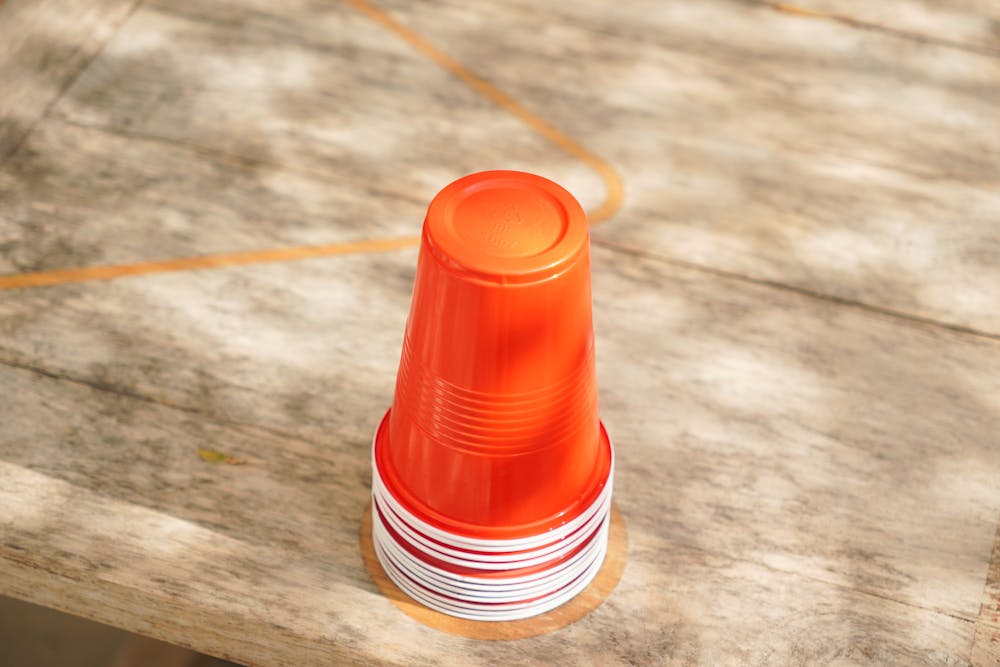
PolitiFact confirmed that, according to Margo Burrage, director of communications for Dart Container Corporation, the parent company of Solo’s cups, the lines on the signature cup were a purposeful part of the design, but for a variety of reasons. “The design of the first SOLO cup was very intentional. When SOLO designed the iconic red cup in 1976, every detail served a purpose and still does to this day,” Burrage wrote in an email. “The rolled rim makes it easier to sip your drink, but also prevents a stack of SOLO cups from sticking together. The indented base makes the cup sturdier and less likely to crack. And those extra lines keep your fingers from slipping while holding the cup. So while the lines weren’t meant for measurement, they were a quite purposeful part of the design.”
Grip, structure, and stackability. That’s the whole list. The lines exist because a smooth plastic surface is hard to hold, especially with a cold, condensating cup in a warm backyard, and because the manufacturing and stacking problems were real engineering challenges that needed real solutions. Nothing about pours. Nothing about cocktail quantities. The lines are doing exactly the same job as the tread on a shoe.
This is also one of those design details that gets more interesting the longer you look at it, because every element of the cup was considered, from the way it grips to the way it stacks, which makes the absence of any measurement intent more striking, not less.
The Theory That Would Not Die
Snopes fact-checked the claim that the seemingly random lines on red Solo cups delineate the proper filling level for various kinds of alcohol: the bottom line for a shot of liquor (1 ounce), the middle line for a serving of wine (5 ounces), and the top line for the right amount of beer (12 ounces). Their finding was clear: “The lines on our Party Cups are designed for functional performance and are not measurement lines. If the lines do coincide with certain measurements, it is purely coincidental.”
The reason this theory stuck is that the measurements happen to be in the right ballpark. According to the NIAAA, one standard drink in the United States contains about 14 grams, or about 0.6 fluid ounces, of pure alcohol – that is the amount found in a 12-ounce can of regular beer at 5% alcohol by volume. Standard wine pours at 5 ounces, and a shot of spirits runs 1.5 ounces. When you look at where the original Solo cup lines actually fell, the coincidence is close enough to be convincing. Close enough that millions of people passed this explanation around on social media as though it were engineering documentation.
Shortly after the rumor started in 2012, Solo posted a playful graphic on its Facebook page revealing the “real” use of lines on the company’s original cup. Their suggestions included chocolate syrup, juice, and cereal portions – which is the company leaning into the joke without confirming the myth. Solo’s actual position, stated by Burrage to fact-checkers, is that the lines were a grip and structural feature, full stop. The alcohol coincidence is just that: a coincidence that happened to map cleanly onto something people already thought about at parties.
When the Cup Changed – and What Disappeared With It
You may have noticed Solo cups no longer sport those iconic lines. According to the Solo website, Solo cups no longer have lines, as they were phased out. The company redesigned the cup several times across the 2000s, and at some point the ridges that generated a decade of internet debate were retired along with the original design.
Solo tweaked the design of its iconic party cup, adding indented grooves in 2003 so that the cup would be easier to grip. In 2009, the cup’s base was squared and the ergonomic grips were refined. Each iteration moved further from the original concentric-ring design that sparked the mythology. The lines that never measured anything are gone now, replaced by a design that does grip work more efficiently. The cup is still red, still stackable, still everywhere – but the artifact that launched ten thousand viral posts has been discontinued.
If you do find original-style cups with the classic ridges, they have picked up a secondary use as improvised measuring tools in the kitchen. The bottom line runs close enough to 1 ounce for mouthwash, the middle close enough to 5 ounces for a small pour of cereal milk, and the top close enough to 12 ounces for a kid’s drink. This works in the same way a butter knife works as a screwdriver – functional, not designed for it, perfectly fine in a pinch.
The Habit of Seeing Meaning Where There Isn’t Any
How thoroughly this myth spread, and how long it lasted, says something real about what people want from design. A cup built for grip and structural integrity spent decades being explained as a responsible drinking guide. The explanation felt right because it told a story about intentional, considerate design – about a product that was not just disposable but secretly useful. People wanted that to be true. The same impulse drives a lot of kitchen mythology – the idea that ordinary objects contain hidden wisdom, that the people who made them thought harder about your daily life than you realized.
The actual story of the cup is, if anything, more interesting. A man who joined his father’s company at 18 and spent decades solving manufacturing problems accidentally created an American icon. He didn’t know it would end up in country songs. He was trying to keep cups from sticking to each other on the production line. The rolled rim that lets you sip without the cup collapsing your upper lip, the indented base that stops it from cracking on concrete, the lines that keep a wet cup in your hand at a July barbecue – all of it was engineering in service of a five-cent party cup that nobody expected to last fifty years.
What the Cup Is Actually Telling You
The plastic cup fill lines were never a message. They were a solution. And the gap between what people decided those lines meant and what they actually were says something true about how we experience design: we look for intention everywhere, and when the real intention is invisible, we invent a better one. Grip engineering doesn’t make a story. A secret measurement system does.
There’s no harm in the myth, and honestly, if using the lines to eyeball a pour of wine helps someone drink less at a party, the cup is doing good work it was never assigned. But the original engineers were thinking about something more basic: a cup that doesn’t slip out of your hand, doesn’t crack on the first pour, and doesn’t weld itself to the cup below it in the stack. That’s it. That’s the whole design brief. Robert Hulseman wasn’t thinking about your margarita. He was thinking about whether the cup would make it from the factory to the backyard in one piece.
Somehow that’s more satisfying than the myth. The myth makes the cup a clever prop in a responsible drinking story. The truth makes it a piece of honest manufacturing that outlived everyone’s expectations, including its inventor’s.
AI Disclaimer: This article was created with the assistance of AI tools and reviewed by a human editor.