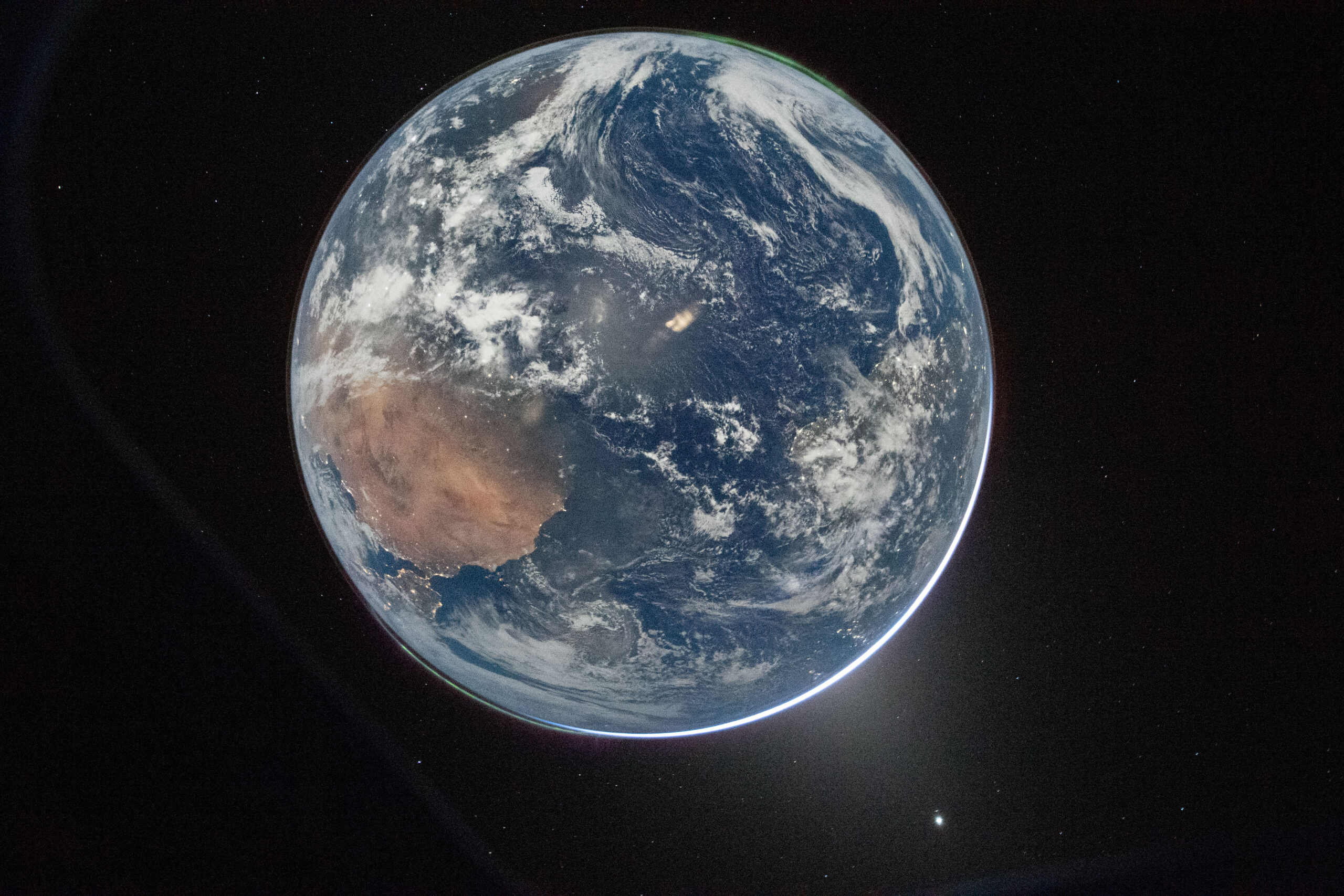

The last time a human being looked out a window and saw the entire Earth hanging in space was December 1972. For more than half a century, that vantage point belonged only to the Apollo crews, to photographs that had grown familiar enough to become wallpaper and screensavers and coffee mugs. Then, in April 2026, four astronauts aboard an Orion spacecraft named Integrity looked out their windows at the same impossible view – and pointed their cameras at it.
What came back changed how a lot of people were thinking about the planet. And for a vocal corner of the internet that has spent years insisting that the photographs from Apollo were staged, composited, or simply wrong about the shape of the world, the NASA Artemis II images arrived like a very expensive rebuttal.
The mission launched on April 1, 2026, which is either a very funny date for humanity’s return to deep space or a perfectly reasonable one, depending on your tolerance for coincidence. The first crewed test flight of NASA‘s Artemis program lifted off from Launch Pad 39B at Kennedy Space Center in Florida at 6:35 p.m. EDT on April 1, carrying the first astronauts to travel to the Moon in more than half a century. The mission lasted ten days. The photographs are going to last considerably longer.
The Crew Behind the Camera
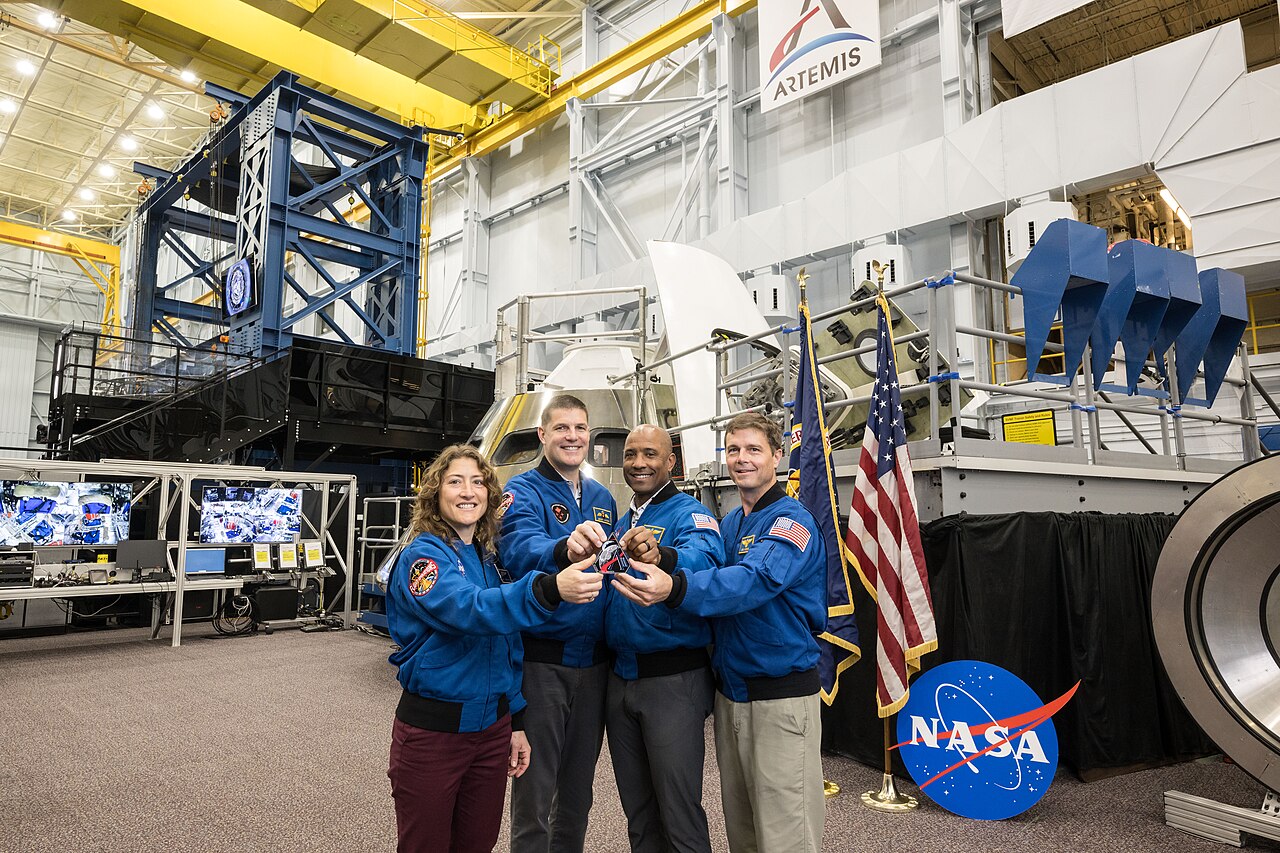
Four astronauts were selected for NASA’s Artemis II mission: Commander Reid Wiseman, pilot Victor Glover, and mission specialist Christina Koch from NASA, and mission specialist Jeremy Hansen from the Canadian Space Agency. Three Americans and one Canadian flew aboard the Orion spacecraft, named Integrity, over the course of ten days.
Wiseman is a former NASA chief astronaut, a U.S. Navy test pilot, and had already spent 165 days in space on the International Space Station (ISS) before strapping in for this one. Victor Glover was the first Black astronaut to live on the ISS for a long-duration assignment, spending six months on the Crew-1 mission. For Jeremy Hansen, it was a milestone with national weight: he became the first of his country to break the orbital plane, making a trans-lunar injection and leading toward the Moon.
The crew also captured striking images of Earth after receiving specialized training on how to photograph the planet from thousands of miles away. This wasn’t a matter of pointing a camera out a porthole and hoping for the best. NASA trained them to go beyond the basics, and the results show it.
“Hello, World”
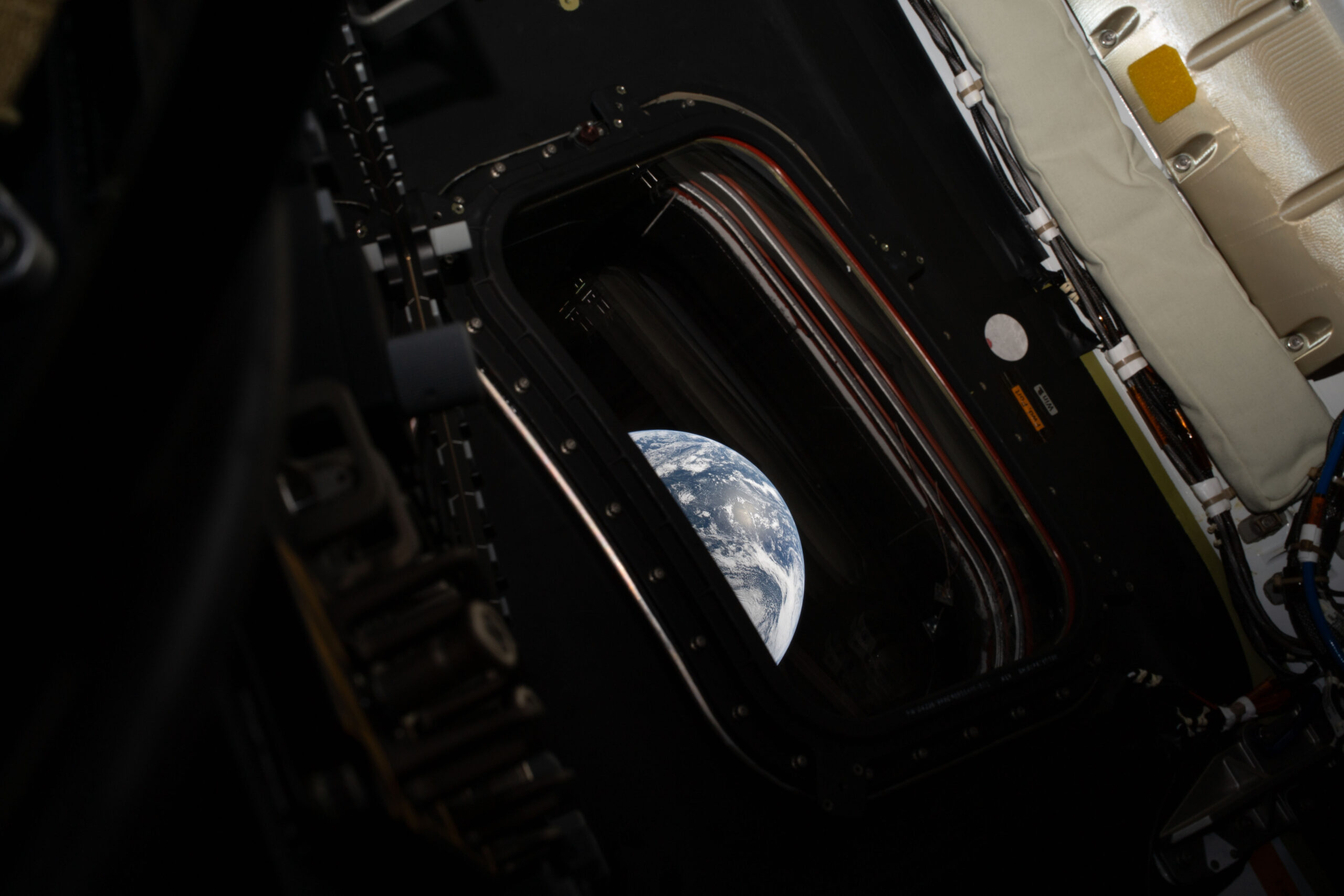
The photograph that stopped the internet arrived first. Commander Reid Wiseman took this picture of Earth from the Orion spacecraft’s window on April 2, 2026, after completing the translunar injection burn. NASA titled it, with deceptive simplicity, “Hello, World.”
From pole to pole, Earth is captured in this snapshot from space. From the spacecraft’s perspective, the Sun is moving behind Earth’s bright limb along the lower right. Africa and the Iberian peninsula are visible on the planet’s surface, while aurorae crown Earth’s south and north poles. This and another photo of Earth were the first downlinked images from the Artemis II astronauts.
The translunar injection burn that preceded the photo is worth understanding for a moment. After the successful burn on April 2 and a roughly eight-hour crew rest period, the Artemis II crew began their second full day in space. Upon burn completion, NASA astronauts Reid Wiseman, Victor Glover, and Christina Koch, along with Jeremy Hansen, became the first people to leave Earth’s orbit since the Apollo program in 1972.
That is the detail that makes the photograph meaningful in a way that no studio could replicate. The image wasn’t taken from low-Earth orbit, where the ISS sits and where the planet still fills the frame close enough to suggest it might be flat at the edges. It was taken from tens of thousands of miles out, with the full sphere of the Earth visible from pole to pole, sitting in the blackness like a marble. NASA published photographs taken from the capsule, including a full view of Earth showing a glowing orb of deep blue oceans and swirling clouds.
Fifty-Four Years Apart
NASA shared side-by-side pictures showing how Earth was captured from space in 1972 by the Apollo 17 crew and in 2026 by the Artemis II crew. The first picture, called “The Blue Marble,” was taken on December 7, 1972, by NASA astronaut Harrison Schmitt from the Apollo 17 spacecraft while it was on its way to the Moon. The second was Wiseman’s “Hello, World.” NASA wrote alongside the images: “We’ve come so far in the last 54 years, but one thing that hasn’t changed: Our home looks gorgeous from space!”
The comparison sparked its own separate debate, which is perhaps a sign that humans will find something to argue about even when presented with the most beautiful photographs in the history of space exploration. Commenters were quick to notice that the new image appeared hazier compared to the iconic 1972 photograph, with many speculating whether climate change was to blame. The questions came fast: why does the older photo look sharper? Why does 1972 equipment seem to outperform 2026 technology?
Several users stepped in to offer some perspective, with one commenter pointing out that the new photo captures the side of Earth not facing the sun, naturally making it appear darker. One view is shaped by film, the other by digital sensors; one by a young space age, the other by a climate-conscious era that reads planetary change into every pixel. The practical explanation involves light, lens choice, and processing decisions as much as it involves anything about the planet’s actual condition. NASA noted that the crew used an iPhone 17 Pro Max for some of the shots – a detail that prompted its own wave of reactions from people who found it either thrilling or absurd that the most consequential space photographs in a generation were partly taken on a phone.
Earthset and an Eclipse Nobody Saw Coming
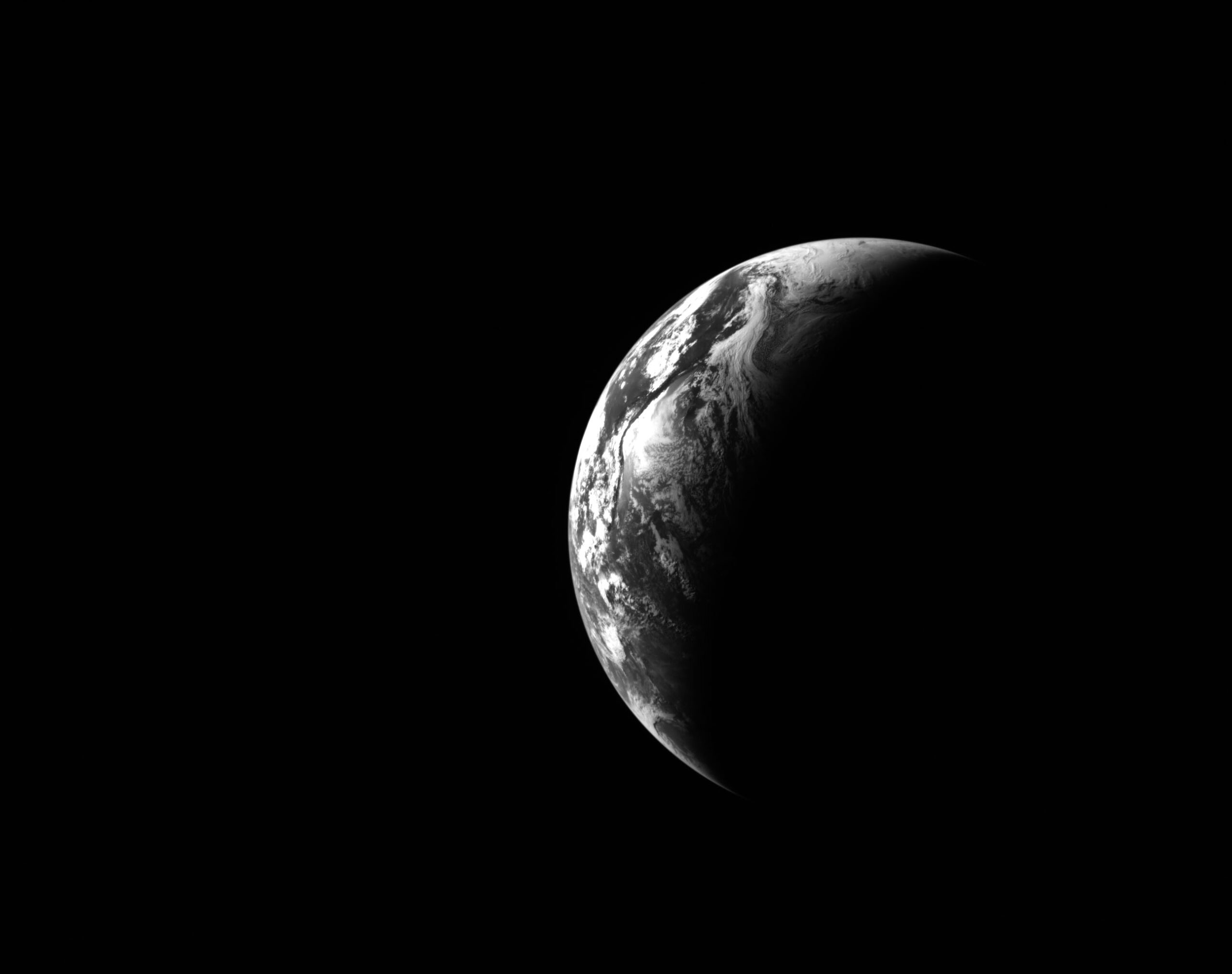
The early Earth photos were remarkable. What followed on April 6 was something stranger and more difficult to describe. The Artemis II crew concluded a historic seven-hour flyby of the far side of the Moon on April 6, 2026.
Among the images they returned was a shot of Earthset, echoing the iconic Earthrise photos taken by Apollo 8 astronauts in 1968. During an Earthset, the planet appears to sink below the lunar horizon. A partially lit crescent Earth drops behind the Moon as seen by the crew aboard the Orion spacecraft, with the sunlit side showing white clouds and blue water over the Oceania region, while the dark areas are experiencing nighttime.
The flyby images also reveal regions of the Moon’s far side, as well as an in-space solar eclipse. The crew witnessed a total solar eclipse in which the sun disappeared behind the Moon for 53 minutes, nearly seven times longer than any solar eclipse seen from the ground on Earth. As the sun disappeared behind the darkened Moon, the crew used the opportunity to study the solar corona – the sun’s outermost atmosphere – glowing around the Moon’s edge.
The Artemis II astronauts also surpassed the record for distance from Earth, a record previously set during the Apollo 13 mission when astronauts traveled 248,655 miles from Earth. At their farthest point, the crew reached 406,740 kilometers (252,737 miles) from Earth’s surface – farther than any human beings in history.
You can view the full collection of NASA Artemis II images on NASA’s lunar flyby gallery, where the photographs from the seven-hour flyby have been catalogued alongside mission context and scientific notes.
What the Flat Earth Corner Made of All This

The flat-Earth response to the NASA Artemis II images was predictable in some ways and revealing in others. The community that has spent years arguing that NASA’s previous photographs were composites or fabrications was now confronted with a new batch, taken on what is essentially a live, extensively documented mission with thousands of people working on it, with splashdown broadcast in real time off the coast of California.
The predominant response was that these photographs, like all the others, are faked. Some argued the sphere visible in Wiseman’s window was itself a composite. Some noted the aurora as evidence of digital manipulation, despite NASA’s specific technical explanation of exactly where each aurora appears in the frame and why. A number of people simply moved the goalposts: the images prove nothing because NASA cannot be trusted, and no amount of imagery changes that prior position.
Artemis II was the first crewed mission to fly to and from the Moon since Apollo 17 in December 1972. The mission carried four real human beings, who spoke to mission control in real time, who took selfies with eclipse viewers on April 6, who reported what they saw from their windows, and who splashed down on April 10 while cameras captured the moment. The evidence does not get more thorough than this. Whether that evidence can reach someone who has already decided it is fabricated is a different question entirely, and one that photographs – however spectacular – have never been able to answer.
What These Photographs Actually Are
The temptation is to frame the NASA Artemis II images as a comeback story, or as a closing argument in a debate about the shape of the world. They are neither, really. They are what happens when four people travel further from Earth than any human beings in 56 years, and they are moved enough by what they see to keep pressing the shutter.
Wiseman, Glover, Koch, and Hansen used a fleet of cameras to take thousands of photos over the course of ten days. Some of those photographs will end up in textbooks. Some already appear as NASA’s Astronomy Picture of the Day. The “Hello, World” image – Earth framed in a spacecraft window, fully round, crowned in aurora light, the sun edging behind it – is the kind of photograph that does not need a caption. The planet is right there, doing its thing, completely indifferent to what anyone on its surface has decided to believe about its shape.
The real weight of these images has nothing to do with flat-Earthers, and everyone who has spent time looking at them probably knows this. The Artemis II mission launched on April 1, 2026, carrying a crew of four astronauts around the Moon on April 6, and returning to Earth on April 10. Ten days. A 685,000-mile round trip. And at some point during those ten days, four human beings pressed their faces to the windows of a spacecraft named Integrity and saw the whole world at once – imperfect, luminous, and unmistakably round – and took photographs so that everyone else could see it too.
The debate about what those photographs prove will continue, because some debates have no natural end. The photographs themselves, though, are not interested in the debate. They just are what they are: the Earth, from far enough away that you can see all of it at once, still looking gorgeous after all this time.
AI Disclaimer: This article was created with the assistance of AI tools and reviewed by a human editor.