
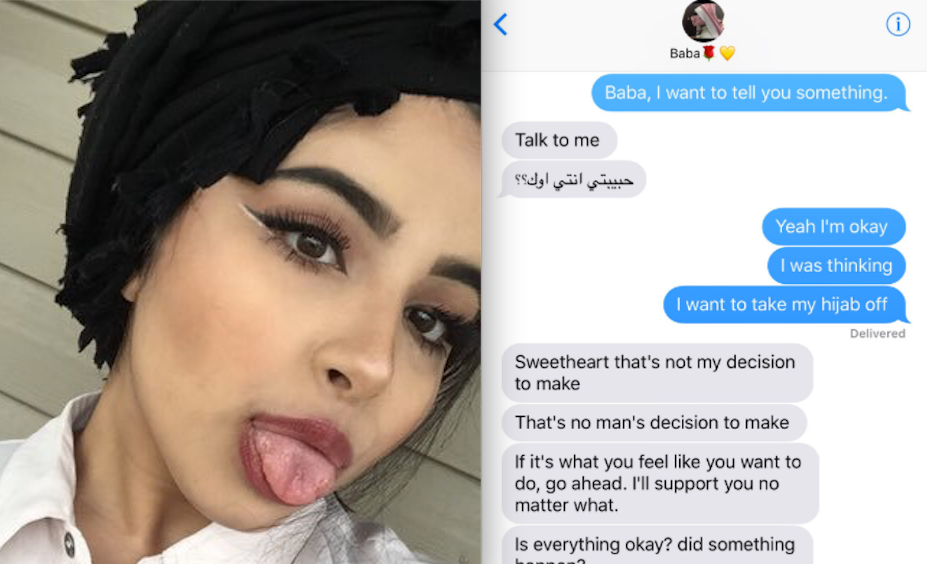
What started out as an Islamophobic message turned into a heartwarming life lesson about religious freedoms and the power of family love and support. In 2017, Lamyaa, a 17-year-old from Pennsylvania, would go viral on social media after she posted a heartwarming text exchange between her and her father. In her post, which was posted to the social media platform X (then called Twitter), she posted 2 images. One of the images showed an exchange in her group chat with friends, where she received Islamaphobic comments due to her faith. The second image shared a heartwarming conversation between her and her father, who resided in Saudi Arabia.
The viral post centred around Lamyaa’s experience as a Muslim woman and her relationship with the hijab. She received hateful comments about her faith and her autonomy on wearing the hijab, with friends in her group chat saying she had no freedom to remove it if she pleases. Lamyaa’s experience highlights an important truth about the hijab that many people misunderstand.
The headscarf worn by Muslim women represents personal faith and modesty, yet it often becomes a target for stereotypes and discrimination. When faced with hateful assumptions about her relationship with her father, Lamyaa decided to respond in an unexpected way. Her decision to screenshot a private conversation with her dad living in Saudi Arabia would spark important discussions about choice, freedom, and what it truly means to wear hijab.
A Conversation That Started in a Group Chat
What formed this viral post began as a group chat with friends Lamyaa participated in, where the conversations drifted towards the current political climate at the time. As conversations turned to President Donald Trump and his policies, Lamyaa felt compelled to share her perspective. The political climate in early 2017 was particularly tense for Muslim Americans. President Trump signed Executive Order 13769 on January 27, 2017, which banned travel from 7 predominantly Muslim countries. This executive order affected millions of Muslims and created widespread fear in Muslim communities across America.
As an Arab Muslim woman, Lamyaa had strong views about policies that directly impacted her community. She spoke passionately against the immigration ban, which targeted Syria, Iran, Iraq, Libya, Somalia, Sudan, and Yemen. For Lamyaa and countless other Muslim Americans, these policies felt deeply personal and discriminatory.
The group chat included people she knew and some mutual friends whom she did not know. The conversation’s tone immediately shifted when Lamyaa identified herself as a Muslim woman during the group chat discussion. When Lamyaa spoke out against Donald Trump’s ban and policies, one group chatter, who she did not know, responded with hostility.
The Insult That Sparked a Bold Response
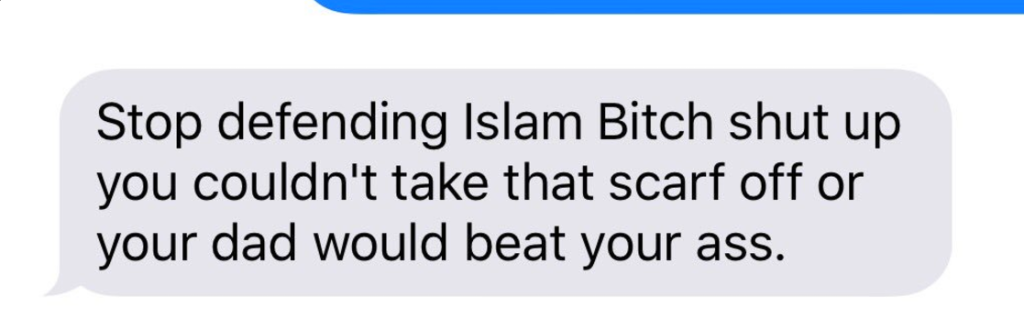
The chatter in the group, who was a stranger to Lamyaa, wrote “Stop defending Islam, B**ch shut up. You couldn’t take that face cover off, or your dad would beat your ass,” which prompted a response that spawned the heartwarming viral post. Lamyaa lamented that she was accustomed to this level of Islamaphobia, especially from non-Muslim Americans. However, she would not let the stranger’s insult be left unaddressed. But instead of taking revenge, she decided to test the stranger’s racist assumptions.
Studies indicate that Muslim women face discrimination at significantly higher rates than Muslim men, with 69% of women reporting harassment compared to 57% of men. Women who visibly identify as Muslim by wearing hijab become easy targets for verbal abuse, physical assault, and online hate. Research shows that 69% of Muslim women who wear hijab experience some form of discrimination, compared to only 29% of Muslim women who do not wear the hijab.
While she had no intention of taking her hijab off, even to prove a point, she wanted to prove negative stereotypes about the relationship between Islam, women’s autonomy and control. Her decision to message her father was not about genuinely questioning her faith. Rather, it was about challenging the ignorant beliefs that too many people hold about Muslims and Islam as a whole.
A Father’s Wisdom From Across the Ocean
Lamyaa texted her father, who lives in Saudi Arabia, with a simple opening. She wrote that she wanted to tell him something. Her father immediately responded with concern, asking in Arabic if she was okay. When Lamyaa told her father she was considering removing her hijab, his response was both unexpected and powerful. He wrote: “Sweetheart, that’s not my decision to make. That’s no man’s decision to make”. He continued by telling her that if removing the hijab was what she wanted, she should go ahead. He promised to support her no matter what.
Her father’s response actually reflects important Islamic principles about personal autonomy and religious practice. As opposed to the negative stereotypes some have about Islam, the Quran states, “Let there be no compulsion in religion“. This teaching means that no one can force another person to practice any aspect of Islam, including wearing hijab. While modesty is considered important in Islamic teaching, the decision to wear hijab must come from personal conviction rather than from other people or force.
Breaking Stereotypes About Muslim Women
Father-daughter relationships in Islam states that fathers should be guardians and protectors while also respecting their daughters’ autonomy. The Prophet Muhammad (P.B.U.H.) extensively cared for and respected his daughter, Fatima’s autonomy. Islamic teachings stress that fathers should guide their daughters with kindness rather than force or fear.
Many people hold the false belief that Muslim women are forced to wear hijab by men, either in their communities or families. While this does happen in some cases due to cultural practices rather than religious requirements, it does not represent the experience of most Muslim women who choose to wear hijab. According to a 2018 survey of American Muslims, 54% of women who wear hijab do so for piety to please God, 21% to show Muslim identity, 12% for modesty, and only 1% because family or a spouse requires it.
The Viral Response That Touched Millions
Lamyaa’s tweet spread rapidly across social media. Within days, it received more than 320,000 likes and 147,000 retweets. People from all corners of the internet shared the post and commented on the father’s loving response. Many Twitter users praised Lamyaa’s father for his progressive attitude and unconditional support. Comments flooded in from people expressing admiration for both father and daughter. One person wrote, “Your dad is so sweet!” while others shared their own similar experiences with supportive parents. Some Muslim women replied with stories of their own fathers who also gave them the freedom to make personal decisions about hijab.
Lamyaa told Upworthy that she received many heartwarming messages from people showing support. More importantly, she heard from people wanting to learn more about Islam or expressing interest in the faith. She felt humbled by the opportunity to help others understand her religion better.
Understanding the True Meaning of Hijab
The hijab serves multiple purposes for Muslim women who choose to wear it. At its core, hijab represents modesty, both in appearance and character. It reminds Muslim women of the values their faith emphasizes and allows them to express their religious identity publicly. Women who wear hijab report that it helps them be recognized as Muslim and serves as a visible symbol of their faith.
For many Muslim women, hijab provides freedom rather than oppression. It shifts attention away from physical appearance and toward personality, character, and intellect. One writer explained that hijab protects Muslim women from the intense pressure that Western culture places on women’s bodies and appearance. While mainstream society increasingly judges women based on physical attributes, hijab offers an alternative that prioritizes inner qualities.
The meaning of hijab varies among individuals who wear it. Some view it as an act of worship and devotion to God. Others see it as cultural identity or personal expression. The headscarf comes in many styles, colors, and fabrics, allowing for personal taste and creativity while maintaining the principle of modesty.
The Reality of Choice and Personal Freedom
The question of choice in wearing hijab is complex and depends on geographic and social context. In countries like the United States, the vast majority of Muslim women who wear hijab do so voluntarily. Many women even face opposition from family members who worry about discrimination or prefer a less visible expression of faith. In Turkey and Lebanon, more than 25% of respondents in surveys believe women should not be required to cover their heads in public.
However, the reality differs in countries where hijab is legally mandated. Iran has required women over age nine to wear hijab since 1981. Afghanistan under Taliban rule enforces even stricter covering requirements. In these contexts, women lack genuine choice because they face legal penalties or social consequences for not covering.
Read More: Son Finally Meets Birth Mother After 58 Years
Addressing the Critics and Clarifying Intentions
Not everyone responded positively to Lamyaa’s viral post. Some critics pointed out that her experience did not represent all Muslim women everywhere in the world. They argued that many women are forced to wear hijab against their will by family members, communities, or governments. These criticisms raised valid concerns about the very real oppression that some Muslim women face.
Lamyaa responded thoughtfully to these comments. She acknowledged that many women are indeed forced to wear hijab and called this horrible. She had previously spoken out against forced covering on multiple occasions. However, she wanted to clarify an important distinction. The oppression some women experience does not represent what hijab symbolizes or why most women choose to wear it.
She later tweeted a powerful response to critics who claimed her father was exceptional. She wrote, “When I show my dad being lenient and progressive, you guys say ‘well that’s one person’, but yet when it comes to terrorism, it’s all of us?“ This comment highlighted the double standard in how people judge Muslims. Individual acts of violence are used to stereotype all Muslims, yet individual acts of kindness and respect are dismissed as exceptions.
A Lesson in Respect and Empowerment
The exchange between Lamyaa and her father offers important lessons about respect, autonomy, and genuine support. The father’s response demonstrated that true parental love involves trusting children to make their own decisions about faith and practice. His words showed confidence in his daughter’s judgment and character. Rather than controlling her choices, he empowered her to choose for herself.
Muslim women continue to face significant challenges in Western societies. Discrimination in the workplace remains a persistent problem, with Muslim women filing workplace discrimination claims at rates far exceeding their representation in the workforce. Women who wear hijab are particularly vulnerable to harassment, verbal abuse, and physical attacks. The visibility of hijab makes Muslim women easy targets for those who harbor anti-Muslim prejudice.
Despite these challenges, many Muslim women choose to wear hijab as an expression of their identity and faith. They do so knowing they may face discrimination but valuing their religious expression more than social comfort. This choice reflects strength and conviction rather than oppression or weakness. Understanding this reality requires listening to Muslim women’s own voices and experiences rather than imposing external interpretations.
Read More: She Was Married Off at 14 , Now She’s a Champion Bodybuilder