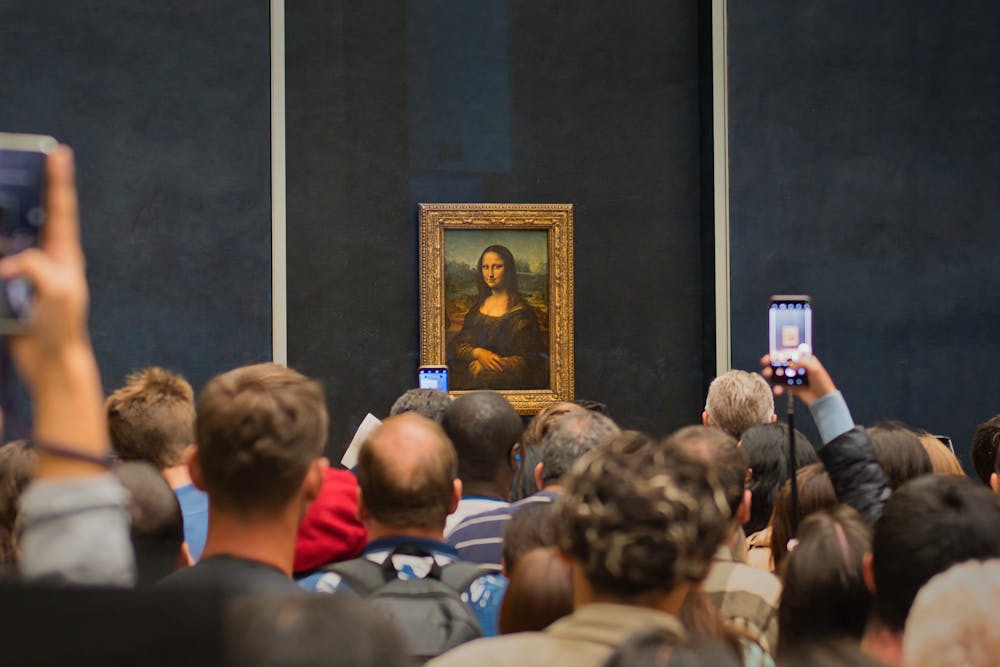

The world’s most famous painting has, by any measure, been one of the most inconvenient pieces of art to actually see. The gap between what the experience is supposed to be and what it actually is has become its own cultural footnote: you queue through I.M. Pei’s glass pyramid, navigate the Denon Wing, push through the Salle des États, and there she is. Behind three inches of bulletproof glass. About the size of a standard sheet of printer paper. Smaller than most visitors expect, which accounts for roughly half of all Louvre disappointments. The other half is the wall of raised phones belonging to everyone else who also made the trip. The whole thing takes about as long as a coffee order and leaves a similar number of people quietly unsatisfied.
That’s not a criticism of the painting itself. It’s a criticism of a system that has long been stretched far beyond what it was ever designed to hold. Some 80 percent of the Louvre’s visitors come specifically to see the 16th-century portrait, and on an average day, that means between 20,000 and 30,000 people converging on a single room. The former museum director, Laurence des Cars, put it plainly in a leaked internal memo: she described many areas of the museum as being in “very poor condition” and, in perhaps the most quietly devastating piece of institutional honesty in recent memory, described visiting the museum as a “physical ordeal.”
Something had to give. And after years of conversations and proposals, a heist that made international headlines, staff strikes, a national auditing report, and a presidential announcement made standing in front of the painting itself, what is finally giving is the museum’s entire eastern side.
The Mona Lisa Louvre Redesign, Explained
French officials chose an international team of architects to usher the Louvre into a “new Renaissance,” with an overhaul that may add up to $1 billion, aimed at addressing crowd control, security, and infrastructure needs at the world’s busiest art museum. The project, named “Louvre Nouvelle Renaissance,” was announced by French President Emmanuel Macron, speaking in front of Leonardo’s iconic 16th-century portrait in the museum’s Salle des États gallery, in January 2025. Macron said, in an address translated from French by the Associated Press: “Notre-Dame has been a catalyst for our architecture and arts and crafts. This new Renaissance project for the Louvre must be for art history and its transmission, a new stage in the life of the nation.”
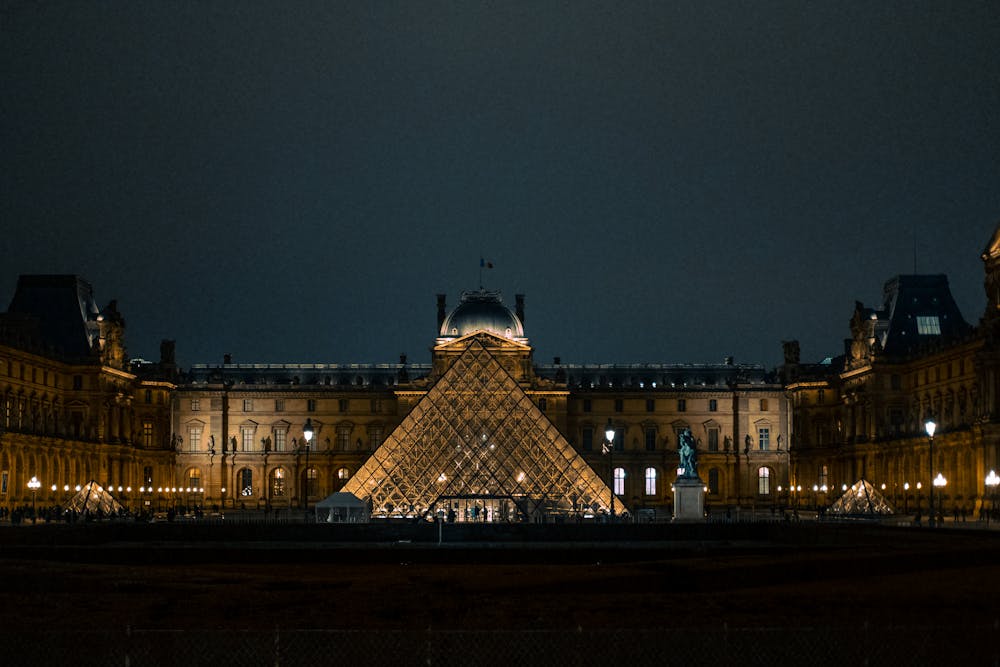
The project marks one of the museum’s largest architectural transformations since I.M. Pei’s glass pyramid debuted in 1989. That pyramid, now an icon but famously controversial when it opened, solved the entrance problem of its era. The Pei addition was designed to support four million annual visitors, but the Louvre now has almost nine million annual visitors, warranting the new entrances.
The Architects Who Won the Job
New York studio Selldorf Architects and Paris-based Studios Architecture won the competition to design the biggest renovation to the Musée du Louvre for 35 years, announced by French Minister of Culture Catherine Pégard. The studios are set to create a pair of new entrances for the historic museum, as well as a dedicated exhibition space for the Mona Lisa painting.
The competition was serious. Selldorf Architects and Studios Architecture’s proposal was selected from a shortlist of five submissions, which included London studio AL_A with Paris design agency NC Nathalie Crinière, Japanese studio Sou Fujimoto Architects, US architecture studio Diller Scofidio + Renfro with French firm Architecturestudio, and Japanese studio SANAA with French studio Dubuisson Architecture. That shortlist itself was drawn from a pool of more than 100 applicants.
Led by Annabelle Selldorf, Selldorf Architects has renovated numerous museums around the world. Last year, it completed the renovations of two of the world’s best-known cultural institutions, the National Gallery’s Sainsbury Wing in London and The Frick Collection in New York. In other words, this is a firm that knows what it means to handle a beloved, historically significant collection and not break it. Studios Architecture, meanwhile, collaborated with Canadian-American architect Frank Gehry on the strikingly modern Fondation Louis Vuitton museum in Paris, giving the team a complementary depth of experience with major French cultural institutions.
According to Dezeen’s coverage of the announcement, the winning design was praised by the Ministry of Culture for combining “an elegant connection between the city, the palace, and the museum.” According to the Philadelphia Inquirer, the decision came after a 21-person international jury convened for a final time to select a winner from among the five contenders.
The Mona Lisa Gets Her Own Underground Gallery
The central move of the entire redesign is the relocation of the Mona Lisa from the Salle des États into a purpose-built space of her own. The new Mona Lisa gallery will be underground, beneath the Cour Carrée, the museum’s easternmost courtyard. Visiting the painting will be available as a separate attraction that requires its own ticket.
That last part marks a genuine philosophical shift in how the Louvre is thinking about its most famous resident – not a tweak to an existing room, but a structural acknowledgment that the painting and the museum have been serving two different audiences who should not, in fact, be sharing the same entrance. The work will receive a custom-built 33,000 square-foot exhibition space. The new gallery will allow people to view the painting without necessarily visiting the rest of the museum, a change that officials hope will further cut down on crowding. Information about Leonardo and the painting’s history will help fill the massive room.
It’s a frank acknowledgment that two entirely different visitor groups have been forced to share the same building, and neither has been particularly well served by the arrangement. The people who came for the Mona Lisa and nothing else have been forced to navigate one of the largest and most disorienting museum complexes on earth. The people who came for everything else have been battling the Mona Lisa crowd at every chokepoint. The new underground expansion will introduce an additional museum wing, including a dedicated gallery for the Mona Lisa – what the Louvre is calling the Parcours Joconde – aimed at recontextualizing Leonardo da Vinci’s masterpiece and redistributing the intense flow of visitors that currently converges on the Denon Wing. As Artforum reported, the new entrances to the museum are also designed to be subterranean and added to the Louvre’s moat, which itself will be turned into a garden designed by BASE, a French landscape agency.
A New Entrance, and a Museum Reconnected to Paris
The Mona Lisa is only part of the story. The broader redesign centers on the Louvre’s eastern facade, the Grande Colonnade, a 17th-century structure of grand classical columns that has, for decades, been essentially the back of the building – the side most visitors never see because they arrive through the pyramid and exit the same way.
The project centers on a redesign of the plaza at the Grande Colonnade, the museum’s eastern facade, which was built in the 17th century in the classical tradition with giant coupled columns. The winning design’s envisioned symmetry for this facade will feature two new underground entrances, expanded exhibition space, dining areas, and gift shops.
Images of the winning design depict a broad plaza leading to the entrance, which would be flanked by gardens and walkways in what is now a dry moat that surrounds the building. The moat itself, currently a feature that most visitors either don’t notice or actively step around, is being converted into a garden designed by landscape agency BASE – which is exactly the kind of thing that sounds improbably ambitious until you remember that Paris has a long and successful history of turning utilitarian infrastructure into places people actually want to spend time.
New pathways and greenery connecting the museum with the rest of Paris aim to solve the museum’s growing foot traffic problem by accommodating an estimated three million more visitors per year. The Louvre currently receives about nine million guests a year. That math, if it holds, would make the post-renovation Louvre comfortably the largest visitor draw in the world by a significant margin.
The Cost, the Critics, and the Complications
None of this has been without friction. When former museum director Laurence des Cars first presented the project in January 2025, she told French newspaper Le Monde the new entrance and exhibition space would cost about 270 million euros, or about $316 million. But France’s national auditing authority estimated that it was more likely to cost 1.1 billion euros. The gap between those two numbers is, to put it gently, significant. French President Emmanuel Macron has responded to complaints about the price tag by making clear that renovating the Louvre is a matter of national importance and cultural pride.
The project has also had to absorb some genuinely dramatic institutional turbulence. The winning architecture firm was supposed to be announced several months ago, before a daylight heist of priceless crown jewels – which are still missing – brought the process to a halt. It exposed grave flaws in the Louvre’s security, as well as the decaying state of the building, parts of which date to 1190. More mishaps followed: a water leak damaged a library, a gallery had to be closed because its beams were found to be unsound, a vast ticket fraud scheme suspected of involving two Louvre agents was exposed, and part of the museum’s staff repeatedly went on strike, protesting working conditions.
Des Cars stepped down in February, and her successor Christophe Leribault is now setting the project into motion. Leribault has made clear he has no intention of scaling back the vision. According to Smithsonian Magazine, Macron has responded to complaints about the price tag by making clear that renovating the Louvre is a matter of national importance and cultural pride.
The Painting and the Place
The Mona Lisa expansion is expected to be completed in 2031, per the Washington Post, and will cost at least hundreds of millions of dollars. Construction will proceed in phases over the coming years, and the museum will remain open during that time – a logistical challenge that anyone who has ever tried to renovate a kitchen while still cooking dinner in it will find deeply relatable, scaled up by approximately a factor of a million.
What the Louvre is attempting is genuinely unusual in the museum world: not just an expansion or an infrastructure upgrade, but a rethinking of how a wildly famous single object relates to the institution that houses it, and how that institution relates to the city around it. The painting has, for decades, defined the experience of the museum in ways the museum was never entirely happy about. The scrum around the Mona Lisa is the first thing many visitors report, and it has colored the reputation of one of the great collections of human civilization.
The redesign is, at some level, an attempt to give the Mona Lisa the context she actually deserves – not a hallway experience where guards hurry you along, but a space designed to hold the weight of what the painting actually is. Whether it succeeds will depend on construction timelines, budget negotiations, political will after the next French presidential election, and the notoriously unpredictable behavior of nine-million-plus annual visitors. But the ambition, at least, is real. The Louvre didn’t get to be the most visited museum in the world by being cautious. And the Mona Lisa, to her credit, has survived considerably more than an architectural controversy.
Disclaimer: This information is not intended to be a substitute for professional medical advice, diagnosis, or treatment and is for information only. Always seek the advice of your physician or another qualified health provider with any questions about your medical condition and/or current medication. Do not disregard professional medical advice or delay seeking advice or treatment because of something you have read here.
AI Disclaimer: This article was created with the assistance of AI tools and reviewed by a human editor.