
You’ve been doing everything right – or at least, everything you were told was right. Eating less. Moving more. Sticking to cardio. Running through the same routine you used to drop weight in your thirties, then wondering why the scale hasn’t budged in six months, and quietly concluding that your body is simply broken. It isn’t broken. It has changed, and the strategies haven’t.
The metabolism mistakes women over 50 make most often aren’t about laziness or lack of discipline. They’re about applying a twenty-five-year-old’s blueprint to a fifty-year-old body, a body that is operating under an entirely different set of hormonal instructions. The old playbook – eat less, do more cardio, repeat – was never particularly efficient, but at thirty-five it could at least limp toward results. After fifty, it actively works against you.
What actually changes is specific, and understanding it is the whole game. Menopause drops estrogen levels, and that single shift triggers a cascade: visceral fat accumulates around the abdomen, bone density drops, and – most critically for metabolism – muscle mass begins to decline at an accelerated rate. You can eat at a deficit every day of your life and still find yourself in a losing position if the thing you’re losing is muscle.
The Real Problem Isn’t Calories
According to the Menopause Society, menopause is associated with a decline in estrogen, which increases visceral fat mass and decreases both bone density and muscle mass. That last part is the one that doesn’t get enough attention in the conversation about midlife weight. Most of the diet culture messaging aimed at women over fifty focuses on what goes into the mouth. Almost none of it focuses on what’s happening to the tissue that determines how the body processes energy in the first place.
Studies show that sarcopenia – the progressive loss of muscle mass, strength, and function – is more common in women than men, particularly after menopause, when hormonal changes directly affect muscle metabolism. After thirty, women naturally lose about three to eight percent of muscle mass per decade, and that loss accelerates after forty. By the time a woman is well into her fifties, the cumulative effect on resting metabolic rate is significant. Muscle is metabolically expensive tissue – it burns calories even when you’re doing absolutely nothing. Fat does not. Every pound of muscle lost is a small but permanent reduction in the number of calories the body burns at baseline, which is exactly why eating the same amount you ate at forty and moving the same amount produces a different result at fifty-two.
The common response to weight gain is to eat less. And for a brief period, that works – mostly because initial calorie restriction tends to shed water weight and some fat. But large calorie deficits can accelerate muscle loss and worsen health outcomes. The very tissue you need to rebuild your metabolism is the first casualty of aggressive restriction. You eat less, lose muscle, your metabolism slows further, you plateau, you eat even less. This is not a strategy. It’s a spiral.
Why Cardio Alone Is the Wrong Tool

The forty-minute treadmill session followed by a carefully calorie-counted lunch is practically a cultural rite for women trying to manage their weight after fifty. It is also one of the most common metabolism mistakes women over 50 make, not because cardio has no value – it does – but because chronic cardio without resistance training addresses none of the underlying problem.
Cardiovascular exercise burns calories during the session. Resistance training does something more interesting: strength training increases your metabolism for anywhere from fourteen to forty-eight hours after you stop your workout, which translates into burning more calories long after you’ve left the gym. That afterburn effect – technically called excess post-exercise oxygen consumption – doesn’t happen after a moderate-paced walk. It happens when you challenge your muscles hard enough that they require repair.
More importantly, resistance training is the primary tool for preserving and rebuilding the muscle mass that menopause is relentlessly eroding. A 2024 study reported by NPR found that women who do strength training exercises two to three days a week are more likely to live longer and have a lower risk of death from heart disease, compared to women who do none. That’s not a minor finding. That’s a case for strength training as a non-negotiable part of a woman’s weekly routine after fifty – not a nice-to-have, not something to add once the cardio is done, but the main event.
The Muscle-Diabetes Connection Nobody Talks About Enough

The consequences of muscle loss extend well beyond metabolism and body composition. Research from the Integrated Women’s Health Programme at NUS Medicine found that women with both weak muscle strength and high levels of visceral fat had the highest risk of developing prediabetes or type 2 diabetes – their risk was 2.63 times higher than that of women who had normal muscle strength and lower fat levels. Women are more vulnerable to decline in muscle mass and function after menopause, and beyond making them frailer, it also increases their risk of developing other adverse health outcomes such as diabetes, malnutrition, and early mortality.
This connection between muscle, fat, and metabolic disease is the part of the conversation that tends to get replaced with simpler messaging about eating less sugar. Muscle tissue plays a direct role in glucose regulation – it’s one of the primary sites where insulin signals cells to absorb blood sugar. When there’s less muscle, that process becomes less efficient, blood sugar is harder to regulate, and insulin resistance becomes more likely. The scale number is almost a distraction from this deeper picture.
Protein: The Thing Most Women Are Underestimating

If resistance training is the structural fix, protein is the raw material. You cannot build or preserve muscle without adequate protein intake, and the amount most women over fifty are eating – especially women who have been in a diet mindset for years – is typically not enough.
The body’s ability to synthesize muscle from protein, a process called muscle protein synthesis, actually becomes less efficient with age. Older muscles require a higher protein stimulus to trigger the same response that a younger body would get from a smaller amount. This means that the protein needs of a woman over fifty are, counterintuitively, higher than they were in her thirties – exactly when many women are eating less of everything in an attempt to manage weight.
Prioritizing 1.0 to 1.2 grams of protein per kilogram of body weight per day is the general guidance for older adults, alongside regular strength training. For a woman weighing 140 pounds (roughly 63 kilograms), that’s approximately 63 to 76 grams of protein per day at a minimum – spread across meals rather than loaded into one sitting, since muscle protein synthesis responds better to distributed intake. If the only protein-rich meal of the day is dinner, the body doesn’t bank the excess for later. It processes what it needs and moves on.
The Movement That Isn’t Exercise (And Why It Matters More Than You Think)

There is an unglamorous, underappreciated category of daily energy expenditure that research keeps circling back to: the calories burned through all the movement that isn’t exercise. Researchers call it NEAT – Non-Exercise Activity Thermogenesis – and it refers to the energy spent walking to the car, fidgeting, doing dishes, standing at the kitchen counter, taking the stairs, shifting in your seat. According to the Obesity Medicine Association, high-effect NEAT movements could result in up to an extra 2,000 calories of expenditure per day beyond the basal metabolic rate, depending on body weight and level of activity.
That is an enormous range. Two people with similar body sizes and similar gym schedules can have vastly different total daily calorie burn based almost entirely on how much they move when they’re not “working out.” A study published in 2025 positioned diet as the primary culprit in the obesity epidemic, and researchers suggest that an overall lifestyle approach – not just formal exercise – may be the most effective bet for losing and maintaining weight. The woman who sits at a desk for nine hours, drives everywhere, and does thirty minutes on the elliptical has a fundamentally different energy expenditure profile than the woman who walks to meetings, takes the stairs, and putters around the house between tasks – even if their official gym time is identical.
This matters for women over fifty specifically because the default response to slowing metabolism is often to add more structured exercise – a second class, a longer run – while the rest of the day stays sedentary. The structured exercise represents a small fraction of total daily movement. The unstructured background movement is the bigger lever, and it costs nothing except the choice not to sit when you could stand.
The Cardio-Only Trap and What to Replace It With
A useful way to think about exercise strategy after fifty: cardio manages the day. Strength training manages the decade. A walk after dinner helps blood sugar. A lifting session twice a week rebuilds the metabolic infrastructure. Neither is better in isolation, and the goal is not to stop doing cardio – it has real benefits for cardiovascular health, mood, and sleep. The goal is to stop doing only cardio and expecting it to solve a problem it was never designed to solve.
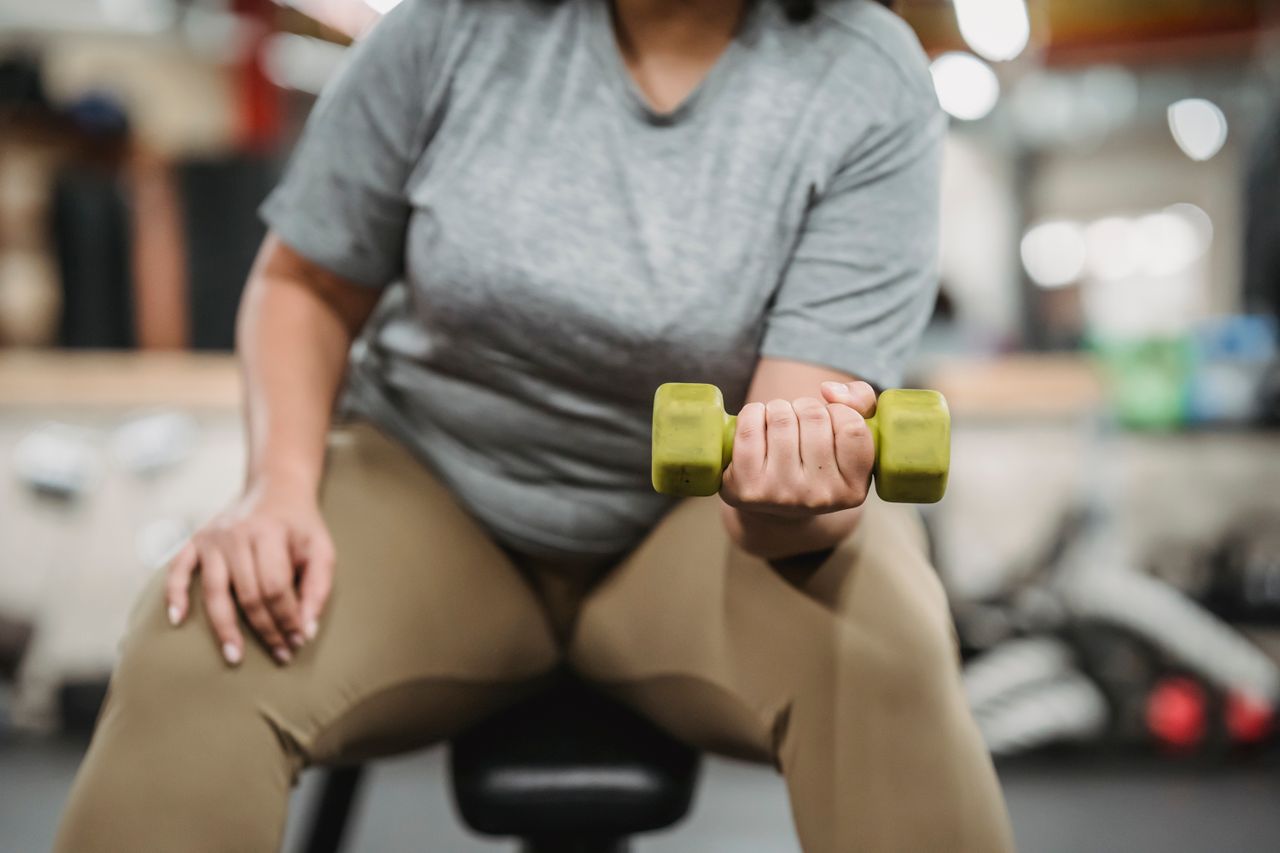
For women new to resistance training, the bar is lower than most people think. Bodyweight exercises, resistance bands, and light dumbbells all qualify. The key variable is progressive overload – gradually increasing the challenge to the muscle so it continues to adapt. A set of twelve bicep curls with a five-pound weight that could be done thirty times isn’t doing much. A set that genuinely challenges the muscle by the last few repetitions is doing the work. Sarcopenia – the progressive loss of muscle mass, strength, and function – leads to reduced physical performance, independence, and social participation, and resistance training is the most evidence-backed intervention available to slow and reverse it.
The other practical shift worth making is in the cardio itself. Continuous moderate-pace cardio does burn calories, but high-intensity interval training (HIIT) – alternating short bursts of harder effort with recovery periods – appears to be more efficient for metabolic outcomes, including insulin sensitivity and fat loss, in a shorter time window. For women with joint concerns or who are new to higher intensity work, the effort level can be scaled: the principle is the interval structure, not any particular speed or impact.
Read More: “Fit Grandma” Says Eating 150 Eggs a Month is Her Secret to Staying Healthy
What This Is Really About
The frame that keeps women over fifty stuck is the idea that weight management is fundamentally about calories in and calories out, and that the formula is the same at fifty-two as it was at twenty-eight. It isn’t. The arithmetic still matters – you can’t eat at a significant surplus and expect to maintain weight – but the dominant variable has shifted. Muscle mass is now the thing that governs the math.
What makes this particularly frustrating is that the advice most commonly given to women who are struggling – eat less, move more, stick with it – is not wrong exactly, but it is incomplete in a way that tends to send women in the wrong direction. Eating significantly less without addressing muscle loss makes the problem worse in the long run. Moving more with cardio alone doesn’t address the root cause.
The metabolism mistakes women over 50 keep making are usually not mistakes born of not trying hard enough. They’re the result of following instructions that were never calibrated for the body they’re living in now. Adjusting those instructions – more protein, more resistance training, more background movement, less aggressive calorie restriction – isn’t a dramatic overhaul. It’s a recalibration. And the body, it turns out, is more responsive to the right inputs than most women over fifty have been led to believe. The hard part isn’t the lifting or the protein or the ten extra minutes of walking after lunch. The hard part is unlearning a set of rules that felt like discipline for so long that questioning them feels like giving up. It isn’t. It’s the more rigorous move.
Disclaimer: This information is not intended to be a substitute for professional medical advice, diagnosis, or treatment and is for information only. Always seek the advice of your physician or another qualified health provider with any questions about your medical condition and/or current medication. Do not disregard professional medical advice or delay seeking advice or treatment because of something you have read here.
AI Disclaimer: This article was created with the assistance of AI tools and reviewed by a human editor.