

You get home from closing, the keys are in your hand, and the place is finally yours. Then the adrenaline wears off, and you realize you have to fill it. That is the moment the second wave of spending begins, and it is every bit as consequential as the mortgage you just signed.
The purchases people make in those first months of homeownership – the furniture, the appliances, the gadgets, the “statement pieces” – tend to follow a very recognizable pattern. There is the excitement of finally having space to fill, followed by the creeping awareness that some of what you bought was aspirational at best and a complete miscalculation at worst. A pool table in a basement you never use. A six-burner range for someone who orders pizza twice a week. A robot vacuum that costs $800 and still misses the corner by the couch every single time.
Home purchases regret is not rare. According to Bankrate’s 2025 Homeowner Regrets Survey, homeowners with regrets most commonly cite maintenance and hidden costs being more expensive than anticipated, at 42 percent. But beyond the house itself, the things people buy to populate it carry their own long trail of second-guessing. These are the 13 purchases that keep coming up, again and again, as the ones people wish they had thought longer about.
1. Oversized Furniture
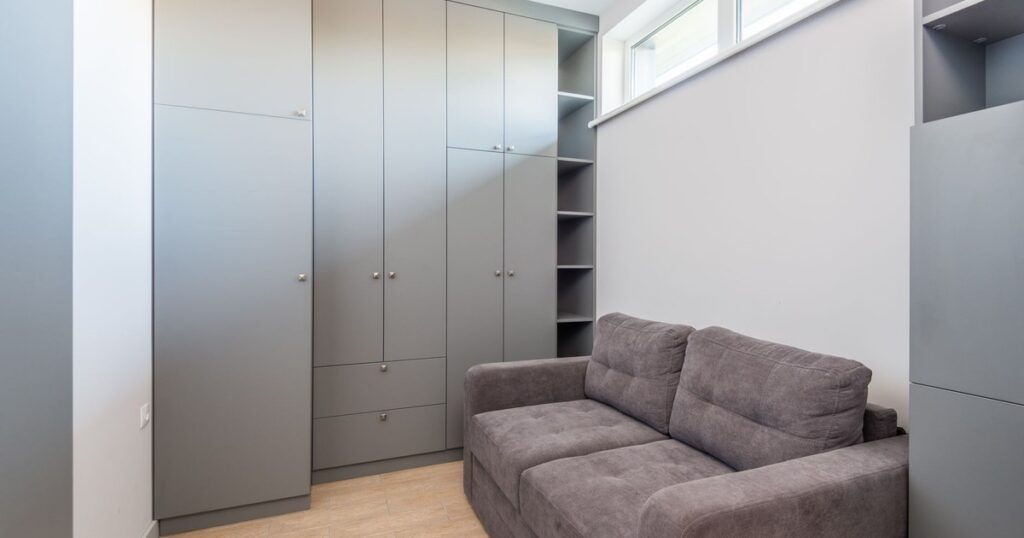
The sectional looked incredible in the showroom. The showroom, however, was approximately the size of an aircraft hangar, and your living room is not. This is the single most consistent furniture regret homeowners report: buying pieces scaled for a room that does not exist in their actual home.
“One of the most regrettable expenses for any homeowner is large and expensive furniture that doesn’t fit the home, whether it’s the physical dimensions or the overall design,” said Ryan Fitzgerald, owner of UpHomes. His advice: measure every room thoroughly and develop a clear design concept before making any large furniture purchases. That sounds obvious in hindsight. In the moment, standing in a furniture store with a new house and a vision board, it is remarkably easy to forget.
Large furniture is hard to return, hard to resell, and hard to ignore when it dominates your space in all the wrong ways. A couch that leaves eighteen inches of walking room is not just aesthetically frustrating – it changes how a room actually functions, every single day.
2. High-End Major Appliances
The pitch is compelling: professional-grade ranges, refrigerators with glass doors and built-in screens, dishwashers with so many cycles they come with a manual. Luxury appliances like refrigerators with glass doors and Wi-Fi connectivity can cost thousands of dollars, even five figures, but they mostly last the same decade or so as those that cost a fraction of the price.
“Many times, new homeowners, especially first-time homeowners, overindulge on appliances, only to realize they really didn’t need to spend that much on them,” according to Jason Gelios, author and real estate expert. The restaurant-style oven gets used for the same three recipes it always was. The smart refrigerator requires firmware updates. The ultra-quiet dishwasher is, technically, quieter – though perhaps not $1,400 quieter.
A bad impulse throw pillow can be donated. A $4,000 range sits in your kitchen for the next decade whether you love it or not.
3. Smart Home Technology That Doesn’t Deliver
The appeal of a fully connected home is real. Lights that respond to your voice, a thermostat that learns your schedule, a doorbell that lets you see who’s there from another state. But the gap between the marketing and the reality has grown wider, not narrower, as more of these products have reached the mainstream.
With home appliances becoming increasingly connected, customer satisfaction has actually dropped, according to the JD Power 2025 U.S. Appliance Satisfaction Study, with overall satisfaction falling 11 points to 699 out of 1,000 compared to 2024. “Increased connectivity often leads to increased confusion,” said Michael Taylor, senior managing director at JD Power, noting that younger generations expect a more intuitive user experience yet report more issues, and that customers with Wi-Fi-connected appliances encounter more problems overall.
A smart lock that glitches and won’t recognize your phone at 11 p.m. is not a convenience. A “smart” washing machine that requires an app to run a basic cycle is not progress.
4. King-Size Beds in the Wrong Room
A king-size bed represents a specific aspiration: space, luxury, finally sleeping like an adult. The problem is that a king-size bed is enormous, and most bedrooms are not built to absorb one gracefully. King-size beds can feel like an obvious upgrade when moving to a home with more square footage, but there are factors many buyers underestimate – specifically, how much space is actually needed once two nightstands and seating at the foot of the bed are factored in.
Interior designer DeNeatra Love-Jeffers has described visiting clients whose primary bedroom felt wrong without them being able to identify why, only to discover that the walkway around the king-size bed measured less than two feet on each side. The furniture was not wrong – the scale was wrong. The bedroom technically fit the bed. It just didn’t have room for anyone to live in it comfortably alongside it.
The fix is expensive and awkward: either sell the mattress, or live with a room that functions as storage for a bed. Measure before you buy. Then measure again.
5. Trendy Decor Tied to a Specific Moment
Every design cycle produces its signature aesthetic, and homeowners who lean fully into it tend to regret it within a few years. The gray-on-gray palette that felt clean and modern in 2019 looked cold and clinical by 2022. The shiplap that felt charming in 2021 was quietly exhausting by 2024. One of the most common regrets real estate professionals observe is spending money on the trendiest available look – Realtor Cappy Hagman of Coldwell Banker specifically cited color trends like gray as a prime example.
Trends move faster than renovation budgets do. Painting a room is manageable. Replacing tile, swapping out cabinetry hardware, or refinishing floors because the aesthetic no longer feels like you is a different category of project and expense entirely.
Professional organizer Lauren Saltman puts it directly: “Trendy items like decorative ladders, open shelving that isn’t practical, or statement pieces chosen mainly for how they look don’t hold up. They can quickly feel dated or end up becoming a surface for clutter rather than something that supports daily life.”
6. Single-Use Kitchen Gadgets
The waffle maker that comes out at Christmas. The pasta attachment that seemed life-changing until you realized making fresh pasta from scratch takes an hour and a half on a Tuesday. The mandoline that has drawn blood more times than it has produced a uniform slice. These are the purchases that accumulate quietly in kitchen cabinets until a move or a renovation forces a reckoning.
Professional organizers consistently flag single-use kitchen appliances as a top regret category, recommending that buyers only purchase appliances they realistically expect to reach for at least once a day or once a week. That is a useful test to run before buying anything. Not “will I theoretically use this” but “when, specifically, in a typical week, will I use this, and how much effort will it take to get it out and clean it afterward?”
The answer to that question, for a spiralizer or a dedicated rice cooker or a fondue set, is often much more honest than the version you told yourself standing in Williams Sonoma. They sell the version where you host parties and everyone is delighted. They do not sell the version where it sits in a cabinet for two years and then goes to Goodwill in a box with the waffle iron.
7. Oversized Pool Tables and Game Room Equipment
Moving into a house with a basement or a bonus room is its own category of purchase temptation. Finally, space. And with that space comes a specific fantasy: the pool table, the ping pong table, the foosball table, the full home arcade. These things are heavy, difficult to move, and sized for rooms that are considerably larger than most American bonus rooms.
The more persistent problem is that the lifestyle the equipment requires – regularly playing pool, having friends over for table tennis on a weeknight – does not always materialize just because the equipment is there. Game room equipment tends to be aspirational in a way that kitchen gadgets are not. Nobody fantasizes about using their spiralizer at 8 p.m. on a Friday. People do, genuinely, fantasize about having a pool table, and then they buy one, and then they realize that setting it up, leveling it, maintaining the felt, and actually having enough clearance on all four sides to take a proper shot is a project unto itself.
A full-size pool table weighs between 700 and 1,000 pounds. These items often stay in the basement of the house they were bought for, sold at a steep loss when the owner moves.
8. Cloud Sofas and Trend-Driven Statement Pieces
The cloud sofa had its moment. Deep, pillow-laden, impossibly soft-looking in every lifestyle photo – it sold a particular vision of home life that was hard to resist. Cloud sofas are among the most commonly cited decor regrets, primarily because the cushions sink and compress within a year or two, fundamentally changing the piece. What starts as an enveloping, luxurious sit becomes a piece you have to actively climb out of while making undignified sounds.
The broader lesson here applies to any large purchase anchored to a trend rather than a genuine long-term preference. Statement sofas, bold accent chairs, dramatic light fixtures chosen because they appeared in every design account you followed for six months – these are the pieces that tend not to survive the next design cycle with their charm intact. A piece you chose because you actually love it will still feel like yours in five years. A piece you chose because everyone on social media had it will feel like a costume by then.
9. Cheap Outdoor Furniture That Won’t Last
Outdoor furniture sits in a particular sweet spot of regret: too expensive to be disposable, not expensive enough to be durable. The mid-range patio set that looks promising in the store photograph tends to rust, fade, or collapse after a single season of actual weather. Umbrellas that advertise UV resistance lose their color by June. Cushions that seemed thick and comfortable absorb moisture and develop mildew by September.
The temptation to go cheap on outdoor furniture is understandable – it lives outside, after all – but the math rarely works. Three consecutive years of buying and replacing a $300 set costs more than one $700 set that was built for actual outdoor conditions. The homeowners who regret their outdoor furniture purchases most consistently are the ones who bought for the photo op and not for the forecast.
10. Excessive Storage Solutions That Create More Clutter
The irony of storage purchases is that buying more of them tends to produce more clutter, not less. The organizational industry is extraordinarily good at making solutions look like the answer to a problem, when often the actual answer is owning fewer things. Trendy storage items like ladder shelves are consistently cited by professional organizers as purchases that prioritize style over actual function.
The bins, the drawer inserts, the matching basket sets, the acrylic organizers that require everything inside them to be decanted into smaller matching containers – these things create the aesthetic of organization without necessarily creating organization itself. Many homeowners report spending significant money on storage systems that they reorganize several times, eventually abandon, and ultimately replace with a different storage system that has the same fundamental problem: there is simply too much stuff.
11. Elaborate Home Security Systems With Ongoing Fees
A home security system is a reasonable purchase. An elaborate layered system with professional monitoring, multiple cameras, smart sensors on every door and window, and a subscription fee that renews annually is a purchase that merits more scrutiny. The regret tends to arrive not at the point of purchase but six months in, when the monthly fee has become a line item in the budget and the system has sent seventeen false alerts about the cat.
The monitoring subscription model has become standard across the security industry, which means the upfront cost of the hardware is often artificially low while the total cost of ownership, spread across years of monitoring fees, is considerably higher. Homeowners who purchase elaborate systems without fully accounting for the recurring costs find themselves in a subscription they feel unable to cancel because canceling it feels like lowering their guard.
12. Hot Tubs
Hot tubs occupy a specific category of home purchase regret: the aspirational item that requires significantly more maintenance than anyone mentioned during the sale. The pitch is relaxation. The reality is water chemistry, filter cleaning, cover replacement, winterization, and electricity bills that go up appreciably the moment the heater starts running year-round.
Heating and operating a hot tub can add anywhere from $50 to $100 to a monthly electricity bill depending on the model and climate, and that is before factoring in the cost of chemicals, annual service, and the occasional repair. For households that use the hot tub regularly, the math might still work out. For the households that use it enthusiastically for the first three months and then watch it sit, it becomes one of the more expensive regrets in the backyard.
13. Built-In Features They Didn’t Actually Need
This one belongs to the home purchase itself: the features that seemed like luxuries – the wet bar in the dining room, the intercom system installed in 2003, the Jacuzzi tub in the primary bath – that homeowners have paid for in the purchase price and now pay for again in maintenance, utility costs, and the eventual cost of removing them. Nobody uses the intercom. The wet bar has become a homework station. The Jacuzzi tub has been used twice and is currently storing towels.
Built-in features that don’t match how a household actually lives are a specific type of home purchases regret because they are expensive to undo and impossible to ignore. They are not items you can donate or sell. They are fixed to the walls, plumbed into the floor, wired into the electrical panel. Learning to love them is one option. So is paying to have them removed. Neither one is particularly satisfying.
What This Is Really About
Most of the regrets on this list are not about stupidity. They are about the gap between the life you were buying for and the life you were actually living. The pool table belongs to the version of you who hosts people on weeknights. The cloud sofa belongs to the version of you who has time to sink into it on a Sunday afternoon without worrying about getting back up. The six-burner range belongs to the version of you who wanted to learn to cook properly, someday.
None of those people are wrong to want those things. The regret arrives when the purchase precedes the reality, when you buy for the aspiration and find the habit never follows. The most durable home purchases tend to be the ones grounded in how the space is actually used at 7 p.m. on a Tuesday – not in how it looks in a photo, not in how it made you feel standing in the showroom, but in the ordinary daily life that is happening there regardless of what you bought to furnish it. That is a harder thing to shop for. It turns out to be the only thing worth buying.
Disclaimer: This information is not intended to be a substitute for professional medical advice, diagnosis, or treatment and is for information only. Always seek the advice of your physician or another qualified health provider with any questions about your medical condition and/or current medication. Do not disregard professional medical advice or delay seeking advice or treatment because of something you have read here.
AI Disclaimer: This article was created with the assistance of AI tools and reviewed by a human editor.