

There is a brainteaser, which claims to be a ‘Harvard University’ puzzle, doing the rounds on social media. The image that keeps circulating online shows the Harvard crest, the words “Harvard University Interview,” and a bold line: “90% were eliminated.” Under that, the puzzle appears in simple handwriting: “7 men have 7 wives. Each man and each wife have 7 children. Q: What’s the total number of people?” It looks simple at first glance, which is why people rush to answer and then argue in the comments. A short sentence with a few sevens seems harmless, yet one or two hidden assumptions change everything. This riddle is less about heavy math and more about how carefully you read a sentence when numbers are involved. Before we touch any calculations, it helps to clear up where this puzzle comes from and why the source is not as impressive as the image implies.
Did This Question Truly Come From Harvard
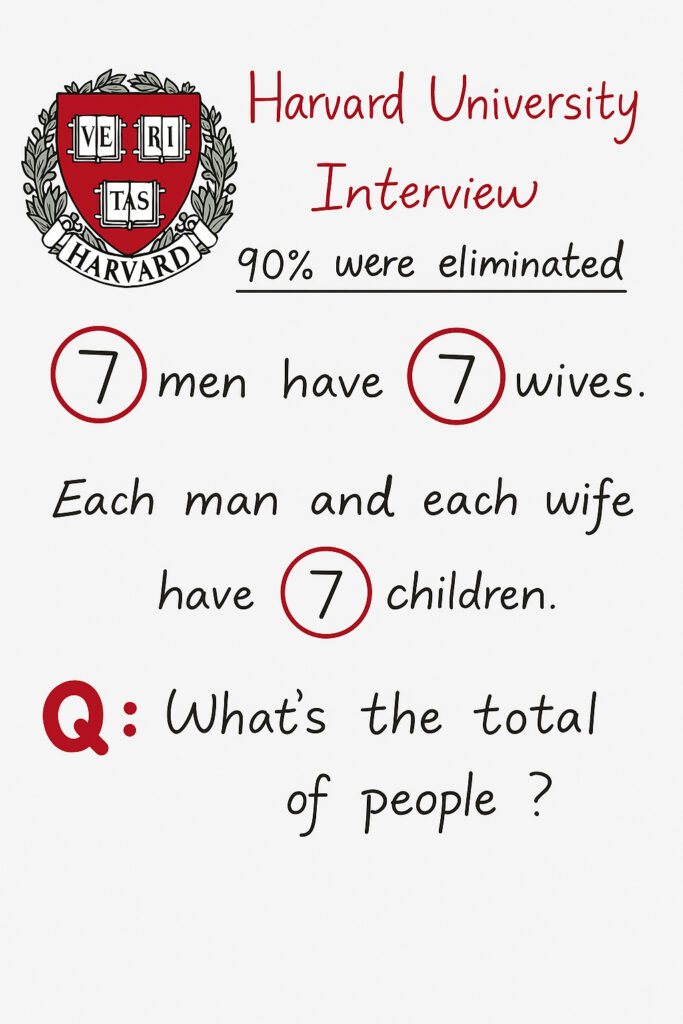
Many posts claim that this puzzle was used in a Harvard interview and that 90% of applicants failed it. There is no reliable record from the university to support that story. No official admissions material, no documented interview script, and no traceable statement from staff. The “Harvard” label mostly works as a marketing trick that makes the question feel more intimidating. People see the crest and assume the problem must test some advanced logic that only future professors can solve. In reality, this is the kind of puzzle that spreads on social media, gets dressed up with a famous name, and then travels without any verification. So when you look at it, it helps to treat it as a fun reasoning exercise, not as documented evidence of how an elite university screens applicants. The origin story may be shaky, but the question itself still does a good job at exposing how fast people jump to conclusions.
Reading The Question Carefully
The full text we need to analyze is short: “7 men have 7 wives. Each man and each wife have 7 children. What’s the total number of people?” Every word in those two sentences has a job. The first sentence tells us how many adults we are dealing with, and the second sentence tells us how many children belong to them. The trap usually starts with the first sentence, because people see two sevens and immediately think “7 men, each with 7 wives.” That is not what is written. If a question wanted you to read it that way, it would say “7 men each have 7 wives.” Instead, “7 men have 7 wives” most naturally describes a group of 7 men who are partnered with a group of 7 wives, giving 7 couples in total. Keeping that interpretation in mind is important before we discuss the mentioned children.
First Interpretation: Seven Men, Seven Wives

This puzzle is definitely confusing, but let’s break it down into a few possible solutions. Take the plain reading: 7 men, 7 wives, one wife per man. That gives us 14 adults in total. At this stage, nothing tricky is happening yet. Many word problems start by setting up the number of adult people and then move on to children, pets, or objects they own. The first sentence might feel too obvious, which encourages people to look for secret meanings that are not there. Of course, another interpretation is possible, and we will visit it later, but if you read the line with ordinary conversational English, 7 men with 7 wives means 7 pairs. So we park that number of adults for now: 14. The real confusion begins when we move to the second sentence that involves children.
What Does “Each Man And Each Wife Have 7 Children” Mean
Here is the next line: “Each man and each wife have 7 children.” There are two main ways people read this. The first way, which matches how families work, is that each couple has 7 children together. The second, more complicated way, is that each adult has 7 children counted separately, which would double the number of kids. Language here matters. In daily speech, when someone says “each mother and father have three children,” they almost always mean they share those three children. The kids are not counted twice, once under the father and once under the mother. The sentence in the puzzle functions in the same rhythm. It lists both parents, then assigns a shared number of children to them. Still, because riddles encourage suspicion, many people wonder whether the puzzle writer intended a more tangled interpretation.
Why Many People Get Lost In The Math

Image credit: Pexels
Once people become suspicious, they start stacking sevens everywhere. A reader who thinks the puzzle hides deeper complexity might say, “Maybe 7 men each have 7 wives, and each of those wives with that man has 7 children, and maybe every mention of a parent means a separate batch of kids.” Within a few seconds the numbers explode, and you end up with huge totals that feel impressive but ignore normal language habits. Social media comments often contain wrong answers because people multiply every number they see without checking whether it describes new people or the same people from a different angle. Others fail in a different way and forget to include the adults in the final count, focusing only on the children because the arithmetic distracts them. The puzzle quietly checks whether you can slow your thoughts down, decide what each sentence truly signals, and then count without inventing new information.
Scenario One: Treating Every Parent As Having Separate Children
Let us still walk through the “separate children” interpretation, because understanding why it inflates the numbers will clarify the correct reasoning later. If someone insists that “each man and each wife have 7 children” means each adult has their own set of 7 kids, we start by recalling that we have 7 men and 7 wives, for 14 adults. Under this interpretation, every one of those 14 adults gets assigned 7 distinct children. That means we would calculate 14 multiplied by 7. Step by step, 10 times 7 equals 70, and 4 times 7 equals 28, so 70 plus 28 equals 98 children. Then we add the adults: 98 children plus 14 adults equals 112 people. This answer looks neat and uses every number just once, so some people feel confident with it. The problem is that it does not match normal family language. A child belongs to two parents at the same time. Listing both parents in a sentence does not magically double the family size.
Scenario Two: Misreading The Wives
Another popular wrong path begins even earlier, at the first sentence. Some readers decide that “7 men have 7 wives” secretly means each man has 7 wives. In that case, you would have 7 men, but instead of 7 wives total, you have 7 groups of 7 wives. So you calculate 7 multiplied by 7 to get the number of wives. Step by step, 7 times 7 equals 49. Then total adults would be 7 men plus 49 wives, for 56 adults. If you pair each man with all 7 of his wives and assign 7 children to every pair, the math becomes wild. There are 49 distinct man-wife pairs. For each pair, there are 7 children. So 49 multiplied by 7 equals 343 children. Add the 56 adults and the total would be 399 people. This number looks dramatic and matches the feeling that a so-called Harvard puzzle should be extremely hard. Yet nothing in the sentence clearly signals that each man has multiple wives, so this reading stretches the language beyond how people usually talk.
Scenario Three: Seven Couples With Shared Children
Now return to the most natural reading. We treat “7 men have 7 wives” as describing 7 couples. That is 7 men plus 7 wives, giving 14 adults. Then “each man and each wife have 7 children” describes what each couple shares. There are 7 couples, and each couple has 7 children. So to find the number of children, we multiply 7 couples by 7 children per couple. Step by step, 7 multiplied by 7 equals 49. Under this interpretation, there are 49 children in total. At this stage we still will not state the final answer, but we can already see that our kid count is much lower than in the earlier exaggerated scenarios. This version reflects how families are usually described and keeps the story grounded in everyday speech instead of treating every mention of a parent as a separate household.
So What Is The Correct Total

With the interpretation in place, we can now count everyone. We already have 14 adults, made up of 7 men and 7 wives. We also have 49 children, shared among those couples. To get the total number of people, we add the adults and the children together. First, add 10 and 4 to keep the adults clear: 10 plus 4 equals 14. Then add the children: 49 plus 14. Break it into steps: 40 plus 10 equals 50, and 9 plus 4 equals 13, so 50 plus 13 equals 63. Under the straightforward reading of the sentences, there are 63 people in this family group. That is the answer most language-aware solvers consider correct. It does not rely on unusual family structures or double-counting kids.
Read More: 20 Head-Scratching Riddles You and The Kids Will Love
Why This Puzzle Sticks In People’s Heads
Why this riddle stays in peoples heads has less to do with the answer and more to do with how strongly people hold on to their first reading, because once someone lands on 112, 399, or another big total, they usually spend their energy defending that number instead of going back to the exact wording of the question. The Harvard label makes that even stickier, because nobody wants to admit they misread a line that teenagers are supposedly solving with ease. The riddle does not test rare talent, it shows how quickly a simple sentence with repeated numbers can push people into rushed thinking as soon as it feels like a challenge. When you slow it down and read each line on its own, you naturally start to ask what each number stands for and whether you have counted anyone twice. That effort strips the argument out of the room and leaves one answer that actually matches the story, and whether or not anyone at Harvard ever used this riddle, it still rewards patient reading more than quick guessing.
Brain teasers feel fun even when you despise math because they frame numbers as a story instead of a test, so you can play with ideas without worrying about grades. You often meet them with friends or family, so they feel social and low stakes rather than stressful. The best ones reward careful reading and patience more than raw speed, so someone who loves words can do just as well as someone who loves equations.
They hand you a challenge, you sit with it for a minute, and then you get that sudden sense of understanding that says the effort was worth it. They also give you a safe way to argue and defend an answer, then share a laugh when the logic lands.
One Final Challenge

Here is one more math riddle you can try and share with your friends. Three cats catch three mice in three minutes. If every cat works at the same speed, how many cats do you need to catch one hundred mice in one hundred minutes. Take a moment to think about the question and the solution before you decide. Ready for the answer? You still only need three cats, because the rate never changes, so three cats handle that job in that time. When you first hear it, you might feel tempted to match the bigger number of mice with a bigger team of cats, so your mind jumps straight to scaling everything up. That jump makes sense because many word problems teach you to pair every new target with more helpers. In this riddle, the key sits in how fast the group already works, since three cats together catch three mice in three minutes, which tells you they handle three mice every three minutes as a team.
So if you stretch the time from three minutes to one hundred minutes, you can ask how many three minute chunks fit inside that span, and you find that the group has more than enough time to repeat their normal work again and again. The same three cats keep catching sets of three mice at that steady rhythm, so by the time one hundred minutes pass, they reach one hundred mice without any extra cats. Once you see it laid out like that, you stop asking how many cats you need and start asking how far a constant pace carries the same group when you give them more time. We hoped you enjoyed these fun little brain teasers!
Disclaimer: This article was written by the author with the assistance of AI and reviewed by an editor for accuracy and clarity.
Read More: Pick the Longest Line: See What It Reveals About Your Personality