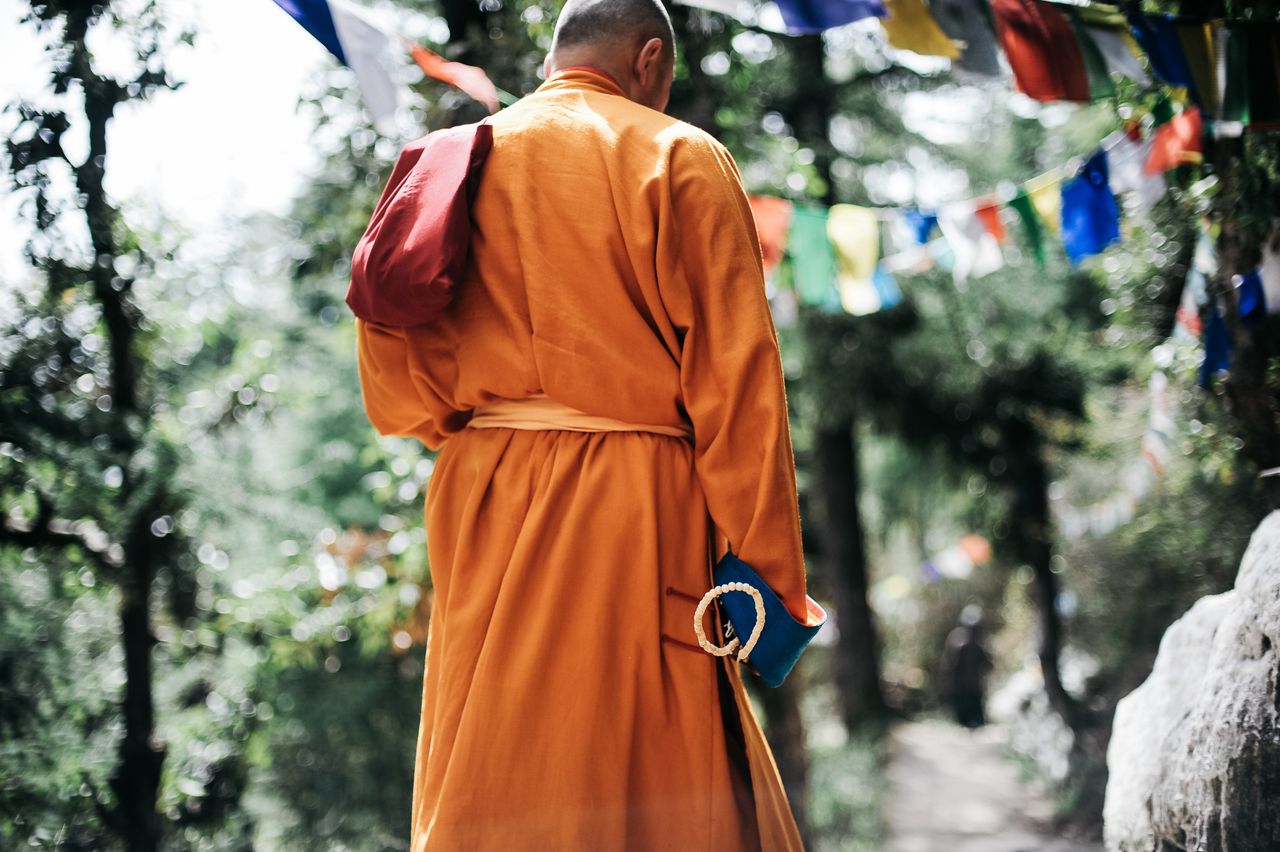

Most people, when asked what happiness looks like, describe something they’re waiting for. A promotion, a relationship, a version of life with fewer problems. Matthieu Ricard describes it differently. For Ricard, happiness is not a destination or an outcome – it is a skill, one that can be trained with the same deliberate effort a musician applies to an instrument, or an athlete to a physical discipline. The distinction sounds simple. The implications, verified by two decades of rigorous neuroscience, are far more radical than they first appear.
Ricard is a French-born Buddhist monk born on February 15, 1946, who received a PhD in molecular genetics from the Pasteur Institute in 1972 before deciding to forsake his scientific career and instead practice Tibetan Buddhism, living mainly in the Himalayas. For most people, that would be biographical background. For Ricard, it is the foundation of everything that followed – a man uniquely positioned to speak about happiness not as a belief system, but as something testable, observable, and teachable.
The label that attached itself to him – the happiest person alive – arrived not from a self-help book or a motivational circuit, but from a laboratory. Neuroscientists at the University of Wisconsin scanned his brain during meditation and found the highest capacity for happiness ever recorded. The headline spread worldwide, and has never entirely lost its grip on the public imagination. Ricard himself has called it an absurdity – a point worth understanding, because his objection to the label is itself one of the most instructive things he has ever said about happiness.
The Science Behind the Claim
256 Sensors and an Extraordinary Brain
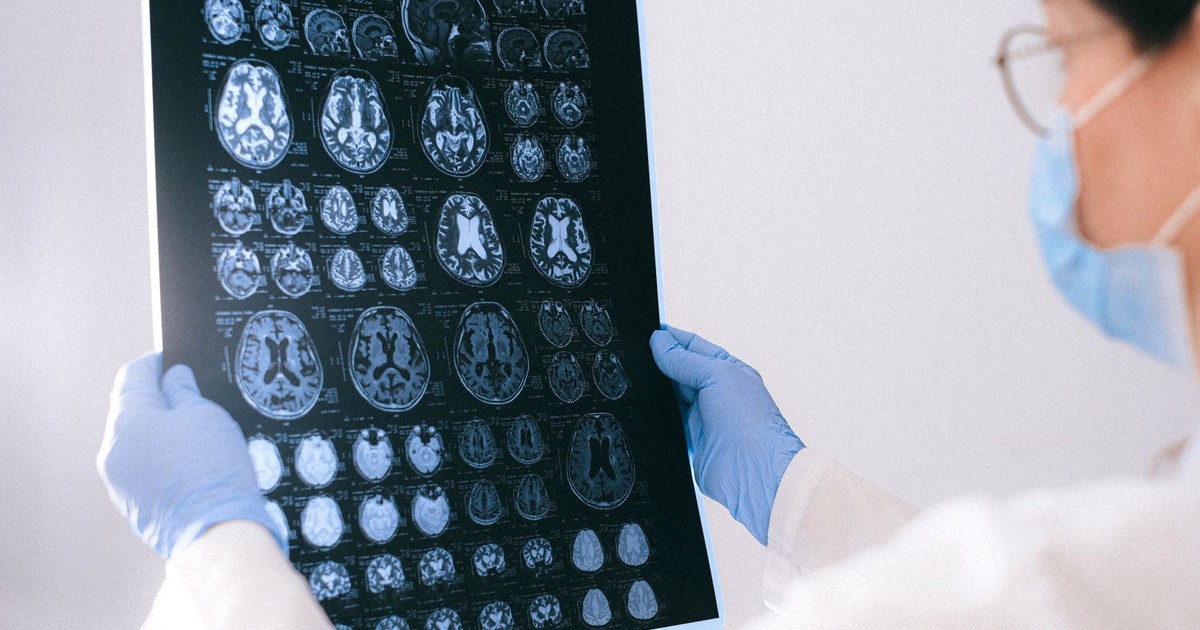
Ricard resides at Shechen Tennyi Dargyeling Monastery in Nepal, and it was from that contemplative world that he was brought into a very different kind of room. Professor Richard Davidson, a neuroscientist, wired up Ricard’s skull with 256 sensors at the University of Wisconsin-Madison as part of research on hundreds of advanced practitioners of meditation. The experiment was not designed to crown a winner. It was part of a sustained program of inquiry into whether decades of contemplative practice could measurably alter brain function. Ricard was one of many monks who volunteered as subjects, and his results stood apart from everyone else’s.
The scans showed that when meditating on compassion, Ricard’s brain produces a level of gamma waves – those linked to consciousness, attention, learning and memory – “never reported before in the neuroscience literature,” Davidson said. He also demonstrated excessive activity in his brain’s left prefrontal cortex compared to its right counterpart, giving him an abnormally large capacity for happiness and a reduced propensity towards negativity.
To appreciate what that means in practical terms: the left prefrontal cortex is the region of the brain most consistently associated with positive emotional states, approach motivation, and resilience. The ratio between left and right prefrontal activity is one of the most studied markers in affective neuroscience. Ricard’s ratio was, in Davidson’s words, off the charts. Not slightly elevated. Off the charts.
A 12-Year Program of Research
The study of Ricard was not a one-off brain scan. Davidson explained that his team had been “looking for 12 years at the effect of short and long-term mind-training through meditation on attention, on compassion, on emotional balance,” finding remarkable results with long-term practitioners who had done 50,000 rounds of meditation, but also with participants who practiced for just three weeks of 20 minutes a day.
Ricard is a longtime participant in an ongoing research study led by Richard J. Davidson that monitors brain waves during various forms of meditation, including compassion meditation. Davidson is director of the Waisman Lab for Brain Imaging and Behavior at the University of Wisconsin-Madison. The research extended well beyond a single subject. The study was part of the researchers’ ongoing investigations with a group of Tibetan monks and lay practitioners who had practiced meditation for a minimum of 10,000 hours, including 16 monks who had cultivated compassion meditation practices.
What Davidson’s lab demonstrated, across this body of work, is a concept now central to modern neuroscience: neuroplasticity (the brain’s capacity to reorganize itself in response to sustained experience). The brain does not simply receive happiness or fail to receive it. It can be trained toward it. Well-being is a skill, Davidson has concluded, and all of the research his colleagues and he have been doing leads to this central finding. Well-being is fundamentally no different from learning to play the cello. If one practices the skills of well-being, one will get better at it.
Davidson’s newest book, Born to Flourish, co-authored with Cortland Dahl, was released in March 2026, bringing this research to a new generation of readers and extending the conversation Ricard helped initiate.
Ricard’s Own Objection to the Title
Here is where it gets genuinely interesting: Ricard was a volunteer subject in the study performed at the University of Wisconsin-Madison on happiness, scoring significantly above the average of hundreds of volunteers. Ricard, however, has called the label “absurd” and untrue.
His objection is not false modesty. The study was more about compassion, which is of course linked with flourishing, Ricard has said, adding: “Anyone who can think for five seconds can immediately see that there’s no way we can know the level of happiness of 8 billion human beings.” He tried, by his own account, to issue disclaimers that nobody listened to. A Tibetan friend eventually told him to simply accept the label and use it for a good purpose. That is, essentially, what he has done – leveraging a headline that oversimplifies his work to point people toward ideas that are more substantive and more useful than the headline itself.
What Ricard Actually Teaches About Happiness
Happiness Is Not Pleasure
The single most important distinction in Ricard’s teaching is one that Western culture systematically ignores. Real happiness, which he calls “eudemonia” (an ancient Greek term), comes from ridding yourself of sources of suffering – hatred, pride, jealousy, and so on. This kind of wellbeing is “a sort of bonus” that comes from compassion, benevolence, and altruism – and it is lasting and stable.
This is not a retreat from the world or a suppression of feeling. It is a reorientation of where you are looking. The happiness that Ricard describes is not the hedonic kind – the spike of pleasure from a good meal, a compliment, a new purchase – which is real but transient. It is a more durable state of clarity and openness that he argues is inseparable from caring about the welfare of others.
Happiness cannot be reduced to a few agreeable sensations. Rather, it is a way of being and of experiencing the world, a profound fulfillment that suffuses every moment and endures despite inevitable setbacks. The paths people take in search of happiness often lead to frustration and suffering instead, because they try to create outer conditions they believe will make them happy.
The outer conditions change. The internal orientation, if trained correctly, does not.
Compassion as a Practical Route, Not a Moral Obligation
Ricard makes a deliberate point of framing compassion and altruism not as religious duties but as the most pragmatic routes to personal happiness available. The monk, molecular geneticist and confidant of the 14th Dalai Lama, argues passionately that meditation can alter the brain and improve people’s happiness in the same way that lifting weights puts on muscle.
His secret to happiness is putting other people first. “I don’t know if it’s surprising or paradoxical but the best thing people can do to be happy is to do something for others,” he has said. The reasoning behind this is not spiritual intuition. It is the observation – reinforced by research – that a life organized entirely around one’s own needs and comfort produces anxiety, defensiveness, and a constant sense of threat. The self becomes the entire horizon, and the horizon keeps closing in.
Acting with other people’s welfare in mind can transform individuals one by one until society reaches what Ricard calls an “altruistic revolution.” He defines altruism simply as “the wish that other people may be happy,” citing research showing that people who give are significantly happier.
Meditation as Mind Training
Ricard is precise about what meditation is and what it is not. As he has put it: “It’s a wonderful area of research because it shows that meditation is not just blissing out under a mango tree, but it completely changes your brain and therefore changes what you are.”
The training analogy is central to everything he says on the topic. Meditating is like lifting weights or exercising for the mind, Ricard has said. Anyone can be happy by simply training their brain. The word “simply” is doing a lot of work in that sentence – the training is not effortless, and Ricard has never claimed it is. But the point is that the capacity for happiness is not fixed at birth, not determined by circumstance, and not the exclusive province of monks who have spent decades in Himalayan retreats.
Researchers found that long-term practitioners – those who have engaged in more than 50,000 rounds of meditation – showed significant changes in their brain function, but those with only three weeks of 20-minute daily meditation also demonstrated measurable change. Three weeks. Twenty minutes a day. The door into this practice is not as narrow as the popular imagination of monastic life suggests.
Anger, Emotion, and the Architecture of Suffering
One of the more counterintuitive things Ricard teaches concerns negative emotions – specifically, the relationship between identifying with an emotion and prolonging it. Anger can fill the mental landscape and project its distorted reality on people and events. When a person is overwhelmed by anger, they cannot dissociate from it, perpetuating a vicious circle by rekindling the emotion each time they encounter the person or memory associated with it. They become addicted to the cause of their own suffering.
The meditative response to this is not suppression. It is observation. Ricard teaches a practice of watching strong emotions with what he calls “pure mindfulness,” noticing them without being absorbed into them. The emotion arises, is seen clearly, and loses its grip because it is no longer identified as the self. This is the internal architecture of the happiness Ricard describes – not the absence of difficult emotions, but the absence of imprisonment by them.
The Life Behind the Teaching
From Paris to the Himalayas
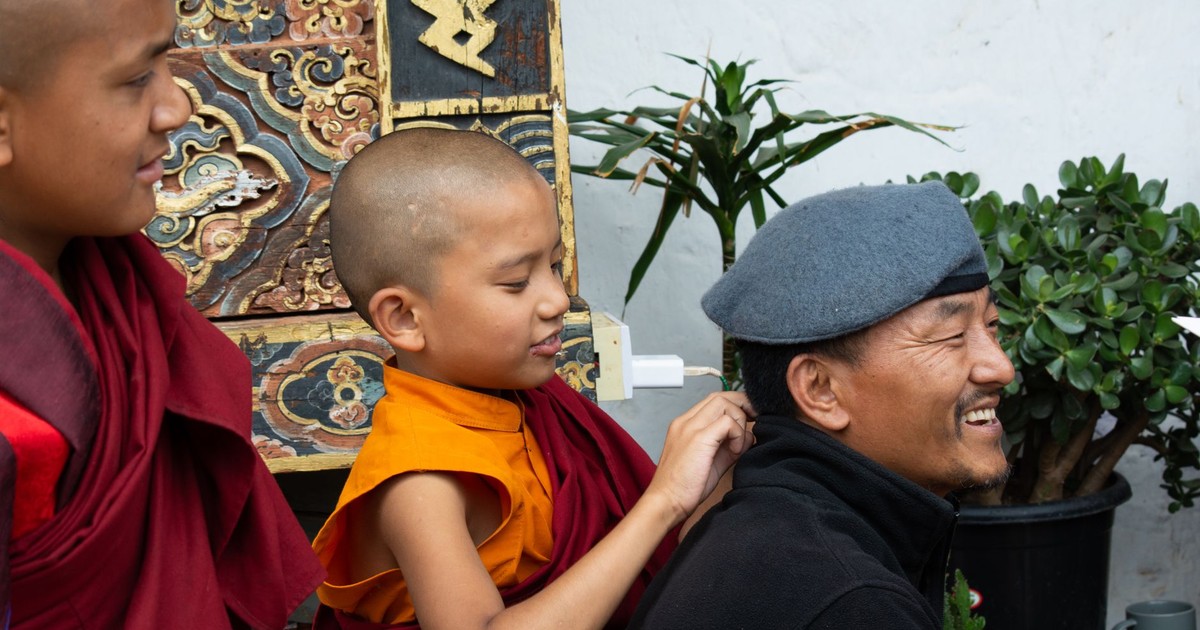
Few modern figures have bridged East and West with the clarity and authority of Matthieu Ricard. Trained as a molecular geneticist before renouncing academic life to become a Buddhist monk in the Tibetan Vajrayana tradition, Ricard’s journey reflects a rare convergence of scientific inquiry, contemplative discipline, and ethical commitment. Over more than five decades of monastic life, he has emerged as one of the world’s most respected voices on meditation, happiness, and altruism.
Since 1989, he has served as the French interpreter for the 14th Dalai Lama. That role places him at the precise intersection of Tibetan Buddhist scholarship and Western intellectual life – a position that has informed every book he has written and every conversation he has had with scientists, philosophers, and policymakers.
He has become an international bestselling author and prominent speaker on the world stage, appearing at the World Economic Forum in Davos, the United Nations, and at TED, where his talks on happiness and altruism have been viewed by over six million people.
Karuna-Shechen: Altruism in Practice
Whatever abstract merit Ricard’s teachings on altruism might carry, his life offers an unambiguous demonstration of them. In 1997, Ricard chose to use all the royalties from his first book, The Monk and the Philosopher, to undertake humanitarian projects. Living among the Himalayan populations, he and some friends and philanthropists felt the need to address the inequalities and suffering they observed in the region – and, inspired by Buddhist teachings and secular ethics, the Karuna-Shechen organization was born.
Founded by Ricard in 2000, Karuna-Shechen acts and advocates for a more altruistic world, contributing to breaking the cycle of intense poverty and developing the full potential of vulnerable populations. The organization works primarily in India, Nepal, and Tibet through a community-driven approach interconnecting health and hygiene, education, food security, economic development, and environmental preservation.
The scale of that work has grown considerably since the early days of a school and a clinic in eastern Tibet. In 2024 alone, Karuna-Shechen collaborated with more than 474,000 individuals and cared for 7,870 animals through a range of interconnected programs addressing community needs in a holistic way. The organization’s 2024 Annual Report marks its 24th year of continuous operations – a record that speaks not to institutional momentum but to the sustained commitment of its founder.
A Body of Written Work
Ricard’s teachings on happiness are not confined to lectures or brain scanning sessions. In Happiness: A Guide to Developing Life’s Most Important Skill, he argues that although people are materially better off than ever before, surveys show they are depressed and listless – and that happiness is not just an emotion, but a skill that can be developed.
His body of work includes The Monk and the Philosopher (with his father, Jean-François Revel), The Quantum and the Lotus (with Trinh Thuan), Happiness, The Art of Meditation, Altruism: The Power of Compassion, A Plea for the Animals, and Beyond the Self: Conversations between Buddhism and Neuroscience (with Wolf Singer). The breadth of that list reflects what makes Ricard genuinely unusual: he is not a popular interpreter of someone else’s ideas. He is a primary source, a research participant, a co-author of peer-reviewed work, and a practicing monk – simultaneously.
What the Research Means Beyond Ricard

The significance of Davidson’s work with Ricard and other meditators extends well beyond one man’s remarkable brain scans. What the University of Wisconsin research established – and what Davidson has spent the subsequent decades expanding upon – is that the neural circuits associated with positive emotional states are trainable. Well-being has four constituents that have each received serious scientific attention, all of them rooted in neural circuits that exhibit plasticity. Practicing these skills can provide the substrate for enduring change, supporting higher levels of well-being in daily life.
The practical takeaway from this body of work is not that anyone should abandon their career and move to Nepal. It is that the qualities Ricard has cultivated – attentional stability, emotional resilience, compassion, a reduced propensity toward rumination – are not personality traits you either have or don’t have. They are, in Davidson’s framework and Ricard’s own, capacities that respond to training. Evidence in both child and adult samples suggests that such training can impact experience, behavior, brain, and body, lending support to the idea of treating happiness itself as a skill that can be enhanced through systematic practice.
The training does not require 50,000 rounds of meditation. It does require consistency, intention, and the willingness to treat the mind as something worth attending to – which, Ricard would argue, is the most underinvested decision most people will ever make.
What the Label Never Captured
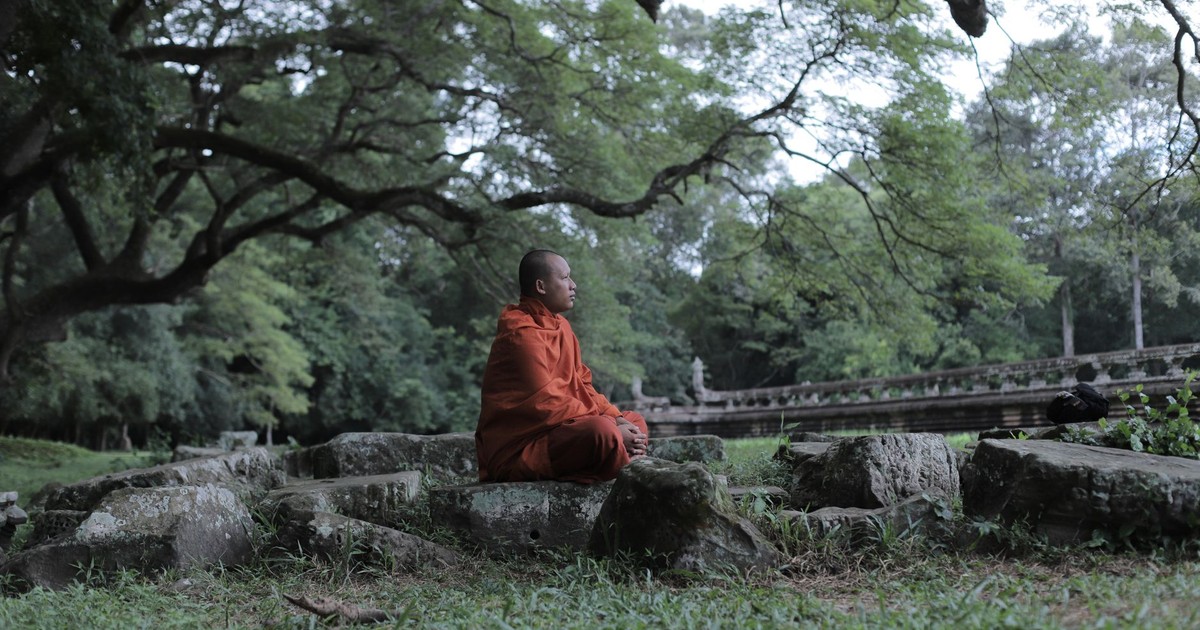
The story of the happiest person alive has traveled around the world many times, often reduced to its most clickable form: a French monk in burgundy robes, a brain full of gamma waves, a label that scientists applied and Ricard spent years trying to disclaim. The fuller picture is harder to carry in a headline but substantially more useful.
Ricard’s core argument is not that happiness is achievable through enlightenment or renunciation or any condition unavailable to ordinary people. It is that happiness has been consistently sought in the wrong places – in external circumstances, in the absence of suffering, in the accumulation of favorable conditions – and that the science now confirms what Buddhist practice has held for centuries: the mind can be trained toward wellbeing with the same rigor applied to any other human capacity. Not overnight. Not without effort. But reliably, measurably, and regardless of the starting point.
The gamma waves were a remarkable finding. But the finding that follows from them – that three weeks of 20 minutes of daily meditation can produce detectable changes in brain function in ordinary participants who have never sat in a monastery – is the one that actually belongs to everyone. Ricard has said, in one form or another, throughout his career, that anyone can be the happiest person alive if they look for happiness in the right place. The science, as it turns out, agrees with him.
What the label “happiest person alive” has always obscured is the thing Ricard most wants people to understand: that the happiness he embodies is not a fixed trait, not a reward for 50 years of monastic discipline, and not something confined to people who have renounced the ordinary world. It is a direction. One you can start moving in today, for 20 minutes, with nothing but a willingness to pay attention to what is already happening in your own mind. The monastery is not the point. The training is the point. And the training, as it happens, is available to everyone.
Read More: Scientists Studying Brain Waves Discover One Activity That Boosts Health in Just 2 Minutes
Disclaimer: This information is not intended to be a substitute for professional medical advice, diagnosis, or treatment and is for information only. Always seek the advice of your physician or another qualified health provider with any questions about your medical condition and/or current medication. Do not disregard professional medical advice or delay seeking advice or treatment because of something you have read here.
AI Disclaimer: This article was created with the assistance of AI tools and reviewed by a human editor.