
Speed limit signs are supposed to be the most boring objects on the road. A white rectangle, a black number, and the vague threat of a fine you’re probably not going to get. You’ve driven past thousands of them without registering a single one. That’s not distraction, exactly – it’s just what your brain does when it decides a road is familiar enough to handle on its own. The sign is there. Your eyes technically sweep past it. But nothing about a round number in a familiar font on a familiar pole sends any signal worth processing. Your brain files it under “already know this” and moves on.
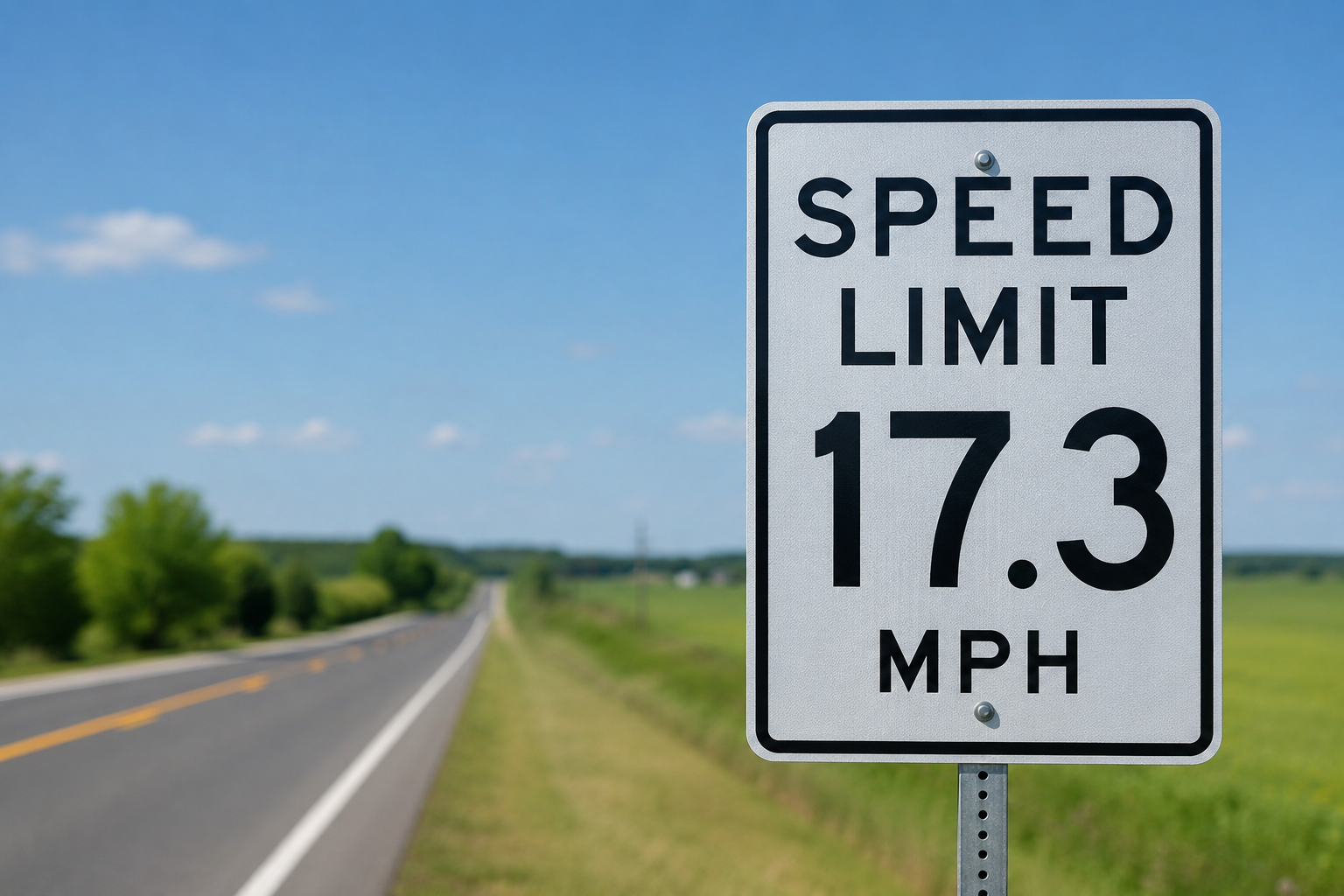
A decimal point speed limit changes all of that. Not 15, not 20, but 17.3 – the kind of number that makes you read the sign twice, look around, and wonder if someone made a typo. That brief double-take is not an accident. It is the entire point.
The decimal point speed limit is a real thing, appearing in a small but growing number of locations across the United States. And if you ever come across one, the right move is the same thing your brain already did: slow down, pay attention, and accept that the number was chosen specifically to make you do exactly that.
What the Decimal Point Speed Limit Actually Is
Wisconsin has a government facility that’s trying to buck autopilot driving with a simple decimal point. Rather than a limit of 15 or 20 mph, drivers at the Outagamie County Recycling and Solid Waste facility have to stay below 17.3 mph. According to officials at the facility, the oddly precise number was chosen for one simple reason: it forces people to stop and actually look at the sign. In a social media post, they explained that the unusual figure helps break up the “autopilot” mindset drivers can slip into on familiar routes.
The site runs a constant mix of contractors, heavy haulers, and local residents every day, all sharing the same roads. A standard 15 mph sign would communicate the same legal limit. It would also be invisible to anyone who had driven past it more than twice. The decimal point changes that, at almost zero cost. Rounding it to a whole number might have been simpler and easier to read, but grabbing drivers’ attention is the point – and in a Facebook post, Outagamie County Recycling and Solid Waste said a decimal-point speed limit “makes you pause.”
Wisconsin isn’t the first place to try decimal-point speed limits. Drivers in Colorado Springs have had to be mindful of the 8.2 mph limit in one particular shopping center for nearly a decade. The number is small enough to be taken seriously and strange enough that people actually clock it. Neither 8 nor 9 would have done the same work.
The Problem the Decimal Is Trying to Solve
Before getting into why a decimal point works, it’s worth understanding what it’s up against, because the phenomenon is more serious than most people realize.
Highway hypnosis is an altered mental state in which a driver can travel lengthy distances and respond adequately to external events with no recollection of consciously having done so. It appears that in this state, the driver’s conscious attention is fully focused elsewhere, while the brain still processes a significant amount of information related to the road and vehicle control on a subconscious level. The car stays in the lane. The foot stays roughly on the gas. But the person behind the wheel is, functionally, somewhere else entirely.
Highway hypnosis is a manifestation of the common process of automaticity – the ability to perform complex actions without being consciously aware of the processes involved. Driving is one of the most thoroughly automatized skills humans develop. Once a route becomes familiar, the brain re-routes resources away from it, treating the drive as background processing rather than active decision-making. Highway hypnosis occurs more frequently on highways with high-quality pavement, especially if there are no sharp curves – but the same principle applies anywhere the environment stops generating novelty. A parking lot you’ve driven through a hundred times qualifies. So does the road leading to a recycling center you visit twice a week.
The consequences are not theoretical. The National Highway Traffic Safety Administration estimates that 91,000 accidents per year are a direct result of drowsy driving, a condition that often overlaps with highway hypnosis. The two states are closely related: both involve the brain operating below full engagement, and both make a driver slower to respond when something unexpected appears in front of them.
In this state, there is also a tendency for the driver to gradually increase speed – a phenomenon known as psychological inertia of speed. Which means that a facility expecting to see 15 mph compliance from someone in a mild highway-hypnosis state is probably not seeing 15 mph at all. It’s seeing whatever speed the driver settled into before they stopped paying attention, creeping upward without anyone noticing.
The Psychology Behind an Odd Number
The mechanism that a decimal point speed limit exploits has a name in behavioral psychology: a pattern interrupt. According to Neurolaunch’s research on pattern interrupt psychology, these interrupts work by momentarily disrupting our state of mind, creating a brief window of opportunity where we’re more open to new ideas or behaviors – like hitting the pause button on our mental autopilot, giving us a chance to manually adjust course.
The brain is, above all things, a prediction machine. It builds models of familiar environments and then runs those models on low power, only escalating attention when something breaks the expected pattern. A standard speed limit sign does not break any pattern. It confirms one. The brain predicted there would be a sign, predicted it would have a round number, saw exactly that, and moved on without pausing. A sign that reads 17.3 does not confirm the prediction. The brain predicted a round number and got a decimal. That mismatch is small, but it is enough to pull conscious attention back to the road, at least for a moment. And a moment is often all a facility like that needs.
Experts describe the psychology behind these decimal point street signs as a “pattern interrupt.” If a person who’s speeding at 33 mph in a 25 mph zone happens to see “25.3” instead of 25 on the sign, they’re much more likely to think twice and pump the brakes.
This is also why the specific number chosen matters less than the fact that it is unexpected. 17.3 and 8.2 are both doing the same psychological work. The decimal is the message. The digits around it are almost beside the point.
What You Should Actually Do When You See a Decimal Point Speed Limit
The short answer is: treat it like any other speed limit sign, only more so. A decimal point speed limit is legally enforceable in the same way any posted limit is. The fact that the number looks unusual does not mean the sign is advisory, approximate, or decorative. Decimal-point speed signs are rarely about legal trickery. They are most often a tool – not a trap – used to convey precision or to mirror the readings coming from electronic sensors. Whether it’s a recycling facility in Wisconsin or a shopping center in Colorado, the people who posted the sign want drivers to move through the area slowly and carefully, and they chose that number to get your attention. They got it. Now actually slow down.
A facility with a decimal point speed limit runs constant traffic: contractors, heavy haulers, and local residents all moving through the same space. That mix is relevant. Heavy commercial vehicles have dramatically longer stopping distances than a passenger car. A pedestrian stepping out from between two parked trucks does not care whether your speed limit was 15 or 17.3 – they care whether you were paying attention. The decimal point exists to make sure you were.
If you’re a parent who regularly drives children through parking lots, facility entrances, or any private property with posted speed limits, it’s worth knowing that these signs tend to appear in places with a specific, documented hazard the operators wanted to address. The sign is a warning before the warning. For more on how road conditions and car safety intersect when kids are in the vehicle, this guide on winter car seat safety is worth a few minutes of your time – the stakes around vehicle safety are consistently higher than they look.
Are These Signs Spreading?
The short answer is: slowly, and not always with decimal points. The psychology of the unexpected number doesn’t require a decimal to work. Other jurisdictions use similar eye-catching numbers, even if they are not decimals. In Nashville, Opry Mills Mall set its speed limit at 24 mph, instead of the usual 25, on the road leading to it. One mile per hour under the standard. Enough to generate a double-take. Probably enough to shave a few mph off the average approach speed.
There’s little data to formally support or detract from the practice. If anything, it’s likely to get drivers to at least think a little harder about how fast they’re going. That absence of hard data is worth being honest about. The decimal point speed limit is a behavioral intervention based on sound psychological principles, but it hasn’t been subjected to rigorous controlled study the way, say, rumble strips or speed cameras have. What officials at places like the Outagamie County facility can tell you is that drivers seem to notice the sign. Whether that noticing translates to sustained speed reduction across thousands of trips over months and years is a harder question.
What the approach has going for it is cost. Changing a sign from 15 to 17.3 is essentially free compared to installing physical infrastructure. If it generates even a modest reduction in approach speeds among the population most likely to be zoned out – the regulars, the contractors, the delivery drivers – it’s probably worth doing.
The Bigger Picture of Road Attention
The decimal point speed limit is a small example of a much larger challenge: roads are specifically engineered to feel frictionless, and that frictionlessness works against awareness. Long stretches of highway are incredibly repetitive and monotonous, making them less cognitively engaging. Driving down boring highways for long distances can cause the brain to essentially “auto-pilot” and function without much conscious thought. Private facilities and parking lots can generate the same effect at lower speeds, which is arguably more dangerous because the consequences of that inattention – a pedestrian, a loading dock worker, a child running between vehicles – arrive faster and with less warning than highway hazards typically do.
As drivers travel along familiar routes at a constant speed, their attention may shift away from the task of driving, leading to a decrease in vigilance and alertness. The lack of novel stimuli – like buildings – as well as the lack of external cues, like traffic lights or street signs, can further worsen this phenomenon.
The facility managers in Wisconsin understood something that years of “Slow Down” signage apparently hadn’t accomplished: you cannot appeal to a brain that isn’t listening. You have to make it listen first, and then deliver the message. A number with a decimal point is, in the most literal sense, an attention-getting device bolted to a post. If it makes one heavy hauler ease off the accelerator a quarter of a second sooner than they otherwise would have, it has done its job.
What This Is Really About
There’s something almost absurd about the idea that a decimal point is the thing standing between a driver and full attention – and also something completely understandable about it, once you accept what driving on autopilot actually looks like. The brain doesn’t ignore signs because drivers are careless people. It ignores them because the brain is doing exactly what it’s built to do: conserve resources by treating the familiar as non-urgent. A sign that looks like every other sign confirms that the environment is exactly as expected. A sign that looks slightly wrong forces a re-evaluation. That re-evaluation takes about one second. One second in which a foot moves toward the brake pedal instead of staying planted where it was.
Nobody is going to put a decimal point speed limit on every road in America. The trick only works because it’s unexpected, and novelty wears off. But for the right location – high-traffic, high-hazard, full of people who’ve driven through it so many times the road has become invisible to them – the decimal point is doing real work. Next time you see one, you now know the move: read it, register it, and actually slow down. The person who posted that sign is counting on exactly that.
AI Disclaimer: This article was created with the assistance of AI tools and reviewed by a human editor.