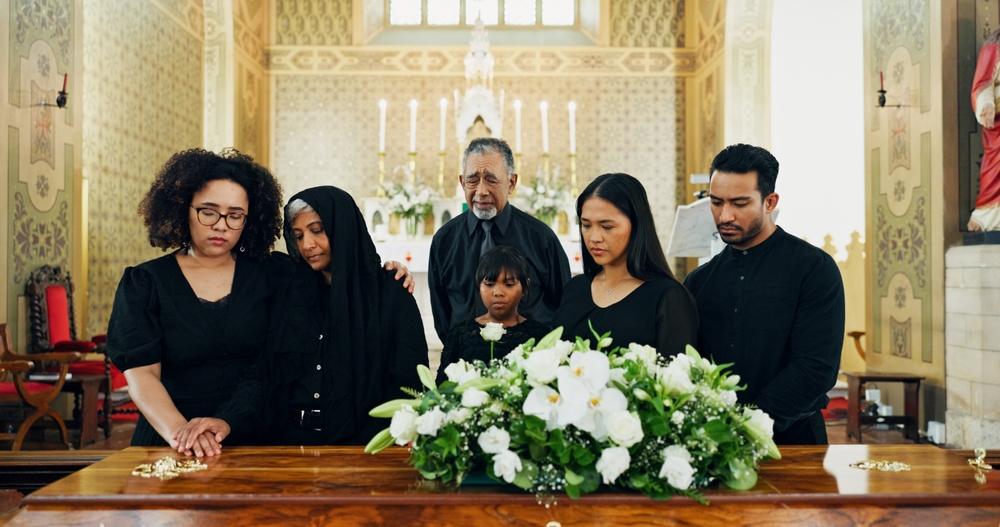

Losing someone you love is one of those experiences that doesn’t follow a script. The grief and connection after loss that people describe are wildly different from person to person, some feel a crushing absence, some feel oddly close to the person they’ve lost, and some feel both at the same time, sometimes within the same hour. None of that is strange. None of it means you’re broken. It just means you’re human, and you’re grieving.
What’s interesting is that researchers are starting to pay real attention to the comfort side of loss. Not just the pain, which is well-documented, but the ways people find meaning, connection, and even peace after someone they love is gone. And some of what they’re finding is genuinely surprising.
One of the biggest threads running through this research involves spirituality. Not religion specifically, and not any one tradition or set of beliefs, but something broader: the sense that there’s more going on than what we can see, that connection might not end at death, and that ritual and meaning-making matter in the healing process. Whether you’re deeply religious, loosely spiritual, or somewhere in between, “I light a candle and talk to her sometimes, I don’t really know what I believe”, the research is finding that it all counts.
What Researchers Are Actually Looking At
When researchers study grief, they tend to separate it into categories. There’s ordinary grief, which is painful but eventually something you integrate into your life, and then there’s what’s called prolonged grief disorder (PGD), basically when grief doesn’t move through, becomes stuck, and significantly disrupts daily functioning for an extended period. Think of it less like a wound that heals slowly and more like a wound that keeps reopening.
A lot of the spirituality research focuses on which people move through grief more adaptively, and where spirituality fits into that picture. A 2024 study indexed on PubMed Central found that spirituality was linked to better emotion regulation in bereaved adults who were experiencing low-to-mild grief symptoms. Those people were better able to manage difficult emotions without getting overwhelmed by them. The same research also found that religious and spiritual factors actively shaped how bereaved individuals processed their emotions after a grief interview, meaning spirituality wasn’t just a background comfort, it was doing something real in the moment.
There’s a nuance worth knowing, though. That same 2024 study found that for people with more severe, clinical-level grief symptoms, spirituality alone didn’t provide the same protective effect. That’s not a knock on faith, it just means that when grief is at its most acute, additional support is usually needed alongside spiritual practice. More on that in a moment.
The People Who Feel Like Their Person Is Still Around
Here’s where the research gets genuinely fascinating. You’ve probably heard someone say it, a parent, a friend, maybe yourself: “I felt like she was right there with me.” Or, “I just knew he was okay.” These moments are called after-death communication experiences, or ADCs. They can take the form of dreams, a sudden sense of presence, a coincidence that feels too specific to be random, or even what people describe as a brief but vivid feeling of contact.
Researchers have been quietly studying these experiences for years, and the findings are hard to dismiss. A 2025 Religions journal study found that people who had ADC experiences showed a measurable reduction in death anxiety, the fear of their own death or of death in general, and developed a stronger belief in an afterlife and a greater sense of spiritual orientation overall.
More striking: 47 percent of participants in that same study said that their ADC experience made it easier to accept their loss. And the shift they described wasn’t just emotional relief. Participants consistently moved away from raw grief and sadness toward something they described as transcendence, gratitude, and a continued sense of connection with the person who had died.
That doesn’t mean these experiences are evidence of anything metaphysical, researchers aren’t making that claim, and neither are we. But it does mean that whether or not you can explain it, the experience itself tends to help. If you’ve had one of those moments and felt embarrassed to mention it, the research suggests you’re in very good company.
Why Family Caregivers Carry a Particular Kind of Weight
If you’ve ever been the person who took care of someone before they died, the one managing the medications, the appointments, the overnight panic, you already know that caregiving grief is its own specific thing. It’s grief layered on top of exhaustion, layered on top of a role that suddenly no longer exists.
A 2025 oncology nursing study looked specifically at 289 bereaved family caregivers who had lost a loved one to cancer. The group had a mean age of 40.4 years, and 77.5 percent were women. What researchers found was that depression, anxiety, and traumatic grief were significantly more pronounced in this group, and they examined spiritual well-being as a key factor in how those individuals moved through the post-loss period.
The study’s framing matters here. Spiritual well-being wasn’t being studied as a nice-to-have. It was being examined as a moderating factor, something that could change the course of grief, either amplifying or softening the weight of it. For caregivers especially, finding comfort and connection after losing a loved one often requires something beyond the practical. The role consumed so much of their identity. What replaces it is part of the grief too.
There’s also the phenomenon researchers sometimes call caregiver bereavement overload, where the period of anticipatory grief during caregiving, the slow, ongoing mourning that begins before the person has even died, collides with the grief that arrives after. The result is that some caregivers feel like they’ve been grieving for years before the death even occurs, and then find that the death opens a second, distinct wave rather than resolving the first. Spiritual practices that provide structure and routine, a daily prayer, a weekly service, even a private ritual tied to the person who was lost, can help regulate that disorienting second wave by giving the grief somewhere to go.
If you’ve been the caregiver in this story, recognizing that your grief may be more complex than average isn’t self-pity. It’s just accurate, and it’s a reason to seek support that’s appropriately matched to that complexity.
How Spirituality Helps With Grief, Practically Speaking
So what does spiritual healing for grief actually look like day to day? Not the version on a motivational poster, but the real version, the one that fits into a regular life?
For some people it’s formal: attending religious services, prayer, lighting candles, reading sacred texts. For others it’s much looser: walking in nature with the intention of feeling close to someone, talking out loud to a person who’s gone, keeping an object of theirs nearby and treating it with a kind of reverence. Both approaches draw on the same underlying mechanism, maintaining a sense of relationship with the person who died, rather than forcing a clean severance.
This is sometimes called “continuing bonds” in grief literature, and it’s been gaining traction as a framework for a while now. The old model of grief was very much about letting go. Move on. Accept the loss. Put it away. The more current understanding, backed by research on spiritual practices for grief healing, is that continuing to feel connected to someone who has died isn’t a sign of being stuck. For most people, it’s a sign of being human.
For parents who have lost a parent of their own, which a significant portion of our readers are navigating, this can feel particularly loaded. You’re grieving while also trying to hold it together for your own kids. You’re modeling what grief looks like for little people who are watching closely. Giving yourself permission to keep a relationship with someone who is gone, and to talk about them freely, turns out to be good for everyone in the household.
You can also read more about navigating loss with family in this honest personal account of what grief actually looks like up close.
When Spiritual Support Isn’t Enough on Its Own
This is the part that’s worth being direct about. Spirituality and connection are powerful. The grief support research is consistent on that. But they’re not a replacement for professional help when grief becomes clinical.

Prolonged grief disorder is real, and it affects a meaningful number of bereaved people. The markers include a persistent inability to accept the loss, intense longing that doesn’t soften over time, difficulty engaging with life or other relationships, and a sense of purposelessness that sticks around well past the early months of loss. If that sounds familiar, not just “I still miss them deeply” but “I cannot function and this hasn’t moved”, that’s a signal to reach out to a therapist or counselor who specializes in bereavement.
The 2024 PMC-indexed research made this distinction clearly: spirituality showed its protective effect in people with moderate symptoms, but those with more severe grief profiles needed more targeted support. Spiritual practice can sit beautifully alongside therapy. They’re not competing. But one isn’t always a substitute for the other.
What This Means for You
Grief research isn’t asking you to believe anything specific or practice any particular tradition. What it is suggesting, pretty consistently, is that the instinct to maintain a sense of connection, to keep talking to someone, to hold onto meaning, to find a framework that makes the loss bearable, is not just emotionally valid. It’s associated with better outcomes.
If you’ve had a moment that felt like contact with someone who’s gone, you don’t need to explain it or defend it. Almost half of bereaved people in recent research said something similar changed their experience of loss for the better. That’s not a small number. If you’re a caregiver who’s lost a patient or a person you cared for, give yourself the extra room that experience deserves. And if grief is sitting on you in a way that isn’t shifting, please don’t white-knuckle it alone, finding comfort after bereavement sometimes means letting a professional in.
The research on grief and connection after loss keeps pointing in the same direction: you don’t have to cut the cord to heal. You just have to find a way to carry it.
A.I. Disclaimer: This article was created with AI assistance and edited by a human for accuracy and clarity.