

A woman in her early 40s sat reading at home when a voice spoke to her. Not menacing or chaotic, but polite, formal, and deeply strange. It told her not to be afraid. It said it wanted to help her. It claimed it knew something was wrong. What followed was a slow collision between psychiatry, patient advocacy, institutional resistance, and a brain tumor diagnosis that arrived not through a headache or a seizure, but through hallucinations so precise they forced a doctor to keep pushing until someone finally agreed to look.
The case belongs to a woman referred to only as AB, European-born, long settled in Britain, married, a mother, and by every account in perfectly good health. She had barely visited her doctor. Then one afternoon, that voice introduced itself. It remains, decades later, one of the most extraordinary cases in medical literature.
The Voice That Introduced Itself

The voice AB heard that afternoon did not bark commands. According to the 1997 case report published in the British Medical Journal by her treating psychiatrist, Dr. Ikechukwu Obialo Azuonye, the voice was specific about its intentions. It claimed to have worked at Great Ormond Street Children’s Hospital. It said a friend was with it. It said they both wanted to help her.
AB, understandably, was terrified. Not because the voice felt hostile, but because hearing voices felt to her like the beginning of madness. She sought psychiatric help, and she found Dr. Azuonye. He examined her. He found nothing physically wrong. His diagnosis was functional hallucinatory psychosis, a condition where a person experiences hallucinations without an identifiable organic cause, and he prescribed an antipsychotic called thioridazine alongside counseling. Within two weeks the voices went away.
AB went on vacation. She was still taking the medication. By every reasonable measure, the treatment had worked and the episode was behind her.
When the Voices Came Back

While the woman was still on vacation, the voices returned and told her she needed to return to England immediately for medical treatment. They gave her a specific address to visit, and her husband drove her there. It turned out to be a department at a large London hospital.
The voices urged her to schedule a brain scan because she had a tumor. They were not vague about it. They named the hospital type, directed her to the right department, and told her something was growing inside her head. They also told her that her brain stem was inflamed.
Azuonye was now in an extraordinarily difficult position. His patient was not acting erratically. She was not psychotic in any conventional sense. She was distressed, articulate, and reporting something extremely specific. He examined her again. There were still no clinical signs pointing to anything wrong. No neurological deficits. No headaches of note. No physical findings that would, by any standard medical reasoning, justify the cost of a CT scan.
He asked for one anyway, explaining in his referral letter precisely what was happening: that hallucinatory voices had told his patient she had a brain tumor, that he had found no physical signs supporting this, and that the scan’s purpose was essentially reassurance. The request was initially declined “on the grounds that there was no clinical justification for such an expensive investigation,” and, he later wrote, “it was also implied that I had gone a little overboard, believing what my patient’s hallucinatory voices were telling her.”
He kept pushing. He negotiated. The scan was eventually approved.
What the Scan Found
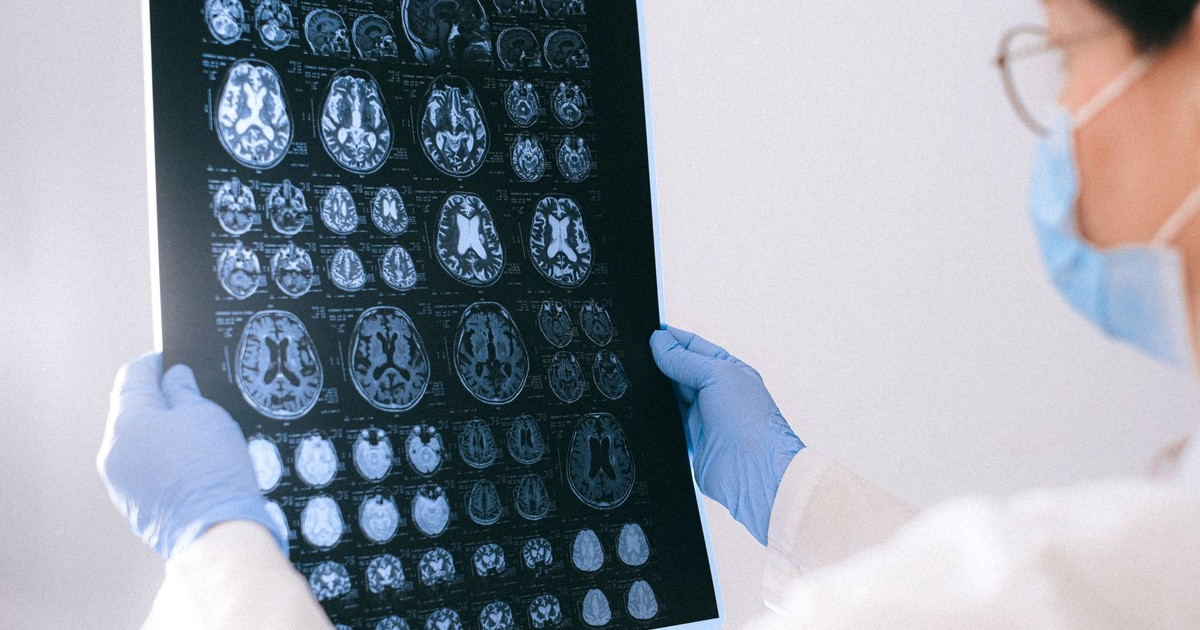
The first scan, completed in April, produced results concerning enough to warrant a second one. That enhanced follow-up scan revealed a left posterior frontal parafalcine mass extending through the falx to the right side, with all the appearances of a meningioma. The tumor was a parafalcine meningioma, a type that grows between the two hemispheres of the brain, arising from the meninges, the layers of tissue that cover the brain and spinal cord.
The growth measured approximately 2.5 inches by 1.5 inches. A neurosurgeon gave AB a choice: operate immediately, or wait for symptoms to appear. She chose surgery without hesitation. The voices, per the case report, “told her that they were fully in agreement with that decision.”
The operation removed the tumor completely. AB recovered without complications. When she woke in the recovery room, the voice spoke to her one last time. It told her: “We are pleased to have helped you. Goodbye.” Azuonye followed up with her 12 years later and found that the voices had never returned.
The Question Nobody Can Fully Answer

Azuonye was careful in how he framed this case. He did not claim a supernatural explanation. He acknowledged that the connection between brain tumors and psychiatric symptoms had been documented before. But he did state, in his own words, that this was “the first and only instance” he had encountered in which hallucinatory voices sought to reassure the patient of their genuine interest in her welfare, offered a specific diagnosis, directed her to the type of hospital best equipped to deal with her problem, expressed pleasure that she had received the treatment they desired for her, and then said goodbye.
What he could not explain, and what nobody has fully explained since, is how the hallucinations knew. The tumor was found in the left posterior frontal region. Most researchers who have discussed the case lean toward the explanation that the tumor itself was the source of the hallucinations, that pressure and disruption in that area of the brain produced voices. But the content of those voices, the specificity, the correct diagnosis, the address of the right hospital department, is harder to account for. The precise cause of the voices’ content continues to be a topic of debate.
The brain, when under pressure from an intracranial lesion, does not always announce itself with headaches and seizures. Sometimes it announces itself by behaving strangely in ways that get labeled as psychiatric disorders and sent to the wrong department.
The Meningioma Misdiagnosis Problem
AB’s story is singular in its details. The content of what the voices said, the way the case unfolded, is unlike anything else in the literature. But the structural problem it exposes, a brain tumor presenting exclusively as psychiatric symptoms and being initially treated as mental illness, is far from rare.
Brain tumors can present with psychiatric symptoms as the only initial indication of an underlying condition, with no obvious neurological signs. Meningioma is the most common primary brain tumor overall, accounting for more than 30 percent of all primary brain tumors, and is also the most common non-malignant type.
Meningiomas can cause psychiatric symptoms in up to 35 percent of patients, particularly when located in the frontal lobe. The frontal lobes are, in neurological terms, often described as “silent,” in that benign tumors such as meningiomas that compress the frontal lobes from the outside may not produce any symptoms other than progressive change of personality and intellect until they are very large. A person can change, subtly and then not so subtly, for years before anyone connects the change to something growing in their skull.
Many patients receive a diagnosis of primary psychosis, such as a schizophrenia spectrum disorder, without proper exclusion of a brain lesion. One documented case involved a patient who carried various psychotic disorder diagnoses for 25 years before a first-ever brain scan revealed a large left frontal lobe meningioma.
When a middle-aged person with no past psychiatric history develops a slowly progressive psychological change that does not respond well to treatment, or whose symptoms do not match any recognized diagnostic criteria, a brain tumor, particularly a meningioma, should be suspected. Middle-aged women are more than twice as likely as men to develop a meningioma. The demographic overlap with AB’s case is not coincidental. It is the profile that clinicians are supposed to flag.
Whether they do is a different question. Psychiatric services are pressed for time, scans are expensive, and a woman in her 40s presenting with new-onset hallucinatory voices is a far more common clinical picture than a meningioma. The clinical reasoning that initially turned down AB’s scan was not irrational. It was, in the absence of physical signs, the standard call. The problem is that the standard call is sometimes wrong in ways that take years to surface.
What This Case Actually Proves

Azuonye presented AB’s case at a medical conference later that year. She attended. The audience, by his account, split almost exactly down the middle. Half wanted a neurological explanation, something about tumor pressure generating hallucinatory content through a process science could theoretically describe. The other half wanted to leave the door open to something harder to categorize.
The brain is not a static organ doing nothing while a mass grows inside it. It is actively responding, adapting, generating signals. That those signals occasionally take the form of voices, and that those voices occasionally carry information that turns out to be true, is not magic. It is also not nothing.
A doctor listened to a patient who was telling him something was wrong, even when the thing she was describing made no conventional sense, and he did not stop pushing until the system agreed to look. The scan that found AB’s tumor was not ordered because the evidence was clinically convincing. It was ordered because one psychiatrist kept making the case for his patient in the face of an institution that had decided, reasonably and wrongly, that the case had already been made.
The voices said goodbye and disappeared. The tumor was gone. AB went home, stopped her medication, and did not hear another word from whatever had been speaking to her for months. Azuonye’s own conclusion was that the voices vanishing after surgery “showed that these symptoms were at least directly related to the presence of the lesion.” According to IFLScience‘s account of the case, the brain tumor diagnosis only happened because someone refused to stop listening.
Disclaimer: This information is not intended to be a substitute for professional medical advice, diagnosis, or treatment and is for information only. Always seek the advice of your physician or another qualified health provider with any questions about your medical condition and/or current medication. Do not disregard professional medical advice or delay seeking advice or treatment because of something you have read here.
AI Disclaimer: This article was created with the assistance of AI tools and reviewed by a human editor.