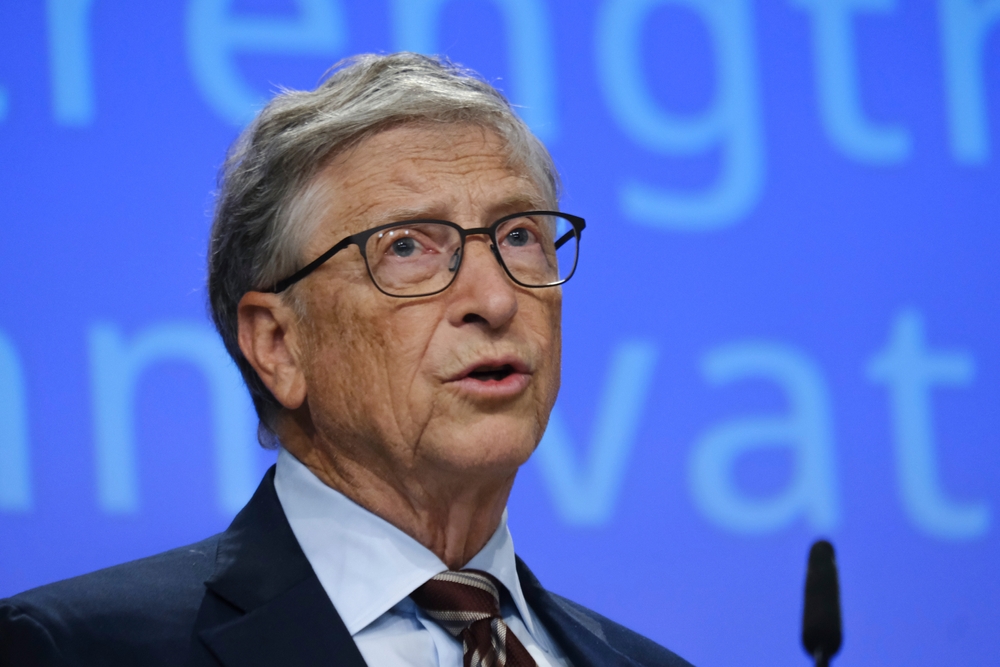

Every few years, someone with real skin in the game says something about the future of work that stops you mid-scroll. Not a LinkedIn thought leader. Not a TED Talk full of bullet points and optimistic music. Someone who actually built the machines and, in doing so, earned the right to tell you what comes next. Bill Gates is that person right now, and what he’s saying is not especially comfortable to sit with.
He has been saying versions of it for a while, but the version he delivered to Jimmy Fallon in February 2025 had a particular directness to it. Over the next decade, advances in artificial intelligence will mean that humans will no longer be needed “for most things” in the world, the Microsoft co-founder told the comedian during an appearance on NBC’s The Tonight Show. He wasn’t hedging. He wasn’t softening it for a primetime audience. He used the words “most things” and moved on. The expertise we currently value, he explained, the great doctor, the great teacher, remains precious only because it is scarce. With AI, he argued, that will become “free, commonplace,” ushering in what he calls an era of “free intelligence.”
That is a sentence worth sitting still with for a moment, because it doesn’t just describe a labor market shift. It describes a fundamental restructuring of what expertise is worth. And if you have spent any part of your adult life building toward a career, raising a child toward one, or quietly worrying whether yours is still standing in ten years, the question of which professions survive that restructuring is not abstract at all. Gates, to his credit, did not just drop the prediction and walk off the stage. He named names.
The Scale of What’s Coming
Before getting to who survives, the numbers tell you why this conversation is happening with such urgency right now. The World Economic Forum’s Future of Jobs Report 2025 projects that 170 million new roles will be created globally by 2030, while 92 million roles will be displaced, producing a net increase of 78 million jobs. On paper, that sounds like good news. In practice, as anyone who has ever been on the wrong side of a “net positive” statistic will tell you, the math rarely distributes itself fairly. The jobs lost and the jobs created do not go to the same people, in the same cities, requiring the same skills. The real challenge is the gap between where jobs vanish and where they come back, between the skills workers already have and the ones new roles require.
The categories most vulnerable are exactly the ones that felt secure for the past generation: information processing, pattern recognition, communication in predictable formats. The white-collar knowledge economy that many of us were told to aim for. Where AI displacement is happening most rapidly, in areas like customer service automation, data entry, financial analysis, and code generation, the barriers to replacement are either absent or have already been overcome, and the employment effects are real and documented. The question everyone is actually asking, even when they phrase it more politely, is whether their job is next.
Gates thinks he has a partial answer to that.
Coders: The Builders Who Still Have to Drive the Car
The first profession Gates identifies as resilient is the one that feels most counterintuitive. Coders, the very people building the tools that are replacing everyone else, are, according to him, relatively safe. Not because AI can’t write code. It absolutely can. But because writing code, in the sense of stringing syntax together, is not actually the hard part of software development.
The people responsible for developing AI systems are among those whose jobs remain secure, Gates argues, because while AI can generate code, it lacks the precision, adaptability, and problem-solving abilities required for complex software development. Someone still has to decide what the software should do, design the architecture that holds it together, and determine where the ethical guardrails belong. AI can fill in the blanks. It cannot write the brief.
Gates believes human programmers will continue to play a critical role in refining, debugging, and advancing AI itself. He put it plainly in a 2025 interview with Axios, comparing the situation to arithmetic: learning to multiply still matters even though calculators exist. The point is not to do what the machine does. The point is to understand the machine well enough to know when it’s being “crazy stupid,” as he put it, and when it isn’t.
The coders who will thrive are not the ones doing repetitive bug-fixing or churning out basic website scripts. Those roles are already contracting. The ones who will endure are the engineers who think broadly about systems, who can hold a technical problem and a human problem at the same time, and who understand that the most important decisions in software development are not about syntax.
Biologists: The Scientists AI Cannot Hypothesize For
The second profession on Gates’ list is biology, and the reasoning here is worth paying attention to, particularly because it says something larger about what AI actually is and is not. Gates has identified biologists as one of the professions he believes will remain safe from AI replacement because these careers rely heavily on creativity, intuition, and complex problem-solving, qualities that current AI systems cannot fully replicate.
AI is extraordinary at analyzing biological data. It can read a genome faster than any human team. It can cross-reference clinical trial results against a century of published literature in seconds. While AI excels at processing large volumes of data and supporting decision-making, it cannot replicate the instinctive leaps in thinking often required in scientific and technical fields. “Biologists play a critical role in human development and medical discovery,” Gates has noted. “Even with AI assistance, forming hypotheses and making conceptual breakthroughs is still a deeply human endeavor.”
The distinction matters because it is not about volume of work or speed of analysis. It is about the moment before the experiment, when a researcher decides which question is even worth asking. That judgment, the choice of what to look for before you know whether it exists, is not something a model trained on existing data can generate from nothing. Anthropic CEO Dario Amodei, in his October 2024 essay “Machines of Loving Grace”, hypothesized that powerful AI technology could compress into 5 to 10 years the biological and medical progress that human scientists might otherwise achieve over 50 to 100, but framed this as a phenomenon requiring human scientists to direct and interpret. The AI accelerates the work. The biologist decides what the work is.
Energy Experts: The Field Too Complex to Automate
The third profession Gates names is energy, and this one perhaps requires the least explanation for anyone who has watched the past decade of climate negotiations, infrastructure crises, and geopolitical energy conflicts. The energy sector is complex for AI to handle independently. From oil and nuclear power to renewable energy solutions, industry experts must navigate regulatory challenges, develop sustainable strategies, and respond to unpredictable global demands.
If you wanted to design a field that would resist automation, you might describe it something like this: globally interconnected, heavily regulated, politically volatile, and dependent on decisions that must account for outcomes decades in the future in conditions that cannot yet be modeled. That is, more or less, the energy industry. Gates has spent decades investing in clean-energy innovation through Breakthrough Energy Ventures, and he’s argued that energy is too complex and globally interwoven to be fully automated. Real-world energy systems depend on human judgment, policy decisions, and ethics, all areas where machines can only assist.
This connects to what Built In reports as a broader pattern: as of 2024, about 42 percent of enterprise-scale companies have actively deployed AI in their businesses, and 92 percent of companies plan to increase their investments in AI technology between 2025 and 2028. That adoption curve is happening everywhere, including in energy. But adoption does not equal replacement. In a field where a wrong call on a power grid affects millions of people, and where a poorly designed policy can set decarbonization back by a decade, AI remains a tool in the room, not the decision-maker at the head of the table.
Athletes: The Fourth Entry That Tells You Something
Gates also gestured, with some humor, at a fourth category: professional athletes. He added this during the Tonight Show appearance, joking that athletes are also likely safe from being replaced. “You know, like baseball, we won’t want to watch computers play baseball,” he told NBC’s Tonight Show.
It sounds like a throwaway line, but the logic underneath it is not trivial. What Gates is pointing to is a category of human activity that remains valuable not because it produces something AI cannot produce, but because we want to watch humans do it. The performance is the point. The imperfection, the effort, the stakes for the person doing it, those are the product. A baseball game played by machines would be technically perfect and completely unwatchable. There is an entire theory of what makes work worth keeping in that observation, and it extends well beyond sport.
What This Actually Means for the Rest of Us
Here is the honest version of what Gates is telling us, the one that lives underneath the list. He is not saying that these four professions are the only ones that matter or that every other career is doomed by next Tuesday. He has acknowledged, repeatedly, that his predictions may not be 100 percent accurate and that AI’s influence on the job market will evolve in ways nobody can yet fully model. Gates has said AI will “change every job,” and that “knowing the innards of the AI helps you understand why it’s so crazy smart sometimes and so crazy stupid other times.” His framework is not about a cliff that some professions fall off and others avoid. It is about which kinds of work require something that remains genuinely, irreducibly human.
What those three fields, and the fourth, share is this: they all require a human being to make a judgment call that cannot be derived from pattern recognition on existing data. A coder deciding what the next generation of software should do. A biologist choosing which disease mechanism is worth investigating. An energy expert reading a room of competing national interests and deciding where to push. An athlete whose performance matters precisely because they can fail. The common thread is not technical complexity. It is the need for a human being who is accountable for a decision that has not been made before.
The Part Nobody Says Out Loud
Gates is not the only person thinking about this, and the list he offered on late-night television is not meant to be exhaustive. It is meant to be illustrative. The actual principle doing the work here is not “these four jobs” but something closer to: the further your work sits from pattern-matching on what already exists, the harder it is to replace you.
That is worth holding onto, not because it resolves anything, but because most people underestimate how much of their work already lives in that territory. The teacher who reads a classroom and adjusts on the fly. The manager who knows which conversation to have before a project falls apart. The parent who figures out what their kid actually needs on a Tuesday night when nothing is going right. None of that maps cleanly onto a job title. It maps onto judgment developed through experience, failure, and paying attention. AI is not coming for that. Not yet. Possibly not ever. And for now, that is enough to keep building toward something.
AI Disclaimer: This article was created with the assistance of AI tools and reviewed by a human editor.