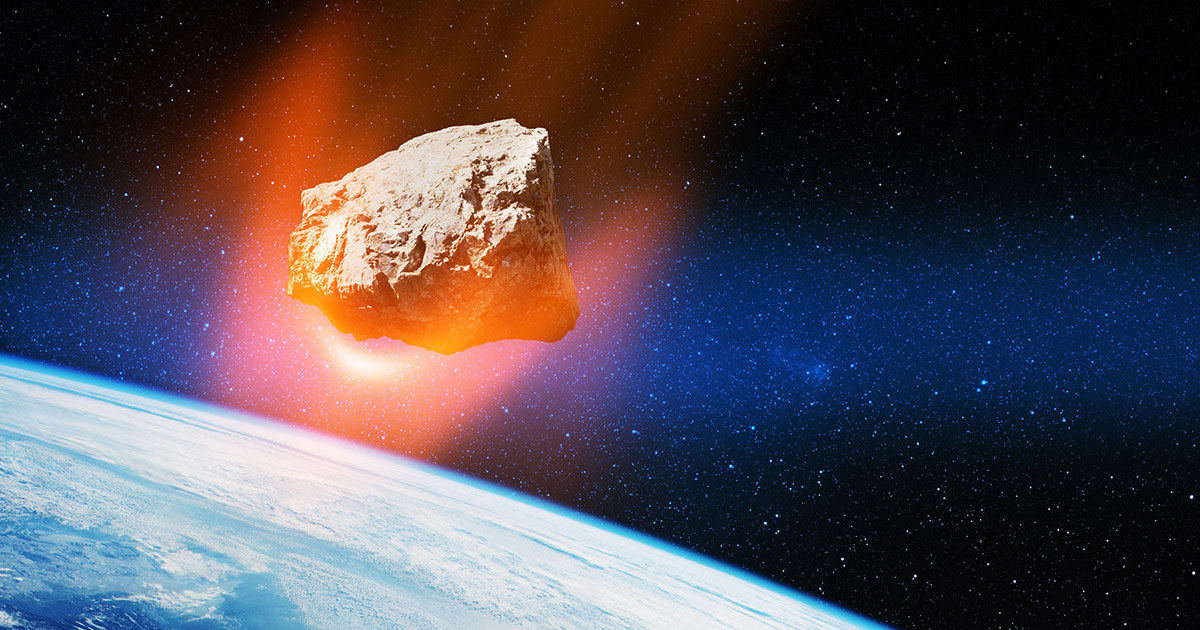

September 24, 2182 is already on the calendar. Not yours, obviously. You won’t be around to see it. Neither will your children, or their children. But somewhere in humanity’s future, that date is circled in planetary defense spreadsheets and orbital mechanics models because it represents the single most statistically significant moment of potential catastrophe that scientists can currently put a name to. The asteroid is called Bennu. It has been studied, photographed, sampled, and argued over for years.
The odds of Bennu actually hitting Earth are low, low enough that the scientists who track it are not losing sleep over September 2182 personally. But Bennu is roughly a third of a mile wide, a dense, slowly tumbling pile of ancient rock and carbon that has been wandering through the inner solar system for billions of years. If it ever does connect with Earth, the conversation about “low probability” will feel somewhat beside the point.
The Bennu asteroid threat is real enough to take seriously and unlikely enough to keep in perspective. Both of those things are true simultaneously, and the science sitting behind them is genuinely worth understanding.
A Rock From the Beginning of Everything
Bennu is a carbon-rich asteroid formed as part of a parent body approximately 4.5 billion years ago, which puts its origins at roughly the same moment the solar system itself was being assembled. Scientists believe Bennu is a fragment of a larger parent asteroid that was collisionally disrupted in the asteroid belt, between the orbits of Mars and Jupiter, and could hold important clues about how planets form.
OSIRIS-REx spent more than two years in close proximity to Bennu, gathering information about its size (about one-third of a mile, or 500 meters, wide), shape, mass, and composition, while monitoring its spin and orbital trajectory. High resolution data obtained by OSIRIS-REx revealed that the surface is far rougher than expected, with more than 200 boulders larger than 10 meters on the surface, the largest of which is 58 meters across.
Bennu’s density tells its own strange story. Analysis of the gravitational and thermal effects has given a bulk density only slightly denser than water, and the predicted macroporosity is around 40 percent, suggesting the interior has a rubble pile structure or even hollows. Bennu is not a solid cannonball hurtling through space. It is closer to a loosely packed pile of gravel and boulders held together by its own weak gravity, which has real implications for how any future deflection attempt would need to work.
The Numbers Behind the Headline

Using NASA’s Deep Space Network and computer models, scientists were able to determine Bennu’s total impact probability through the year 2300 is about 1 in 1,750 (or 0.057%), and researchers identified September 24, 2182, as the most significant single date in terms of a potential impact, with an impact probability of 1 in 2,700 (or about 0.037%).
To put that in some kind of everyday frame: if you flipped a coin and needed it to land heads 11 times in a row to win, those are roughly the odds you’re rooting against. It’s a small number. But it is not zero, and it is not zero for a very specific, well-understood reason.
On September 25, 2135, Bennu will make a close flyby of Earth. Our planet’s gravity will tweak Bennu’s path, making it a challenge to calculate its future trajectory. During the flyby, there is an extremely small chance that Bennu will pass through a “gravitational keyhole,” a region of space that would set it on just the right path to impact Earth late in the 22nd century. These keyholes are not large. The keyholes are all less than approximately 20 kilometers wide, with some being only 5 meters wide. Threading a needle across decades of orbital mechanics, influenced by the gravity of every planet in the solar system and the heat radiating off Bennu’s own surface, is the actual challenge here.
The Force That Sunlight Exerts on a Rock
One of the most counterintuitive parts of tracking Bennu’s trajectory is how much work a phenomenon called the Yarkovsky effect does in the calculations. As Bennu travels around the sun, sunlight heats up the side facing it. As the asteroid spins, the heated side cools down as it rotates away. As it cools, the surface releases infrared energy, which generates a small amount of thrust on the asteroid, a phenomenon called the Yarkovsky effect.
That thrust is minuscule by any intuitive measure. Over years and decades, though, it accumulates. Astronomers have calculated that the Yarkovsky effect has shifted Bennu’s orbit about 0.18 miles (284 meters) per year toward the Sun since 1999. That accumulated drift determines where Bennu will be in 2135, which determines whether it passes through a keyhole, which determines whether September 24, 2182 becomes a date worth worrying about. Everything connects. The OSIRIS-REx mission was partly designed to measure this effect directly, and the data it returned allowed researchers to rule out many of the previously possible impact scenarios while narrowing down the ones that remain.
What Happens When It Arrives
The impact probability for Bennu is low, but researchers at the IBS Center for Climate Physics at Pusan National University ran the simulations anyway. Using a coupled high-top Community Earth System Model with interactive chemistry, their simulations injected up to 400 million tons of dust into the stratosphere and found marked disruptions in climate, atmospheric chemistry, and global photosynthesis.
The worst case scenario showed that Bennu would inject about 400 million tons of dust into the atmosphere, causing a global cooling event of roughly 7 degrees Fahrenheit (4 degrees Celsius). Global rainfall would drop by 15 percent, and ozone levels would drop by 32 percent, with plant photosynthesis taking a 20 to 30 percent nosedive after impact.
Lead author Dr. Lan Dai, a postdoctoral research fellow at the ICCP, described the potential disruption to photosynthesis as an “abrupt impact winter” that “would likely cause massive disruptions in global food security.” Co-author Axel Timmermann, director of the IBS Center for Climate Physics, noted that the conditions produced would be “similar to those seen only for some of the largest volcanic eruptions in the last 100,000 years.” The disruption to photosynthesis alone, affecting both terrestrial and marine ecosystems, would ripple through every food chain on the planet for years. Bennu-sized asteroids strike Earth on average every 100,000 to 200,000 years, which puts the geological rarity of such an event in context without making it feel any less consequential if you happen to be alive for it.
What Bennu Carried From the Early Solar System
The Bennu asteroid threat is only one half of what makes this rock worth paying attention to. The other half is what it carried to us in a sample canister dropped by parachute into the Utah desert in September 2023. NASA’s OSIRIS-REx mission, launched in 2016, successfully collected 120 grams of samples from Bennu in 2020 and delivered them to Earth in September 2023.
Early analysis of the sample revealed dust rich in carbon, nitrogen, and organic compounds, all of which are essential components for life as we know it. Dominated by clay minerals, particularly serpentine, the sample mirrors the type of rock found at mid-ocean ridges on Earth. The magnesium-sodium phosphate found in the sample hints that the asteroid could have splintered off from an ancient, small, primitive ocean world.
In January 2025, NASA revealed that while the samples did not show evidence of life, their contents suggest that the conditions necessary for the emergence of life were likely widespread in the early solar system. The amount of ammonia in the samples indicates that Bennu emerged from the colder, outer regions of space. And then the findings got more specific still. A wide range of carbon- and nitrogen-rich organic compounds were identified in the samples, including 14 of the 20 amino acids that make up proteins in terrestrial organisms, as well as all four nucleobases (adenine, thymine, cytosine, and guanine) that are the essential building blocks of DNA and RNA.
The chemical precursors to life on Earth were present on a 4.5-billion-year-old rock that has been looping through the inner solar system since before any life existed here. It does not prove that life came from space. It does raise some compelling questions about where the raw materials came from. The asteroid that might one day threaten the planet is also, somewhat poetically, carrying evidence about how life on that planet may have gotten started.
What Happens Between Now and 2135

Scientists have both time and tools. Planetary scientist Lindley Johnson of NASA’s Planetary Defense Coordination Office has noted that kinetic impactor technology could divert an asteroid like Bennu if action were taken with sufficient lead time. NASA’s planetary defense office is also studying other options, such as gravity tractors and ion beams.
The DART mission, which deliberately crashed a spacecraft into the asteroid Dimorphos in September 2022, already proved the concept. The impact successfully altered Dimorphos’ orbit around its parent body, Didymos, reducing its orbital period by 32 minutes, and DART proved it’s possible to move an asteroid. The technology needed to redirect Bennu, if the 2135 flyby confirms it is on a concerning path, is not theoretical. It is demonstrated.
September 2182 is only genuinely dangerous if two things happen in sequence: Bennu passes through one of those narrow gravitational keyholes in 2135, and humanity chooses not to act on the roughly 50 years of lead time that would follow. By 2135, as one researcher put it, “we’ll know for sure,” because Bennu will be close enough to track with ground radar and map out its future path. The answer will come long before the threat could be realized. Every telescope that tracks Bennu between now and then refines the orbit. Every year that passes without a keyhole passage being confirmed slightly lengthens the odds.
What This Actually Means
The Bennu story has been told a lot of ways: as a harbinger of doom, as a non-story dressed up in alarming statistics, as a NASA PR exercise. None of those capture what it actually is, which is one of the most thoroughly documented examples of what serious, unglamorous planetary science looks like when it works properly. A spacecraft spent years orbiting a half-kilometer pile of rubble in the dark, measuring the way sunlight pushed it a few hundred meters sideways per year, so that researchers could calculate whether a particular stretch of space a century from now is a doorway to catastrophe or just empty sky.
The 0.037 percent probability does not shrink with repetition, but context matters. It is the highest single-date impact probability for any known asteroid on record, and it belongs to a rock that has delivered samples of the early solar system directly into a laboratory in Utah. The same object that scientists are tracking as a potential threat is also the one handing over carbon molecules and amino acid precursors that predate the Earth itself. If that is not a reason to keep watching, nothing is. The calendar date in 2182 will resolve one way or the other. What the samples have already told us will not stop being true regardless of which way it goes.
AI Disclaimer: This article was created with the assistance of AI tools and reviewed by a human editor.
Editor’s note: This article has been updated to mathematically correct the coin flip analogy from “2,700 times in a row” to “11 times in a row.”