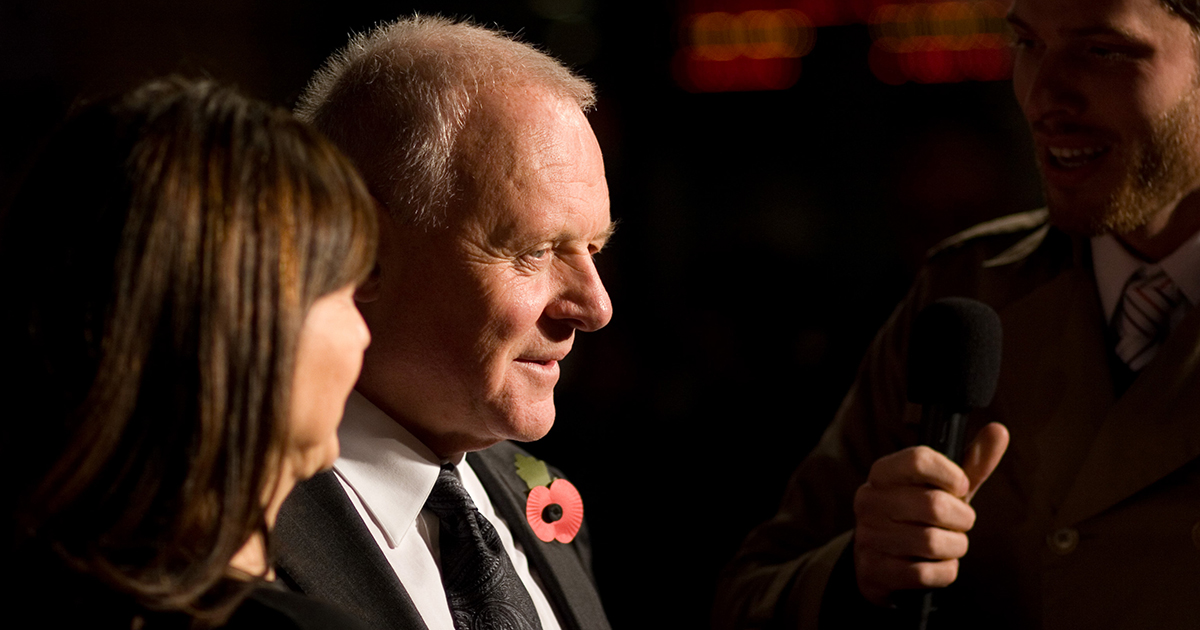

Anthony Hopkins turned 88 this year without showing any particular interest in winding down. He released a psychological thriller, Locked, kept up his painting practice, and published a memoir in late 2025. And now, as a logical next step for a man who has never done anything in the expected order, he is releasing his debut classical album on Decca Classics. Not a vanity project. Not a soundtrack. An album of original orchestral compositions that he has been writing, revising, and living with for more than six decades.
The album is called Life Is a Dream. Hopkins has been composing the collection of classical music over six decades, with the record set for release on August 21. He wasn’t sneaking off to compose between film sets as a hobby. Music came first. Acting was the detour.
The man who became synonymous with Hannibal Lecter, with Richard Nixon, with Odin, with the repressed butler Stevens in The Remains of the Day – that man was, before any of it, a boy from Port Talbot, Wales, who sat down at a piano at age four and never really got up.
The First Desire
Born in Port Talbot, Wales, Hopkins began playing the piano at age four and is said to have started performing Beethoven and Chopin just a few years later. That is not a biographical footnote. That is someone who, before he had any idea what an acting career was, had already chosen his medium. After a couple of years improvising his own themes, by his teenage years in the 1950s Hopkins was composing music for local plays.
He has talked about this for years without it ever quite landing the way it deserves to. In a 2009 interview with Gramophone magazine, Hopkins described music as his “first desire” and “first wish” – something more aligned to the concert hall than the stage. The acting career happened, spectacularly, but the composing never stopped. It just happened quietly, in hotel rooms and backstage pianos, in the margins of one of the most celebrated screen careers of the last fifty years.
One of the most specific and telling details of this story comes from 1963. Inspired by the landscape around his childhood home, Hopkins composed “Bracken Road” when he was a young actor at the Liverpool Playhouse, improvising on a piano before rehearsals. He was at the beginning of an acting career that would eventually bring him two Academy Awards. And there he was, backstage, writing music about the fields and mountains of South Wales. The piece has been with him for over sixty years. It is now the lead single of his debut album.
What the Album Actually Is
Conducted by Gustavo Dudamel and performed by the Philharmonia Orchestra, the album gathers original orchestral works inspired by Hopkins’ family, his Welsh roots, and the experiences that have shaped his life.
The album also features pianist Sergio Tiempo, cellist Gregorio Nieto, The Bach Choir, and the Choristers of Winchester Cathedral. Its 12 tracks include “Fanfare and March,” “Farewell My Love,” “And The Waltz Goes On,” “My Fatherland,” “Margam,” and two pieces for orchestra titled “Samsara” and “The Eagle.”
Other pieces are more contemporary: “Stella Aria” was written for his wife, and “Tara” was written for his niece. Then there are the three movements of the 1947: Suite for Solo Piano and Orchestra, the suite that gives the album its emotional spine. The title refers to the year, to a specific childhood, to a specific place – the streets and fields of Margam, South Wales, where Hopkins grew up as the son of a baker.
The finished orchestration of “Bracken Road” reflects several influences cited by Hopkins, including the Harry James Orchestra, Jackie Gleason’s orchestral ballads, and the slow movement of Edward Elgar’s First Symphony. That combination – American mid-century popular orchestration meeting Welsh classical tradition – tells you something about what this album is trying to do. It is not a composer reaching for prestige. It is a composer writing from memory, from genuine influence, from the specific emotional furniture of one particular life.
The album was recorded at London’s Alexandra Palace in April. Hopkins was present during the sessions and gave notes to the musicians directly.
Gustavo Dudamel and a Collaboration Worth Naming
The conductor Gustavo Dudamel is not an obligatory piece of prestige casting. He is one of the most celebrated conductors working today, and his statement about the collaboration carries real weight. Dudamel said that Hopkins “is one of those rare artists whose creative voice transcends any single medium,” adding that “the same depth of imagination, humanity, and emotional truth that has defined his extraordinary work on stage and screen is present in his music.” He described Hopkins as approaching music “with the heart of a storyteller and the instincts of a poet, creating sound worlds that are both deeply personal and universally resonant.”
Dudamel does not treat Hopkins as a celebrity curiosity. He treats him as a composer. The Philharmonia Orchestra does not perform novelty albums, and Decca Classics does not sign actors looking for a late-career reinvention stunt.
This Is Not the First Time
People discovering Hopkins’ music through Life Is a Dream will be surprised to learn that an award has already been involved. A self-taught composer, Hopkins shared the Classic Brit Award in 2012 for Album of the Year for his composition contribution to “And the Waltz Goes On,” and he made his live musical performance debut in Saudi Arabia in 2025 with the Life Is a Dream concert played by Britain’s Royal Philharmonic Orchestra.
The 2012 award came through violinist André Rieu, who recorded Hopkins’ waltz – a piece Hopkins had written in 1964 – as the title track of his album. Hopkins’ wife had sent the waltz to Rieu for consideration, and Rieu recorded it. The album reached number one in the UK charts. At the Classic Brit Awards ceremony at the Royal Albert Hall, Rieu dedicated the award to Hopkins and called him “the greatest actor we have now on this planet.” Hopkins, who had composed that waltz nearly fifty years earlier and may have assumed it would never be heard by anyone, stood in the audience and watched an orchestra play it.
The Saudi Arabia concert in January 2025 was a different kind of milestone. On January 17, 2025, Hopkins made his live musical performance debut in Saudi Arabia during Riyadh Season, with a gala concert at the Bakr Al-Sheddi Theater in Boulevard City, featuring his original compositions performed by Britain’s Royal Philharmonic Orchestra. Morgan Freeman and Matthew McConaughey hosted the evening. Hopkins opened his address to the audience with an Arabic greeting and spoke about growing up as the son of a baker in South Wales, wondering how he had arrived at this particular moment. The concert was broadcast live on MBC1. The album announcement followed about eighteen months later.
For readers interested in the longer story of artists whose musical lives span extraordinary decades, the story of Ray Anthony at 103 – the last living member of the Glenn Miller Orchestra – covers a different but equally remarkable relationship between a life and its music.
The 12 Tracks and What They Cover
The full tracklist of Life Is a Dream reads like an autobiography organized by feeling rather than chronology. “Fanfare and March” and “Farewell My Love” open and close emotional brackets. “My Fatherland” draws on traditional Welsh melodies, and “Margam” names the South Wales landscape directly. The three-movement 1947 suite anchors the album’s middle section, giving it a structural spine that connects childhood memory to orchestral form.
“And The Waltz Goes On” – the piece that brought him the 2012 Classic Brit Award – appears here again, now recorded by the Philharmonia Orchestra rather than André Rieu’s Johann Strauss Orchestra that first made it famous. It is the only track with a prior public life, and its inclusion suggests Hopkins wanted the album to be complete, to contain the arc.
“Stella Aria” and “Tara” are the most personal pieces in one specific way: they were written for living people. One for his wife, one for his niece. That is not the same as writing music inspired by landscape or memory. That is writing music as a direct act of love, intended for someone who will recognize themselves in it. Whatever else this album is, it contains that.
What “My Whole Life Is a Dream” Actually Means
Hopkins has said, in the statement released with the album announcement, that “my whole life is a dream.” He said signing with Decca is “the honor of a lifetime.” He said some of these pieces have lived with him for decades. These are not the words of someone doing a vanity project. These are the words of someone who has been holding something for a very long time and has finally been given the right room to put it down in.
A man who spent sixty years as one of the most recognized faces in cinema was simultaneously writing music that almost no one heard. Not as a secret, not as a hobby he was embarrassed about – he has talked about it openly for decades – but as a private practice that ran alongside the public one. The compositions are dated. “Bracken Road” goes back to 1963. The waltz goes back to 1964. These are not recent enthusiasms. They are a parallel life, finally given a proper recording.
Hopkins said of the project: “Music was my first desire, my first wish. I’ve been composing music all my life. Some of these pieces have lived with me for decades, and I still find myself returning to them.” Life Is a Dream arrives on August 21 on CD and digital platforms. The vinyl edition follows on October 30.
The Long Game
Hopkins has been composing since before most of his films were made, through the decades when the acting career took everything it needed, and out the other side. The Anthony Hopkins classical album was not a pivot or a retirement project. It was always there.
At 88, most people are not making their debuts. Hopkins is releasing twelve original orchestral compositions, recorded at Alexandra Palace with one of the world’s great conductors and one of London’s finest orchestras. The fact that it took this long is not a tragedy – the pieces themselves existed, were loved, were returned to. What changes on August 21 is simply that the rest of us get to hear them too.
Disclaimer: This information is not intended to be a substitute for professional medical advice, diagnosis, or treatment and is for information only. Always seek the advice of your physician or another qualified health provider with any questions about your medical condition and/or current medication. Do not disregard professional medical advice or delay seeking advice or treatment because of something you have read here.
AI Disclaimer: This article was created with the assistance of AI tools and reviewed by a human editor.