
Air travel usually follows a procedure. You board, squeeze your bag into the overhead bin, and settle into your seat. You scroll through the in-flight entertainment and pick something that will help pass the time. Around you, strangers do the same. Headphones go on. Screens glow. The cabin becomes a collection of private worlds stacked side by side. That small separation is part of what makes flying tolerable.
On a flight during the Super Bowl in 2023, nearly every passenger tuned into the live broadcast. Seatback screens across the cabin showed the same game, and replays flickered row after row. Big plays drew scattered cheers. You could feel the tension rise and fall with each drive down the field. For a couple of hours, the plane stopped feeling like a random group of strangers and became a shared living room in the sky.
While most of the cabin watched the championship game, one passenger selected a completely different film. Someone snapped a photo of their screen and posted it online. The image spread quickly. Some people laughed, while others jokingly labeled the traveler a menace to society.
The 1 dude watching Hitch on this plane should be jailed. A menace to society pic.twitter.com/Cut701G68h
— Brett Hanfling (@Brett_Hanfling) February 13, 2023
The outrage was exaggerated and playful. But the reaction reveals something deeper. Why does opting out of a shared sports moment provoke such strong feelings? Why does one person’s screen become symbolic?
In the United States, the Super Bowl is more than a football game. It functions like a cultural ritual. When nearly everyone in a confined space chooses the same broadcast, entertainment becomes something communal. It becomes a shared experience, and when someone steps outside that experience, it challenges an unspoken expectation that we participate together.
The Super Bowl as Modern Day Ritual
The Super Bowl consistently ranks among the most-watched television broadcasts in the United States. Tens of millions tune in every year. Even people who do not follow football often gather for the halftime show or the commercials. It becomes a national moment that extends beyond sports fans.
In many ways, it mirrors traditional rituals. It happens at a fixed time. Plans are built around it. Grocery stores prepare. Restaurants advertise viewing specials. Airlines stream it live. That predictability gives it ceremony. People anticipate and organize their day around it. That behavior alone signals importance.
It also creates synchronized attention. Millions watch the same plays unfold in real time. They react together. Social media fills with commentary seconds after a big moment. Group chats explode. For a few hours, vast numbers of people focus on a single narrative arc. There is suspense, victory, or heartbreak.
Sociologists describe rituals as activities that reinforce shared identity and align participants emotionally. Religious services, national holidays, and even graduation ceremonies do this. They remind people they are part of something larger than themselves, and the Super Bowl fits that pattern.
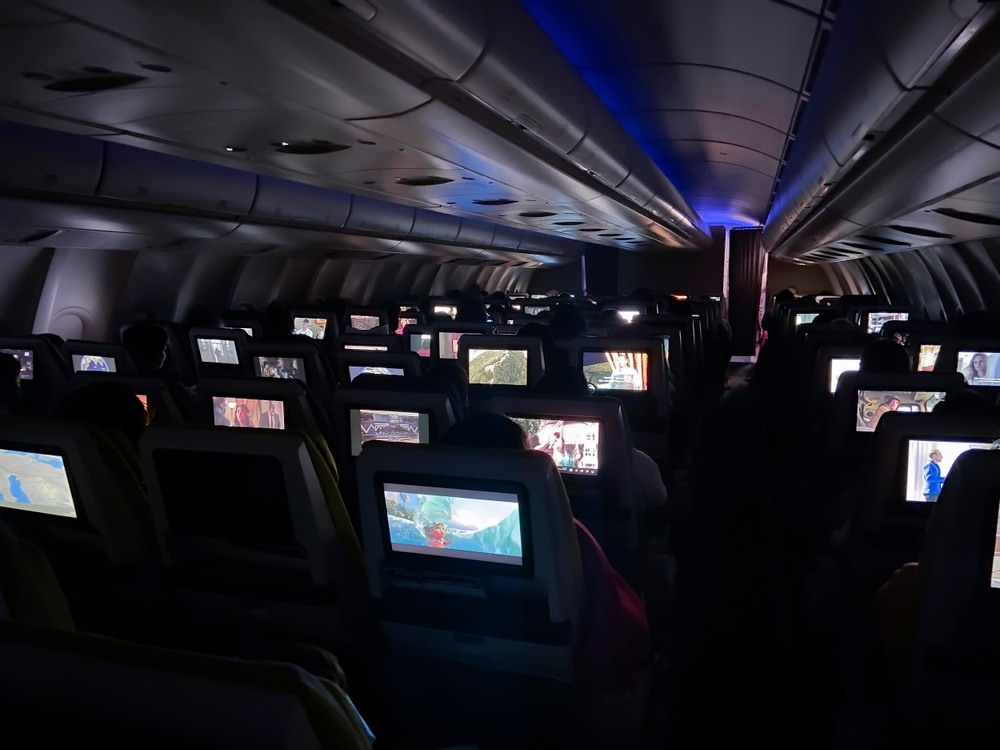
Now, picture that alignment inside an airplane. Instead of dozens of unrelated movies playing across screens, most of the cabin watches the same game. The glow of identical broadcasts creates visual unity, where strangers glance up at the same replay and the plane becomes a small reflection of the broader culture below.
In that environment, the one passenger watching something else stands out. Not because they disrupted anyone. Not because they complained. But because they were visibly outside the shared ritual.
Humans notice patterns, so when most people align, deviation becomes more visible. Psychologists often point out that contrast draws attention faster than conformity. One different light in a row catches the eye, and that is what happened here.
The irony is that airplanes are designed for individual choice. Each seat offers control over which film you choose, or whether to sleep or work. Yet when a powerful cultural event enters that space, participation starts to feel like the default.
When Entertainment Feels Like Obligation
On paper, the Super Bowl is optional, and no rule requires you to watch. Yet when almost everyone around you participates, neutrality disappears. The decision not to join begins to carry meaning.
This dynamic reflects what researchers call normative social influence. People often conform because they want acceptance or because they assume the group knows something important. The pressure does not have to be spoken. It can simply come from observing what everyone else is doing.
In a confined environment like an airplane, that effect intensifies. You are already sharing limited space with strangers. When a shared broadcast takes over most screens, it creates a temporary sense of unity. That unity feels good, and it reduces the awkwardness of proximity. It gives the cabin a common storyline. Choosing something else interrupts that symmetry.
Importantly, interruption is not the same as harm. The passenger did nothing wrong, and they exercised the same freedom everyone else had. But once a majority aligns, deviation can appear symbolic. It looks like resistance, even if it is just a preference.
Events like the Super Bowl also create social currency. Watching means you can participate in the next day’s conversations. You understand the references because you share the emotional arc. Opting out risks missing that collective debrief.
That is part of what gives major sports events ritual power. Participation signals membership in the shared moment. When someone declines, it reminds the group that belonging is a choice, not a requirement.
The internet’s reaction reflected this tension. Many comments were humorous, and some praised the passenger’s independence. Others framed the act as betrayal, though clearly in jest. Humor often exposes invisible norms, so the joke only works because an expectation exists.
The passenger did not volunteer to become a symbol. They were photographed and posted online without consent, and the ritual moved from the cabin into the algorithm.
Sports as Civic Ceremony, From Stadiums to Screens
Seen through that lens, the lone passenger’s different film choice becomes more than a preference. It represents stepping outside a shared ceremony, even if only symbolically. The act itself is harmless, yet rituals, especially ones that command synchronized attention, tend to magnify even small deviations.

In earlier eras, that moment would have remained inside the ritual space. A few people might have noticed, and some might have laughed. And then the ceremony would have continued without interruption. But today, rituals do not stay contained; they travel online.
The Super Bowl no longer unfolds only in living rooms or stadiums. It unfolds across timelines, comment sections, and trending feeds. Every shared moment now has a second life online. And once a ritual enters the digital arena, deviation does not just stand out; it spreads.
Ritual in the Age of Virality
If no one had taken a photo, the moment would likely have faded. Instead, it became content. Social media amplifies contrast. A plane full of people calmly watching the same broadcast is not compelling, but a single outlier is. It creates narrative tension and invites commentary, and algorithms reward that engagement.
Once posted, the image spread quickly. Headlines emphasized laughter and mock outrage. The framing transformed a simple choice into a cultural talking point. Modern public spaces often function like stages. Even semi-private environments, such as airplanes, are subject to smartphone documentation. People assume a level of anonymity when they travel. They do not expect their screen choice to become a viral story.
The Super Bowl, already charged with cultural meaning, amplified the contrast. Because if the event is treated like a national ritual, declining participation looks like stepping outside the collective experience. The platform highlights that tension and feeds it back to users.
Language escalates quickly online. Calling someone a menace to society is clearly exaggerated, yet it reflects how rituals draw lines between insiders and outsiders, even playfully. Shared events strengthen identity, and deviation highlights boundaries.
What fascinates many observers is how quickly entertainment becomes moralized. No one was harmed, and no rule was broken. Still, people debated the choice as if it carried a deeper meaning. The passenger’s screen symbolized independence within conformity. It exposed how strongly collective events shape expectations, even in spaces built for individual control.
Belonging and the Freedom to Choose
Humans have a powerful need for connection. Research shows that social exclusion triggers real distress. Participating in shared rituals strengthens bonds and creates what sociologists describe as collective energy. Watching a championship game together can produce that effect, even among strangers.
Inside that airplane, most passengers aligned emotionally with the same narrative. For a few hours, they shared suspense and reaction. That shared focus reduced isolation, and it made the cabin feel less fragmented. The lone passenger reminded everyone that participation is voluntary.
That reminder highlights a tension in modern culture. We celebrate individuality, and we encourage personal preference. At the same time, we crave shared experiences, and we want moments that unite us. When those two values collide, even small choices can feel significant.
The passenger may not have intended any statement. Maybe they don’t like football, or they may have been tired. They may simply have wanted a different story, yet their choice became symbolic because it occurred within a highly visible ritual moment. Some viewers admired that independence, while others reacted with exaggerated disapproval. Both responses reveal how strongly collective events influence perception.
Airplanes, ironically, are structured around autonomy. Each seat offers a screen and a menu of options and supports choice. The social atmosphere, however, can change when a major event dominates attention.
Sharing moments, or just doing what the heck you want?
In the end, the passenger’s film choice was never really about football. It was about how much meaning we attach to shared moments. The Super Bowl may be a game, but for many, it feels like a ceremony, a pause in the year when millions look in the same direction at the same time.
Maybe that is why the image struck such a chord. It captured a contrast, one screen glowing with a different story in a cabin full of sameness. Not rebellion. Not disrespect. Just a choice. And perhaps that is the real takeaway. Even inside our biggest cultural rituals, individuality still slips through, one small screen at a time.
A.I. Disclaimer: This article was created with AI assistance and edited by a human for accuracy and clarity.
Read More: Woman Sparks Outrage for Refusing to Give Window Seat to Crying Child