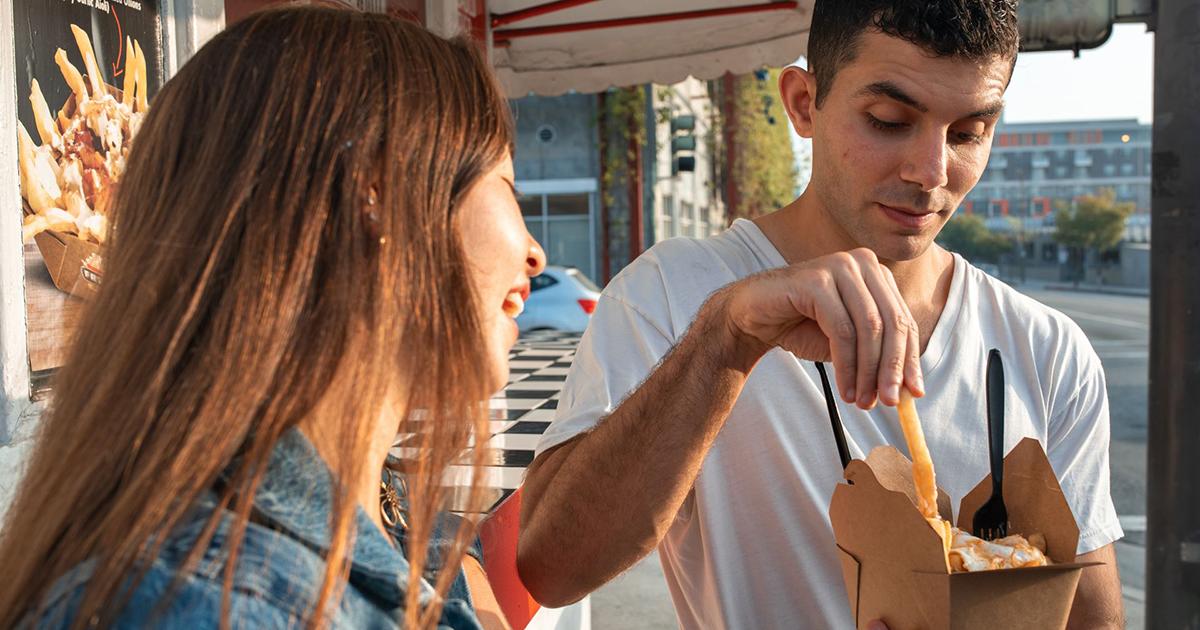

Every bite you have ever taken from someone else’s plate without asking tasted better than it had any right to. You know this. The person whose plate you raided knew it too, which is part of why they guarded it. What nobody could quite explain, until recently, was why the food was objectively, measurably more delicious despite being physically identical to what was already on your own plate. It turns out the explanation reaches into the architecture of human psychology, into the neuroscience of reward and risk, and into a behavioral phenomenon so old and so universal that it appears in the Bible, in Dante, and now in a formally peer-reviewed study involving a laboratory, a stern confederate, and a basket of French fries.
The folk wisdom that stolen food tastes better is one of those truths that people accept without much interrogation, like the sandwich made by someone else tasting better than the one you assembled yourself. Both are real. Both are measurable. And both, as it turns out, are traceable to specific, identifiable psychological processes that have nothing to do with seasoning or temperature and everything to do with what the brain does when it believes it is getting away with something. The science on this is newer than you might expect. Until 2026, almost no controlled research had directly tested whether transgression itself – the act of taking what you are not supposed to take – could systematically alter the hedonic experience of eating. Now it has been tested. The results are not subtle.
The Study: French Fries, a Stern Confederate, and the Science of Small Crimes

The researchers were careful to frame their methodology precisely: the term “stolen food” was used metaphorically, referring to a structured and ethically approved simulation of unauthorized consumption in which participants were explicitly instructed to take fries from a confederate’s portion under controlled conditions. The deception was institutional, not personal. The study was approved by the Moscow Independent Ethics Committee, all participants provided written informed consent prior to enrollment, and the protocol incorporated elements such as confederates pretending not to notice fry theft, which was fully disclosed during post-study debriefing. Participants retained the right to withdraw their data, though none exercised that option.
The experiment was conducted by Valentin Skryabin, an addiction psychologist from the Russian Medical Academy of Continuous Professional Education. A group of 120 adults rated identical portions of fries obtained under four different scenarios: their own portion, receiving fries as a gift, and taking fries from another person without permission in a mix of low- and high-risk situations. The fries were, in every measurable physical sense, identical – same weight, same temperature, same preparation. The only variable was the context in which each participant obtained them.
Stolen fries were described as crispier, saltier, and more intense, and were significantly more enjoyable than those eaten legitimately, despite no physical difference. Those taken in high-risk situations were rated nearly 40% higher in a measure of taste pleasantness compared with a participant’s own fries.
Participants also reported higher levels of guilt and excitement during unauthorized taking – but this alone could not explain why they enjoyed the fries more. Something deeper was operating. The study, published in Food Quality and Preference and titled “Stolen fries are spicier than justice: How covert larceny enhances taste,” identified three overlapping psychological processes responsible for the effect.
Three Mechanisms Behind Why Stolen Food Tastes Better

Psychological Reactance: The Brain Wants What It Cannot Have
A foundational account of why forbidden objects gain value comes from psychological reactance theory, which holds that perceived threats to behavioral freedom amplify desire for the restricted object. Empirical support for this pattern is well established, from classic demonstrations that restricted options become more attractive to later reviews confirming robust reactance effects across multiple domains. Applied to the present context, these accounts predict that the framing of an item as unavailable or forbidden should be sufficient to enhance its perceived quality, independent of any physical change in the stimulus.
Skryabin identified three processes that simultaneously influence taste perception, beginning with psychological reactance – the well-documented tendency for restricted or forbidden things to become more desirable simply because they are framed as off-limits. This is not a minor quirk of appetite. The effect of breaking the rules imposed by others is associated with reactance and commodity theory. Reactance theory assumes that people like to behave according to their own desires, and if this freedom is threatened, they experience reactance – a negative emotional state they seek to escape by behaving against the rules forced upon them.
The phenomenon is robust enough that a 2026 meta-analysis in Human Communication Research found that freedom-threatening language elicited a slightly stronger anger response than negative cognitions, indicating that anger and negative cognitions may have different weights in representing overall psychological reactance. In other words, the impulse toward forbidden things is not a single uniform reflex. It is a layered emotional response, and that layering, when applied to food, produces measurable changes in how something tastes.
Physiological Arousal: The Adrenaline Seasoning
The second process is more physical. According to Skryabin, arousal plays a direct role: taking something you are not supposed to raises your heart rate, sharpens your attention, and that heightened physiological state appears to amplify the sensory signal – the same saltiness registers with greater intensity, the same crunch feels more satisfying.
This tracks with what researchers know about how the body processes sensory information during states of elevated arousal. When the nervous system is activated – when the heart is beating a little faster and attention is sharpened – sensory inputs are not merely received, they are amplified. Researchers attribute the stolen food effect to psychological effects such as reactance, the tendency for people to perceive things as more desirable once they are restricted or forbidden, while excitement and a mild sense of guilt may also enhance the overall sensory experience. The guilt, it turns out, is not a side effect. It is part of the flavor.
As the researchers note, the context affects not just enjoyment but the way taste buds and the brain react. The stolen French fries were perceived as saltier, crispier, and fresher when served with a side of guilt. That is a qualitative shift in sensory perception, not merely a difference of opinion about enjoyment.
Expectation: A Script the Brain Has Been Running Since Childhood
The third process is perhaps the most philosophically interesting. As Skryabin explains, “We’ve all absorbed from childhood the idea that stolen food tastes better, and the brain is remarkably good at finding what it’s looking for.”
This is expectation as a sensory modifier – a pre-loaded perceptual script that the brain executes before the food even reaches the tongue. The study suggests a third pathway by which transgressive acquisition might enhance taste: if participants expect stolen food to be more enjoyable, consistent with that prior belief, the expectation itself shapes the experience. The cultural transmission of the “stolen food tastes better” maxim is therefore not merely folk wisdom. It is an active ingredient in the very phenomenon it describes. The belief creates part of the outcome it predicts.
The Forbidden Fruit Effect: A Framework Older Than the Study
The study’s findings did not emerge from a vacuum. The Forbidden Fruit Effect is the name given to the human tendency to want something more if it is off-limits or challenging to get. Psychologists first coined the term in the 1970s, but the concept has been around for much longer.
Skryabin is cautious about overreaching from a single study, but notes that the Forbidden Fruit Effect is found across literature, from the Bible to Dante’s Inferno, suggesting that restrictions amplify desire across consumer choices, information access, and even romantic attraction. The stolen food phenomenon is not, in other words, an isolated curiosity about French fries. It is a specific, edible expression of a broader human tendency – the same tendency that makes a restricted book more compelling, a forbidden relationship more magnetic, and a diet more likely to fail on the day you have declared certain foods completely off the table.
The study joins a growing body of research showing that taste is not determined solely by the food itself. Social and emotional factors also influence how intensely flavors are perceived. After all, taste is not created on the tongue alone.
The Multisensory Context of Eating: What Else Changes the Taste

The stolen food finding fits neatly within a larger and well-established body of research on environmental and contextual influences on food perception. A recent study published in Food Quality and Preference noted that there have been many studies demonstrating how outside factors affect the taste and enjoyment of food – for example, music can make wine taste better, while playing crunchy sounds can make potato chips seem more crisp.
The wine-and-music connection is particularly well-documented. A study published in Food Science & Nutrition found that the effect of music on wine perception can indeed be demonstrated even in wine experts, and the amount of wine tasting experience, as measured in years, did not moderate the influence of music on sensory and hedonic wine evaluation – suggesting that the auditory modulation of drinking experience is not influenced by the increased analytical abilities afforded by traditional wine tasting expertise.
More recently, a 2026 study in Foods examining live music at public wine tastings found that music shapes wine appreciation primarily through emotion-based and expectancy-related processes rather than through direct sensory enhancement, and that auditory context functions as a meaningful component of multisensory wine experiences.
The implication is significant: the physical substance of food is only one input into the brain’s hedonic calculation. The emotional register, the social context, the presence of risk, the soundtrack, the permission – or absence of permission – all of these recalibrate how the brain processes taste signals. Stolen food tastes better not because the fries are different, but because the eater is different in the moment of eating them.
The Risk Gradient: Why the Sterner the Guard, the Better the Fry

One of the study’s most striking findings was what might be called the social risk gradient. The investigation empirically substantiates the folk intuition that stolen food carries heightened hedonic value, demonstrating that unauthorized acquisition of French fries amplifies taste perception through identifiable psychoaffective processes. The data reveal a social risk gradient: fries taken covertly from stern confederates were rated markedly superior to those obtained legitimately or through generosity, with guilt being a key factor.
This finding has a kind of ironic elegance. The more disapproving the person guarding the food, the tastier the food becomes when you take it anyway. The fries swiped from a distracted, easygoing confederate were already rated higher than one’s own fries. The fries taken from the stern, watchful confederate – the one whose reaction you most feared – were rated highest of all. The threat of social sanction is, apparently, the finest seasoning available.
Despite the apparent superficiality of the study, the underlying principle seems solid: “The brain assigns amplified hedonic value to contested or restricted experiences,” concludes Skryabin. That principle extends far beyond the dining table.
Limitations and What Comes Next

The study was “deliberately homogeneous – French fries, one sitting, one laboratory,” meaning researchers do not yet know whether the effect applies to other foods, such as cheese, which is reportedly the world’s most stolen food. Skryabin himself notes that cheese “would be an obvious next candidate.”
The sample was also drawn from a single population, conducted under laboratory conditions rather than in naturalistic dining settings, and limited to one sitting. The controlled design was precisely what allowed the physical variables to be held constant – which is what makes the taste results credible – but it also means the findings should be treated as a robust starting point rather than a comprehensive account of transgressive eating.
Whether the effect applies beyond food is an open question. Skryabin thinks so but remains cautious about overreaching from a single study, noting that restrictions amplify desire across consumer choices, information access, and romantic attraction. Future research may test whether the stolen food effect holds across cultures with different norms around food sharing, across age groups, and in conditions where the “theft” is more genuinely unauthorized – rather than the carefully supervised simulation the ethics committee rightly required.
What the Fry Already Knew

The 2026 study by Valentin Skryabin and colleagues is the first controlled experimental evidence that transgressive acquisition of food directly enhances hedonic perception – meaning the act of taking the food without permission, rather than anything about the food itself, is what makes stolen food tastes better. Identical fries eaten under unauthorized conditions were rated nearly 40% more enjoyable than the same fries eaten from one’s own plate. The effect scaled with risk: the more fraught the theft, the tastier the spoils.
Three verified psychological processes account for the finding. Psychological reactance amplifies desire for anything framed as forbidden or restricted. Physiological arousal during a mildly transgressive act heightens attention and sharpens sensory signals, making the same saltiness more saline and the same crunch more satisfying. And cultural expectation – the deeply embedded, cross-generational belief that stolen food is more delicious – creates a perceptual lens through which the brain interprets incoming sensory data.
None of this means you should make a habit of raiding other people’s plates. But it does mean that the next time someone narrows their eyes at you across the dinner table, you are not imagining it: that fry genuinely tasted better. The brain was not lying to you. It was doing exactly what it was built to do – finding reward in the contested, the forbidden, the briefly held thing that was never quite yours to take.
AI Disclaimer: This article was created with the assistance of AI tools and reviewed by a human editor.