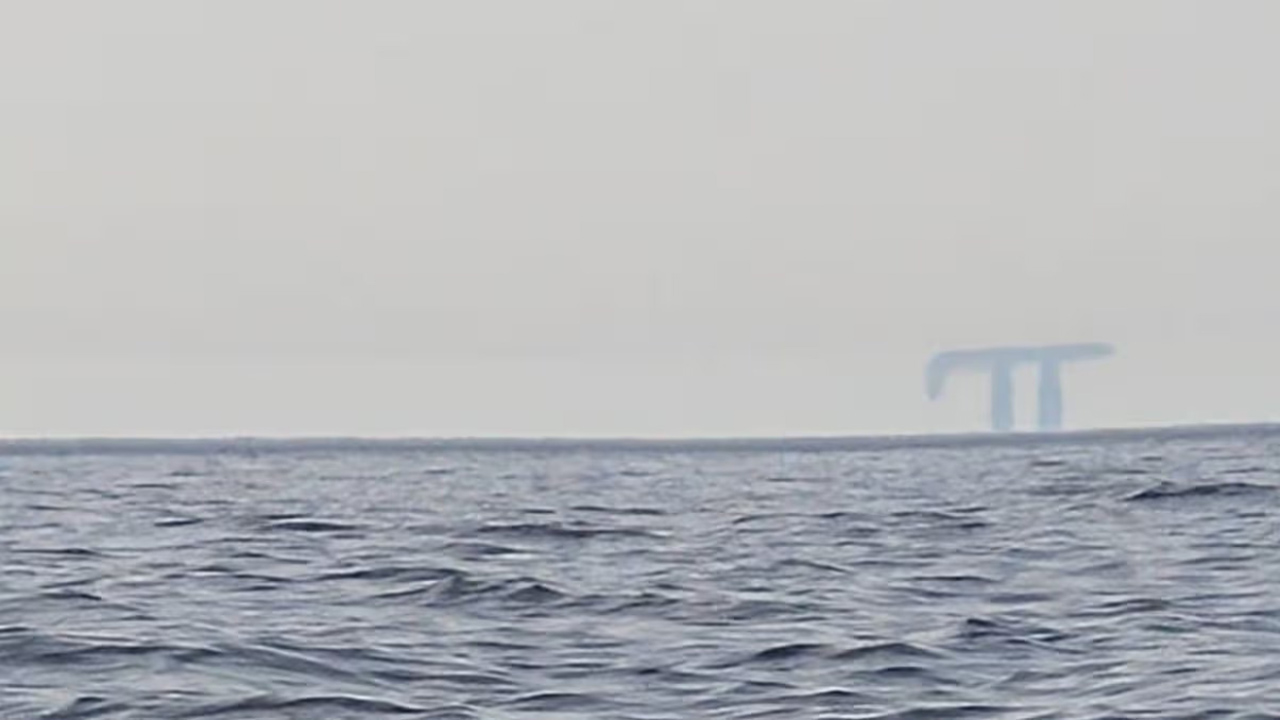

Something strange appeared above the waters off Cornwall’s north coast, and it wasn’t a cloud formation or a trick of failing eyesight. Passengers aboard a sightseeing vessel run by St Ives Boats were watching the horizon when colossal shapes began to materialize above the sea’s surface – forms so enormous, so alien in proportion, that several witnesses reached for “ghosts” and “aliens” as the only frames of reference they had. Photographs were taken. Social media threads erupted. The shapes morphed and collapsed and rebuilt themselves in the time it took people to process what they were looking at.
What they had witnessed was a St Ives Cornwall mirage of a type so rare in British waters that the company’s own operator had never encountered it there before. The phenomenon has a name – Fata Morgana – and it carries centuries of mythology, navigational catastrophe, and scientific fascination behind it. The Cornwall sighting was not simply a visual curiosity. It was a brief, startling window into one of the most dramatic atmospheric optical phenomena on Earth.
This report draws on meteorological science, historical record, and eyewitness accounts to explain what happened off the Cornish coast, why it happened, and why events like this have shaped human history in ways that go far beyond a boat trip.
What Passengers Reported
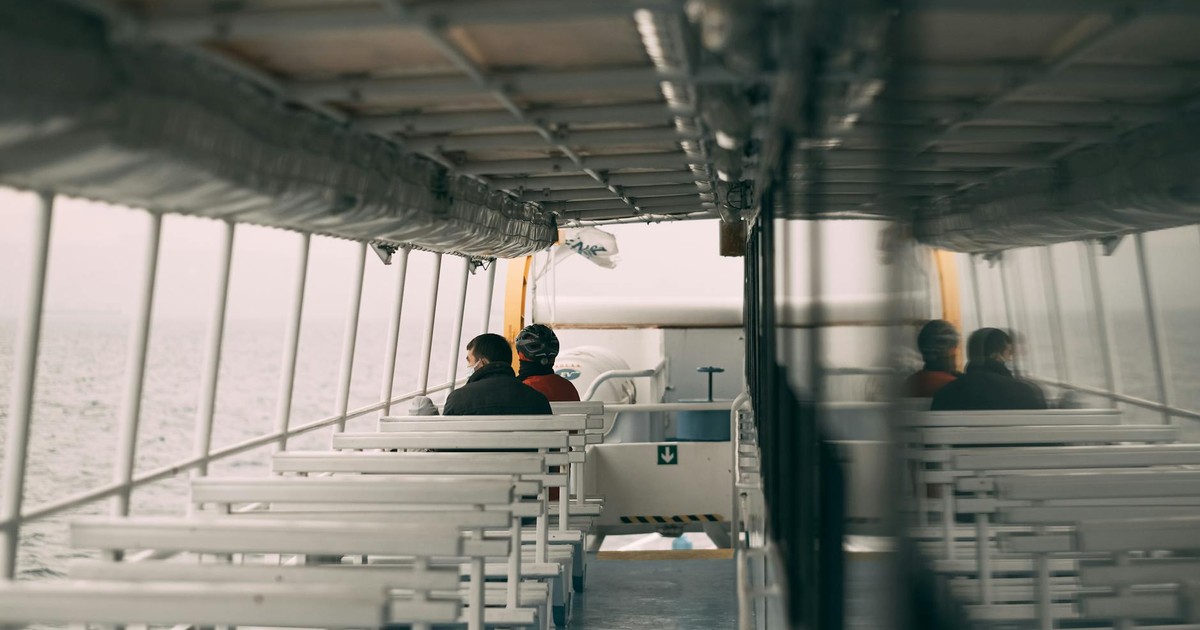
The shapes appeared to morph and change, adding to the confusion and intrigue among those on board, with one passenger remarking, “It looked like ghosts or aliens.” These were not observers straining to see something faint at the edge of vision – the raw, unfiltered reaction of reaching for supernatural vocabulary tells you something about the scale of what they saw. The extraordinary sight, observed during the sea-safari expedition, appeared to show structures stretching hundreds of metres into the sky.
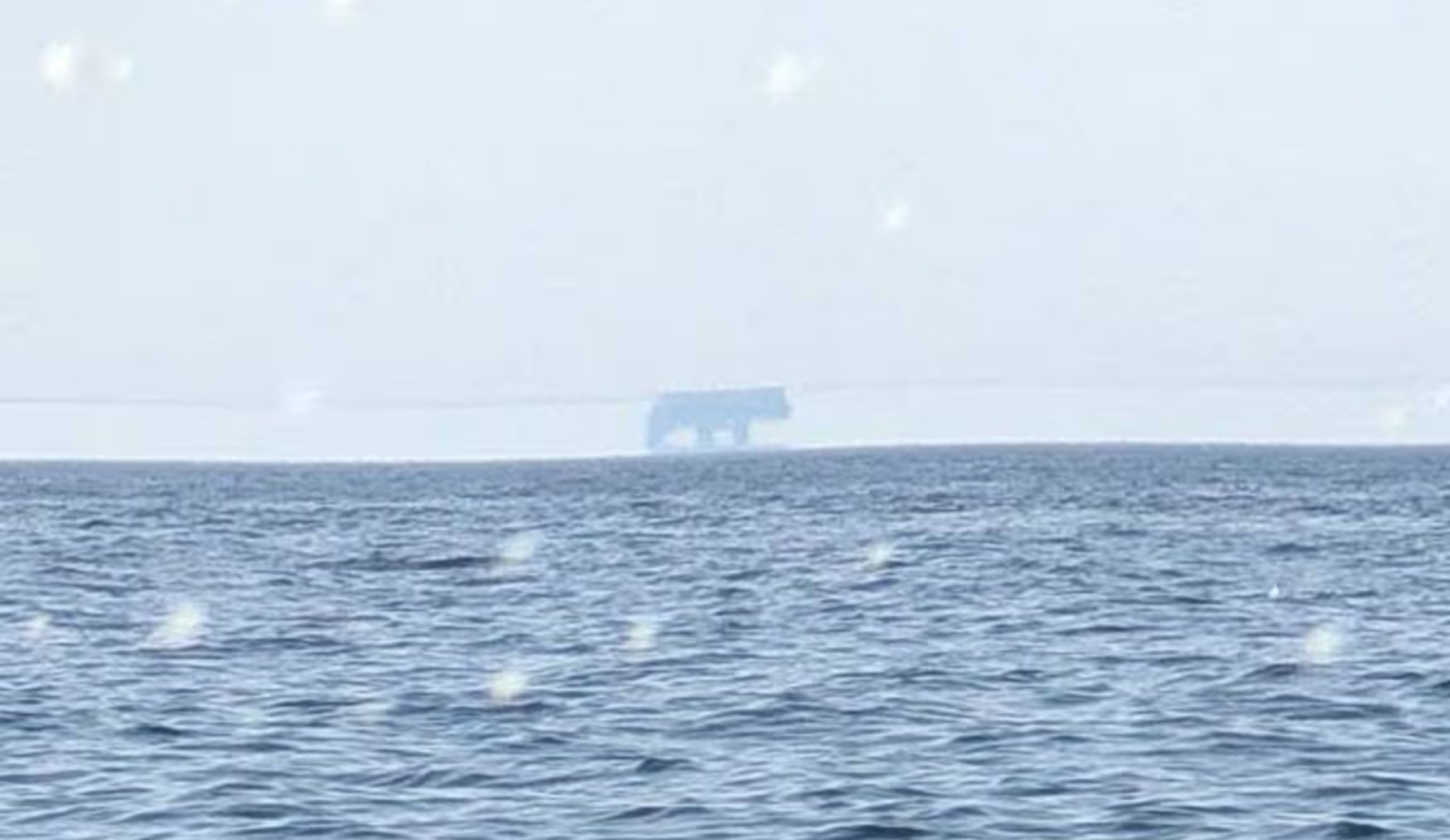
In a social media post, St Ives Boats explained: “It was surreal seeing these huge ‘structures’ and weird atmospheric changes,” adding that they believed the distortion was of an aircraft carrier and container ships that were, by that point, many miles away.
Mike Hancock, from St Ives Boats, said the “surreal” experience looked like a “huge bear on the horizon.” Online, people speculated that it might be a ship or a crane, but it was actually a Fata Morgana mirage of an aircraft carrier. What made the event particularly striking was its duration and dynamism. Hancock recalled: “It would come in and out of focus and we actually had three horizons at one point, the whole horizon sort of tripled and was bendy.” “It was just so surreal.”
Hancock noted that while he had encountered mirages previously, a Fata Morgana was something he had never witnessed in Cornish waters, though the effect occurs commonly in other parts of the world. The Fata Morgana is not a universally rare atmospheric event – it is rare here, in British coastal waters, which is precisely why passengers had no prior mental category for what they were seeing.
The Atmospheric Physics Behind the Illusion
According to SKYbrary, a Fata Morgana is a type of mirage – an image caused by atmospheric refraction, which refers to the bending of light waves as they move through mediums of different density, typically layers of air with different temperatures. But it represents the most extreme and complex end of that refraction spectrum.
For a Fata Morgana to occur, two atmospheric conditions must be met. First, there must be a temperature inversion in which the cooler layers of air sit closest to the surface and the warmer layers are stacked above. Second, the temperature gradient must be extreme enough to create an air pocket that traps light – a structure called an atmospheric duct.
The phenomenon occurs when an exceptionally steep temperature inversion traps a layer of cold air beneath significantly warmer air above, and this extreme temperature difference creates what scientists describe as an atmospheric duct, functioning like a curved lens that bends light rays far more dramatically than ordinary mirages.
How Ordinary Objects Become Giants
A Fata Morgana is a highly complex, fast-changing form of a superior mirage that drastically distorts distant objects, stacking them vertically into unrecognisable shapes or towering structures. This vertical stacking effect is what produces the illusion of enormous scale. A vessel sitting low on the water at a distance of many miles becomes, through this process of atmospheric distortion, something that appears to rear hundreds of metres into the air.
Objects like small boats, low cliffs, or small islands are stretched upwards into massive, surreal columns or walls, and the illusion frequently displays multiple images of the same object stacked on top of one another – some perfectly upright, others completely upside down. The result is something that confounds even experienced observers, because it violates every intuitive rule about how distant objects should look.
The air layers involved are rarely perfectly flat. As they ripple and move, the refracted light continuously changes, causing the mirage to shift rapidly. This is why the shapes Hancock’s passengers witnessed were not static. They grew, compressed, rotated in apparent form, and periodically vanished – only to rebuild themselves as the atmospheric layers shifted.
A Superior Mirage vs. a Fata Morgana
Most superior mirages tend to be stable, as cold air has no tendency to move up and warm air has no tendency to move down. Superior mirages can make objects below the horizon visible or distort the image of an object at the horizon, and can make things appear bigger, closer, or suspended in air. A standard superior mirage, in other words, produces a single displaced image – a ship that appears to float. The Fata Morgana is something categorically more extreme.
A Fata Morgana is a dynamic type of complex superior mirage that produces an image with multiple stacking vertical and horizontal mirage layers that are constantly in motion. According to Wikipedia’s entry on Fata Morgana, the mirage classically comprises three or more false images, which can change shapes in a matter of seconds. The Cornwall sighting, with its reported “three horizons” and continuously morphing formations, fits that description precisely.
The Name and Its Mythology
The name comes from the Italian phrase for “Fairy Morgana,” referencing King Arthur’s shapeshifting half-sister, Morgan le Fay, due to the mythical way these illusions seem to build castles in the sky.
Sailors navigating the Strait of Messina between Sicily and Southern Italy long reported extraordinary visions on the horizon – castles, towns, and islands appearing to float or shimmer above the sea. The local combination of sea currents, topography, and atmospheric conditions made the Strait particularly prone to superior mirages, and before the scientific explanation, these visions were interpreted as magical.
In some versions of Arthurian mythology, Morgan le Fay lived on a magical island called Avalon and conjured floating palaces to lure sailors off course. The Strait of Messina already had a tradition of associating her with its strange atmospheric visions. The illusion made the myth feel real, and the myth gave the illusion a name and a story – the two fed each other for centuries.
According to the Flying Dutchman legend, the ghost ship is usually spotted from afar, sometimes seen to glow with ghostly light, and one of the possible explanations for the origin of the legend is a Fata Morgana mirage seen at sea. The Cornwall passengers who instinctively reached for the word “ghosts” were joining a tradition of human perception that stretches back at least as far as the medieval period.
For a deeper look at how the brain processes images it can’t immediately categorize, this piece on visual perception and hidden images explores why even intelligent observers can be thoroughly fooled.
When Mirages Rewrote History: Phantom Islands and Arctic Exploration
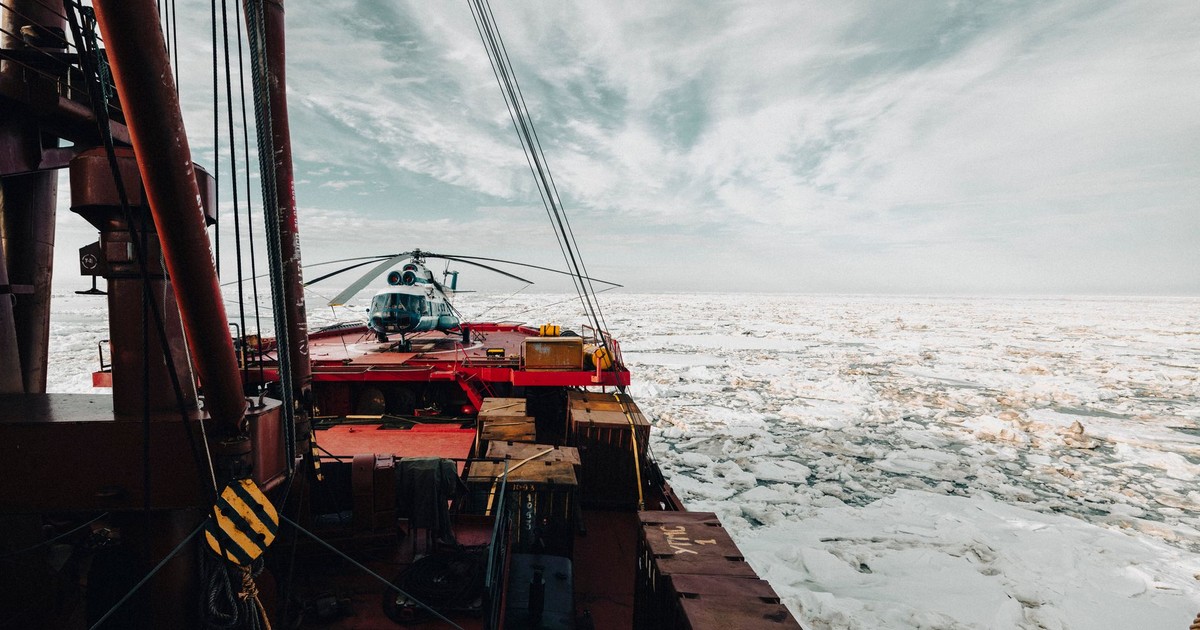
In the 19th and early 20th centuries, Fata Morgana mirages played a role in a number of “discoveries” of Arctic and Antarctic landmasses that were later shown not to exist. Icebergs frozen into the pack ice, or the uneven surface of the ice itself, may have contributed to the illusion of distant land features.
Robert Peary reported the Crocker Mountains in 1906 – what looked like a significant mountain range north of Ellesmere Island in Canada, which he mapped and named after a financial backer. A follow-up expedition found nothing there. The Crocker Mountains don’t exist. Peary almost certainly saw a Fata Morgana of distant ice formations that the atmosphere had transformed into something that looked like a mountain range.
According to National Geographic, researcher Kevin Wittmann at Spain’s Universidad de La Laguna, who completed his thesis on ancient maps, found that phantom islands “spawned many problems for seafarers chasing these shadowy landmasses.” As Wittmann noted: “Those expeditions were expensive, and in some cases dangerous, and finding out that they were sailing to a place that doesn’t exist was not good.”
In the Arctic, Fata Morgana Land exemplifies such an illusion – first reported in 1907 by Danish explorers Johan Peter Koch and Aage Bertelsen during the Denmark Expedition to northern Greenland, appearing as a vast archipelago with cliffs and snow-covered peaks. It does not actually exist. Its status as a mirage was confirmed only in 1993.
Phantom islands appeared on official maps. Ships locked themselves in ice chasing landmasses made entirely of refracted light. Some of those expeditions ended very badly.
Why Cornwall? Conditions That Make It Possible
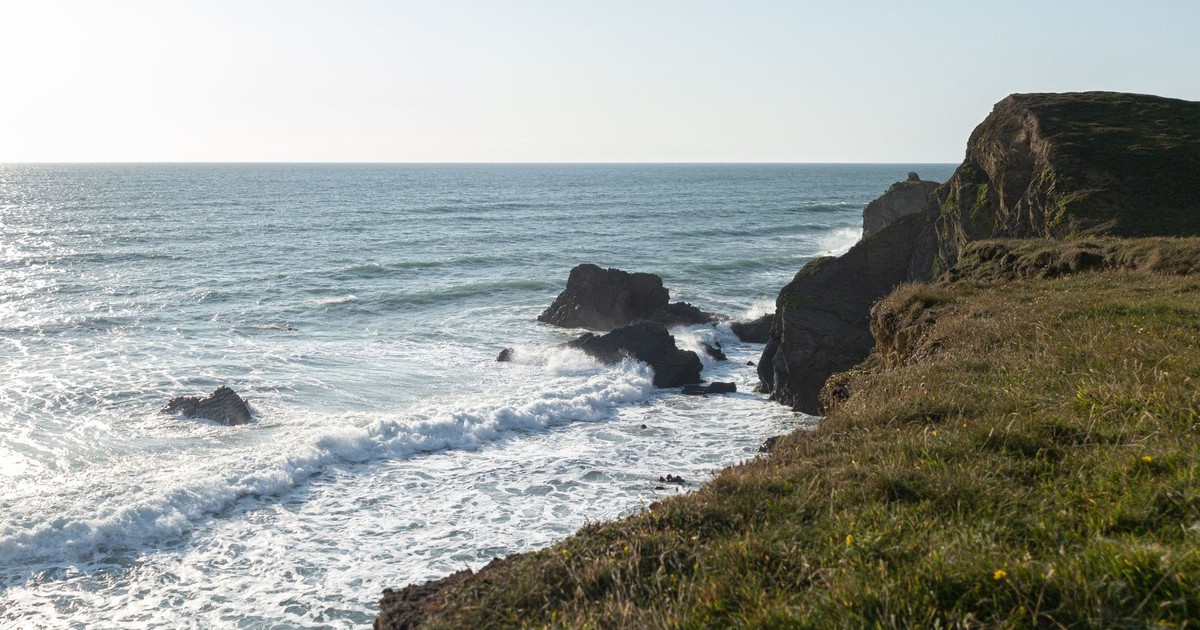
The Fata Morgana effect is most likely to occur where significant temperature differences exist between layers of air, such as across oceans, glacial expanses, or desert regions. Cornwall’s coastal waters are not typically associated with the extreme thermal inversions necessary to produce one.
Superior mirages usually appear in polar regions or at other latitudes over a cold body of water with a layer of warmer air above it. The Cornish sea in the right seasonal conditions – cold surface water meeting warm, still air above – can occasionally reproduce those dynamics on a smaller scale. When it does, the visual consequences can be as dramatic as anything seen in the Arctic.
The optical phenomenon occurs because rays of light bend when they pass through air layers of different temperatures in a steep thermal inversion where an atmospheric duct has formed. In calm weather, a layer of significantly warmer air may rest over colder, denser air, forming the conditions required. The combination of relative sea calm, an unusual thermal profile for the season, and the presence of large distant vessels – an aircraft carrier and container ships miles offshore – provided both the atmospheric mechanism and the raw material for the illusion.
Fata Morgana mirages are visible to the naked eye, but in order to see the detail within them, it is best to view them through binoculars, a telescope, or a telephoto lens. The photographs taken by St Ives Boats passengers, shot through camera optics, captured more structural detail than the naked eye alone would have resolved.
Social Media, Speculation, and the Public Response

An image showing the rare mirage off the coast of Cornwall led to significant speculation on social media about exactly what it was. Mike Hancock from St Ives Boats had spotted it off the north coast, and online commenters speculated that it might be a ship, a crane, or other objects – before the Fata Morgana explanation emerged.
The guesses cycling through comment threads – crane, cargo ship, offshore platform, military structure – all shared a common instinct: that something physically solid must be responsible. That instinct is completely understandable and, scientifically speaking, not entirely wrong. There was a solid object involved. It was simply located many miles away, beyond the visible horizon, and the atmosphere had stretched and stacked its image into something unrecognizable.
Unlike so-called perceptual “optical illusions,” a mirage is a real optical phenomenon and can be photographed. The photographs circulating on social media were not capturing something that didn’t exist. They were capturing real light, genuinely bent into an extraordinary shape by real atmospheric physics. People who dismissed the images as doctored or staged were making the same error as those who dismissed them as supernatural – both assumed the camera was lying, when the atmosphere was the one doing something unusual.
What This Tells Us About Where We Look
The St Ives Cornwall mirage event was not a hoax, a drone display, or a mass misperception. It was a textbook, if exceptionally rare, Fata Morgana – a superior mirage of the most complex and visually dramatic kind – produced by a precise atmospheric configuration over Cornish coastal waters, with a distant aircraft carrier providing the raw object for the atmosphere to distort.
The science is mature. The conditions required are well understood: cold surface air, significantly warmer air above, and a steep enough temperature gradient to form an atmospheric duct that bends light far beyond what standard superior mirages achieve. What is unusual in this case is the location. Cornwall is not the Strait of Messina. It is not the Arctic. The thermal inversions necessary for a full Fata Morgana are genuinely uncommon in British coastal waters, which is why an experienced boat operator who had seen ordinary mirages before had never witnessed one there.
The historical record adds weight to what might otherwise seem like a single eccentric afternoon off the Cornish coast. This same phenomenon inscribed nonexistent islands onto official navigational charts. It sent expeditions into polar ice in pursuit of landmasses that consisted of nothing but refracted light and cold air. Baron Eduard Toll led an expedition to find Sannikov Land – almost certainly a Fata Morgana of Bennett Island – and he and three companions were lost after departing their ice-bound ship on a dog sled journey from which they never returned. The passengers aboard the St Ives Boats sea safari were, in a practical sense, extraordinarily fortunate to be standing on a modern vessel with cameras in their pockets rather than navigating by those charts.
What the Cornwall sighting adds to the record is a reminder that the Fata Morgana is not geographically contained to the places we most associate with it. Given the right atmospheric conditions – conditions that climate variability makes incrementally less predictable – it can appear anywhere that cold water meets warm air in the right proportions. And when it does, it will not announce itself as a mirage. It will announce itself as something impossible.
AI Disclaimer: This article was created with the assistance of AI tools and reviewed by a human editor.