

Hair loss has a way of turning rational women into supplement hoarders. The panic sets in sometime around week three of watching the drain accumulate more than it should, and suddenly you’re standing in a pharmacy aisle reading the back of a bottle that promises “visible thickness in 30 days” with a blend of seventeen ingredients you’d need a biochemistry degree to evaluate. You buy it. Of course you buy it. And then, sometime around week six, you start to wonder whether your hair is actually worse.
That instinct deserves a second look. The supplement industry has built an entire category around the very understandable panic of watching your hair thin, and the pitch is almost always the same: you must be deficient in something, and this capsule has it. The reality is considerably messier. Some supplements genuinely help, but only under specific conditions. Others are genuinely capable of making hair loss worse. And a handful sit in a gray zone where the marketing is miles ahead of the science.
What nobody on the label is going to tell you is that the difference between a supplement helping your hair and harming it often comes down to whether you actually needed it in the first place.
The Problem With Supplementing in the Dark
According to the ISHRS, hair restoration experts warn that consuming supplements without getting to the root of what is causing hair thinning may not only be a waste of money but can also be hazardous to your hair health. While multiple types of hair loss can be associated with or worsened by vitamin or mineral deficiencies – most commonly zinc, iron, and vitamin D – consuming excess amounts of those same substances can also cause shedding, which compounds the problem.
This is the part the marketing skips. The assumption built into most hair supplement advertising is that more of a good thing is always better, and that assumption is wrong for almost every nutrient involved in hair growth. The hair follicle is not a bucket you fill. It’s a cycle – a biological rhythm of growth, transition, and rest – and disrupting that cycle is just as possible by overdoing nutrients as by running low on them.
Hair restoration experts recommend establishing baseline serum levels through routine blood tests to determine whether a deficiency actually exists before supplementing. That one step, which takes a single appointment and a standard blood panel, is the difference between a supplement that works and one that quietly accelerates the very problem you’re trying to fix. And yet most people skip it entirely, because the bottle is right there on the shelf and the blood test requires a doctor.
The Biotin Situation
Biotin is probably the most over-supplemented vitamin in the hair care space, and it’s also the one with the largest gap between popular belief and clinical evidence. Walk into any pharmacy and you’ll find biotin supplements in doses ranging from 1,000 to 10,000 micrograms, often marketed specifically for hair, skin, and nails. The doses are enormous relative to what the body actually needs, and the promise is specific: take this, grow more hair.
A 2024 review in the Journal of Clinical and Aesthetic Dermatology examined all available controlled trials on oral biotin for hair growth. The researchers found a large discrepancy between public perception of biotin’s efficacy and what the scientific literature actually supports – and the highest-quality study in the group found no difference between the biotin group and the placebo group. The other trials were vulnerable to methodological bias and produced no striking results in biotin’s favor.
What biotin can do, in doses that high, is interfere with your bloodwork. Elevated serum biotin levels can interact with various laboratory immunoassays, and a death has been reported where biotin interference with a troponin test led to the missed diagnosis of a heart attack. Thyroid panels, hormone levels, vitamin D readings – all of these can return skewed results when someone is taking high-dose biotin. So the supplement that isn’t helping your hair may also be obscuring the actual cause of your hair loss when your doctor runs tests. That’s the scenario that should give anyone pause.
Vitamin A: The One That Actually Can Make It Worse
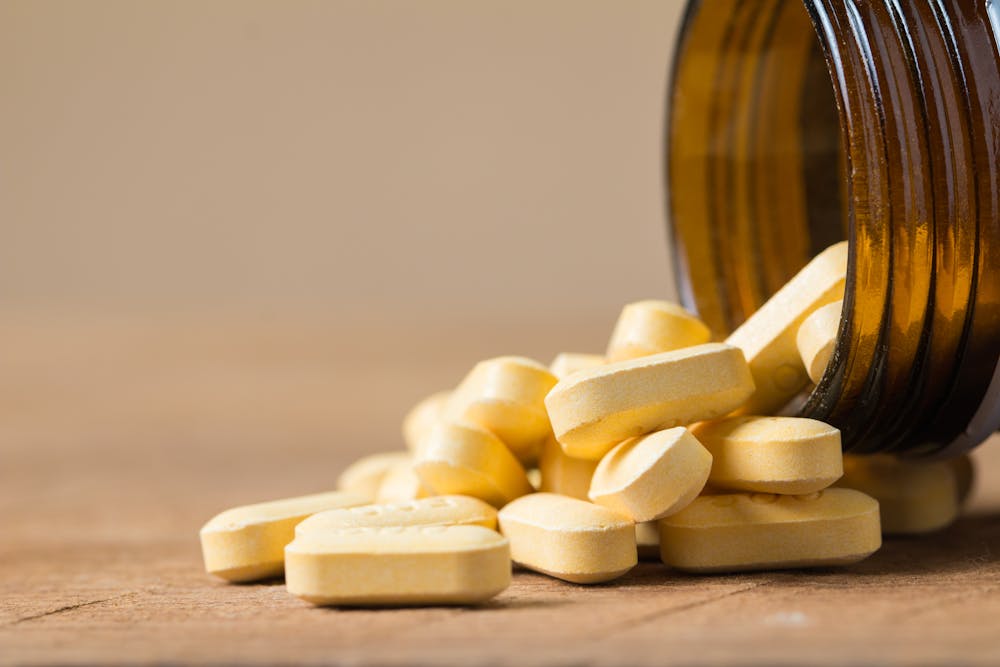
If biotin is the supplement that doesn’t do much, vitamin A is the one that can actively backfire. According to Harvard Health, excessive intake of vitamin A and selenium, in particular, can lead to increased hair loss – and this finding is well-supported across dermatology literature.
The mechanism involves the way the body handles fat-soluble vitamins. Unlike vitamin C or B vitamins, which flush out through urine when you take more than you need, vitamin A accumulates in the liver. The most frequent cause of supplement-induced hair loss is chronic, excessive intake of vitamin A: because it is fat-soluble and the body stores unused portions in the liver, toxic levels build up with sustained overuse. For adults, the tolerable upper intake level is 3,000 micrograms of preformed vitamin A per day, and consistently exceeding this threshold – often through high-dose supplements or retinoid acne medications – can damage hair follicles and trigger shedding.
The particular risk here is stacking. A woman might take a general multivitamin that already contains vitamin A, eat fortified foods, use a hair supplement with additional vitamin A, and top it off with a retinol skincare product – and suddenly she’s well above the upper limit without realizing it, because no single source looks alarming on its own. Hair loss from vitamin A toxicity doesn’t announce itself with a label. It just looks like your hair is falling out more than it should, which was presumably the thing you were trying to stop.
Selenium: A Narrow Safe Window
Selenium sits in most hair and nail supplements because it genuinely does play a role in thyroid function and in the structural integrity of hair. The problem is that its safe range is narrow. If you exceed 400 micrograms of selenium daily, you may develop selenium toxicity, which can manifest as severe digestive, neurological, and cardiological symptoms – and can also cause hair to fall out.
A 2023 case report in the Journal of Cosmetic Dermatology documented a 48-year-old woman who developed severe hair loss and nail discoloration within weeks of starting a selenium supplement and a multivitamin complex. The proposed mechanism involves selenium substituting for sulfur in keratin proteins, disrupting the disulfide bridges that give hair its structural integrity and leading to abnormal development of both hair and nail protein structure.
The case is notable not because it’s unusual but because it illustrates exactly how these situations unfold: a person takes two supplements simultaneously, neither of which looks dangerous on its own, and ends up with selenium toxicity because the combined dose crossed the upper limit. Since selenium supplements aren’t always properly monitored and may contain higher doses than recommended, it is ideal to get daily selenium from food sources like fish, cereals, poultry, eggs, and dairy – and a robust body of scientific literature confirms that too much selenium causes moderate to severe hair shedding through selenium toxicity.
The Hidden Ingredient Problem
Beyond the individual nutrients, there’s a structural problem with the supplement industry that is worth understanding before reaching for any hair supplement. The FDA is not authorized to review supplements for safety and efficacy before they go to market, and there are reports of inadequate active ingredients, microbes, heavy metals, and toxins found during compliance monitoring by independent organizations.
This matters practically because it means the label on a hair supplement is a representation, not a guarantee. A bottle that claims to contain a certain dose of a nutrient may contain more, less, or something different entirely. And for nutrients like selenium and vitamin A, where the gap between helpful and harmful is not that wide, that uncertainty has real consequences.
A 2025 case report from researchers at NYU Grossman School of Medicine illustrates a subtler version of this problem. A patient was unaware that a popular hair nutraceutical contained vitamin D, leading to unintentional excessive intake when she was also supplementing vitamin D separately. The case highlighted that because these supplements are available over the counter and routine vitamin D screening is not recommended for the general population, elevated levels and potential toxicity may go undetected in many patients. She wasn’t doing anything reckless. She was just taking what the bottle told her to take, without knowing that another bottle she was already using contained the same ingredient.
When Supplements Actually Help
None of this is an argument against supplements as a category. It’s an argument for specificity. The conditions under which supplements genuinely support hair growth are documented – they just require a diagnosis first.
Iron deficiency is one of the strongest established links to hair loss, particularly in premenopausal women. Vitamin D deficiency has a well-supported association with multiple forms of hair thinning, including the kind that follows major physical stress like childbirth or illness. Zinc deficiency can contribute to diffuse thinning. When any of these deficiencies is confirmed by a blood test, targeted supplementation at appropriate doses addresses the actual cause of the shedding, and the hair responds. That’s the scenario where the supplement category earns its reputation.
The issue is that this scenario requires a diagnosis, and the supplement aisle doesn’t ask for one. Some supplements can contribute to hair shedding when taken in high doses or without a clear deficiency – what supplements cause hair loss is often less about the product itself and more about overuse, nutrient imbalance, or toxicity disrupting the hair growth cycle, as excess amounts of vitamins and minerals can push more follicles into the shedding phase.
Getting the Blood Test You Actually Need
If your hair is thinning and you want to do something about it, the most productive step is a conversation with your doctor before you buy anything. A standard panel can check your ferritin (iron stores, not just iron levels – ferritin is the more sensitive measure), vitamin D, zinc, thyroid function, and in some cases hormone levels. Each of those results tells you something specific. A low ferritin number means iron supplementation is likely to help. A normal ferritin number means it probably won’t.
This doesn’t need to be a dramatic medical event. It’s a conversation most primary care doctors are happy to have, and it takes a single blood draw. What it gives you is information – which is the one thing the supplement label consistently refuses to provide.
If you’re already taking a hair supplement and your hair loss has worsened rather than improved, that’s a legitimate data point worth taking seriously. It doesn’t necessarily mean the supplement is causing the problem, but the possibility that it’s compounding it is real enough to warrant a pause and a blood panel before continuing.
What This Is Really About
The appeal of supplements for hair loss is not irrational. Hair thinning is stressful in a way that is genuinely hard to explain to someone who hasn’t experienced it, and when doctors don’t have a clear answer or much treatment time to offer, a bottle on the shelf that promises something feels better than nothing. The problem is not that the impulse is wrong. The problem is that the industry meets that impulse with marketing, not medicine.
The honest version of the hair supplement story is this: the nutrients that support hair growth are real, deficiencies in those nutrients are real, and correcting a confirmed deficiency can genuinely help. But taking a supplement without knowing your levels is a gamble, not a treatment – and for several nutrients, the odds of making things worse are higher than the label will ever admit. Getting a blood test first doesn’t close off any options. It just makes the options you choose worth taking.
Disclaimer: This information is not intended to be a substitute for professional medical advice, diagnosis, or treatment and is for information only. Always seek the advice of your physician or another qualified health provider with any questions about your medical condition and/or current medication. Do not disregard professional medical advice or delay seeking advice or treatment because of something you have read here.
AI Disclaimer: This article was created with the assistance of AI tools and reviewed by a human editor.