

The leg has been bouncing under the conference table since before the meeting started. The song has been looping in the back of your head for three hours, not because you like it that much, but because the repetition of it does something. The thumbnail finds the edge of the credit card when you’re on hold. The fingers drum a private rhythm on the steering wheel at red lights. None of these things have ever seemed worth examining. They’re just what you do.
Stimming, short for self-stimulatory behavior, is the term used to describe repetitive movements, sounds, or sensory actions that the brain reaches for to regulate itself. According to research, stimming is associated with autism and ADHD, though anyone can experience it. Which means the person reading this right now, with no diagnosis of anything, might have been stimming their way through life for decades without ever knowing what to call it.
What makes stimming behaviors worth understanding is not that they’re pathological. Most of the time, they’re not. They are the nervous system doing what the nervous system does: trying to find equilibrium in a world that is frequently too loud, too dull, too uncertain, or too much. Below are nine behaviors that might look completely ordinary from the outside but are, in fact, exactly what stimming looks like in real adult life.
1. Leg Bouncing and Foot Tapping

The office meeting is twenty minutes in. The agenda has been covered. Someone is still talking. And your leg, entirely without your permission, has been vibrating the underside of the table since minute four. This is almost certainly the most universally recognized stimming behavior in existence, and it gets dismissed constantly as impatience or rudeness when it is usually neither.
Vestibular stims – movements that engage the body’s sense of balance and spatial awareness – include rocking back and forth, bouncing the leg, spinning, jumping, or shaking the head. Leg bouncing belongs firmly in this category. The rhythmic, repetitive quality of the movement is exactly what the nervous system is after. It’s not that you’re bored, exactly. It’s that the meeting requires you to sit still and be cognitively present, and your body has decided those two things are in conflict and is doing something about it.
According to Neurospark Health, ADHD stimming is more often about maintaining attention, energy, and impulse control – an autistic adult might rock or flap when overwhelmed, while someone with ADHD might click a pen, bounce their leg, or twirl their hair to stay focused. The leg bounce, in other words, is not a sign that you’re checked out. It’s often the opposite.
2. Hair Twirling and Scalp Touching

The hand goes up and finds the hair before you’ve registered that your brain was looking for something to do. You might wind a strand around your finger, tug lightly, rub it between your fingertips, or run your fingers slowly across your scalp. You’ve probably been doing this since childhood. Someone, at some point, probably told you to stop. You likely did not stop.
Tactile stimming behaviors can be self-oriented, like hair twirling, skin rubbing, scratching, nail biting, or making twiddling movements with hands. Hair twirling is one of the most common tactile (touch-based) stims across all neurotypes. The sensation of the hair between the fingers, the slight pressure on the scalp, the repetitive motion – all of it delivers a precise and reliable kind of sensory feedback. The nervous system receives input it knows how to process, and something settles.
What makes hair twirling worth examining is how automatic it is. Most people who do it don’t notice they’ve started. They’re on a phone call, or sitting with a difficult email draft, or watching a movie that’s slightly too intense, and the hand has already made its way there. The body found what it needed before the mind knew it was looking.
3. Nail Biting and Cuticle Picking

This one makes people uncomfortable to discuss because it can cross into territory that leaves marks, and because the cultural message around it is shame rather than curiosity. But nail biting and cuticle picking are textbook stimming behaviors, and understanding that is actually more useful than decades of being told to just stop.
Nail biting fits precisely into stimming: it provides consistent oral and tactile stimulation, it has a predictable rhythm, and it’s most common during moments of stress, boredom, or intense cognitive focus – all situations where the nervous system is looking for something to regulate around.
The real line to notice is the difference between occasional nervous nail biting and the kind that happens so automatically you’re mid-bite before you’ve noticed you raised your hand. The latter is not a bad habit waiting for a strong enough desire to change. It’s a regulatory mechanism your brain has been reaching for because it works, and the reason it keeps working is the same reason all stimming behaviors do: the repetition, the sensation, the rhythm.
4. Rocking and Swaying

Rocking gets coded as something children do, or something that signals distress so severe that onlookers feel unsettled. In reality, it is one of the oldest and most universal self-regulatory movements human beings have. You rock a crying baby. Adults rock in rocking chairs. People sway side to side while standing in lines they didn’t choose. The motion is deeply embedded.
Whether you realize it or not, habits like these could be considered self-stimulatory behaviors, also known as stims. According to the Cleveland Clinic, stimming is identified by its repetitive movements and vocalizations. Rocking engages the vestibular system – the part of the inner ear and brain that governs balance and spatial orientation – and produces a calming feedback loop. This is the same reason that rhythmic movement is reliably used to soothe infants, and why the impulse to sway doesn’t fully disappear when you grow up.
For adults, rocking tends to be more contained: a slight forward-and-back shift in a chair, swaying while standing at a kitchen counter, the unconscious rhythm that happens while you’re absorbed in something difficult. If you’ve ever caught yourself doing this during a hard phone call, or while reading something that required full concentration, you weren’t being strange. Your brainstem was being practical.
5. Pen Clicking and Object Fidgeting

The pen clicks. It clicks again. And again, and again, in a pattern that the person sitting next to you has been clocking for eleven minutes and composing a strongly-worded internal monologue about. This is, objectively, one of the more socially fraught stimming behaviors, but it belongs on this list because it is extremely common and almost universally misunderstood as mere thoughtlessness.
ADHD stimming in adults often takes the form of fidgeting or repetitive movement used to stay focused or manage restlessness, with common examples including leg bouncing, pen clicking, finger tapping, doodling, pacing, playing with hair, or chewing gum. Object fidgeting works because it gives the hands something reliable and repetitive to do. The clicking of a pen, the spinning of a ring, the folding and unfolding of a piece of paper – these behaviors occupy the part of the brain that wants to move so that the part of the brain that needs to think can get on with it.
The interesting wrinkle is that this kind of stimming is often most intense during the activities that look like they require the most focus: a meeting, a lecture, a difficult conversation. That’s not a coincidence. The body is managing input so the mind can stay present. The fidgeting is, in its own roundabout way, how you’re paying attention.
6. Humming, Singing Under Your Breath, and Vocal Sounds

There is the person who hums while they work, the person who narrates slightly under their breath, the person who makes small, almost inaudible sounds when they’re concentrating deeply. These are not personality traits. They’re vocal stimming behaviors, and they’re significantly more common than most people realize.
Humming a random song, biting nails, or absentmindedly spinning a pen to help pay attention, chewing on pens or rocking back and forth when anxious – this is stimming, and it’s a normal part of living with adult ADHD. Vocal stimming works through the same principle as physical stimming: the repetition and the sensory quality of the sound create a predictable, controllable input that helps regulate the nervous system. Humming, specifically, produces vibration in the chest and skull, which has its own distinct physical quality, separate from the sound itself.
People often suppress vocal stimming early because it draws attention and reaction from others. A child who hums constantly during classwork will be shushed. An adult who makes small sounds while focusing at a desk might hear comments about it. This early and repeated correction can make adults unaware that the behavior still emerges in private – in the car, at home with the headphones on, wherever there’s no one watching.
7. Skin Picking and Repetitive Touching
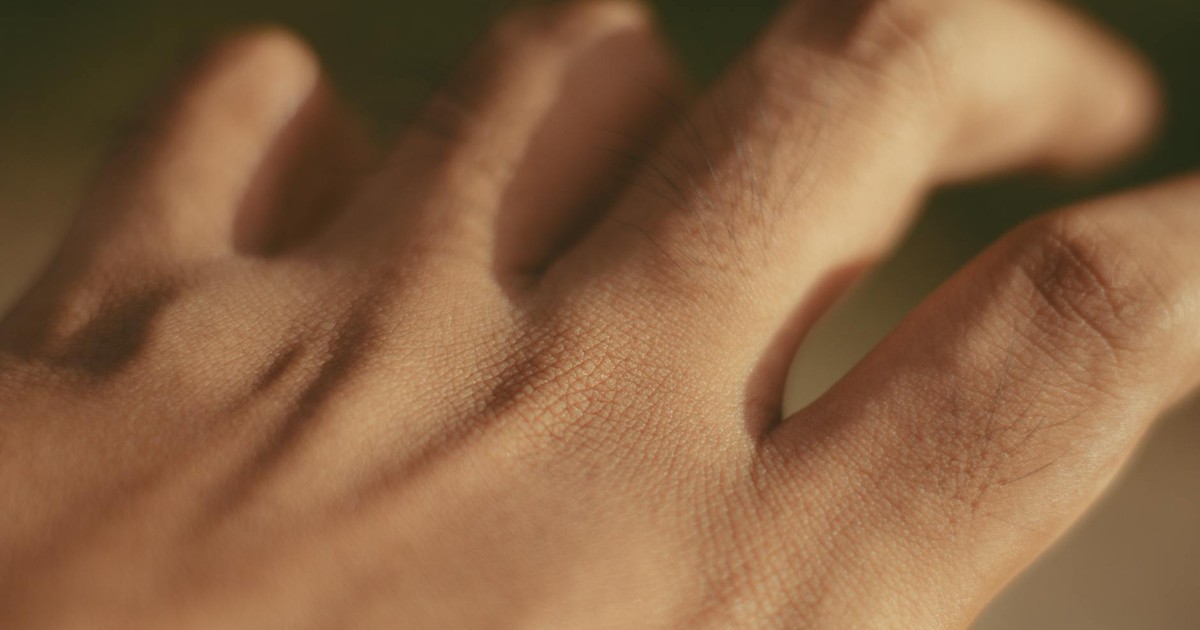
This is the stimming behavior most frequently mistaken for something else: anxiety, obsessive behavior, a stress response that’s gotten out of hand. All of those things can be true at the same time as it being a form of stimming. The categories are not mutually exclusive.
Skin picking and repetitive touching belong in the tactile stimming category and often happen when other regulatory options are unavailable. You’re in a situation where you can’t move freely, can’t make noise, and have to stay still and appear composed. The fingers find a rough patch of skin on your hand, or the edge of a hangnail, and the repetitive tactile feedback provides what the rest of the environment isn’t.
Research from the University of Rochester Medicine (April 2025) found that in people with autism, the brain processes self-generated touch differently than in neurotypical adults, which may help explain why repetitive touch behaviors are so persistent and so hard to simply will away. If skin picking has become something that leaves marks, interrupts what you’re trying to do, or happens without any awareness that it started, the nervous system is asking loudly for something it isn’t getting – and the most useful response is curiosity, not shame.
8. Repetitive Speech and Phrase Echoing

This one surprises people. Most stimming behavior is physical, so the vocal-cognitive version gets overlooked. But repeating phrases, replaying conversations, echoing lines from TV shows or songs in your head, or saying the same words in sequence under specific circumstances – all of these can be stimming behaviors.
Stimming is often a way of getting sensory needs met or regulating sensory experiences. Sometimes people stim without thinking about it, and other times they stim on purpose, and it might also be related to the emotions someone is feeling. Verbal repetition works the same way physical movement does: the familiar, controlled quality of a known phrase or sound delivers predictable input to the brain. If you’ve ever found yourself looping a specific song in your head during a stressful commute, not because you love the song but because the repetition itself is what you need, this is the underlying mechanism.
The echoing of lines from films or shows – sometimes called scripting – is a well-documented behavior in autistic people, but milder versions of phrase repetition and verbal looping appear in people across all neurotypes. It sits at the edge of stimming and habit, and the line between them is less important than the recognition that the behavior is serving a function.
9. Tapping, Drumming Fingers, and Rhythmic Hand Movements

The fingers drum the desk during a conference call. The hand taps a pattern on the thigh in the waiting room. Two fingers knock a private rhythm on the steering wheel between traffic lights. There is no song. There is no audience. There is just the repetition, the mild impact, the reliable return of the sensation.
According to a 2025 study in SAGE Journals examining autistic adults’ experiences of stimming, many participants described their stimming as a positive experience and a genuine source of sensory comfort – though one they frequently suppressed to avoid social judgment. Finger tapping and rhythmic hand movements are among the most straightforward examples: the motion is controlled, repetitive, and produces consistent tactile and proprioceptive feedback. Proprioception – the body’s sense of where its own parts are in space – is one of the regulatory systems that stimming tends to engage. Tapping and drumming give the nervous system a stream of self-generated, predictable input that it can use to calibrate.
What distinguishes this from simply being restless is the specific and private quality of it. The patterns tend to be consistent for a given person across time. You likely tap the same rhythms, in the same situations. That specificity is not random. The nervous system found something that works and returns to it.
What You Were Actually Doing All Along

The suppression starts early. You stop the leg bounce when someone looks at you. You swallow the hum. You sit on your hands. You spend forty years doing this and then wonder why you feel, at the end of long days, like you ran a marathon without moving. The findings from that SAGE study are worth sitting with plainly: autistic adults reported that stimming was often positive and genuinely helpful, and that the negativity around it came not from the behavior itself but from other people’s reactions to it. That dynamic is not unique to autistic people.
For anyone who has spent a lifetime being told their fidgeting was rude, their humming was annoying, their pen clicking was inconsiderate – the reframe here is not a small one. These behaviors exist because they work. They’re not a failure of self-control or a quirk you never managed to polish away. They’re the nervous system doing the job it was given, with the tools it found. Knowing the name doesn’t require a diagnosis to be useful. You can simply have the information, and let it change how you think about what you reach for when the world gets to be too much. The habits you’ve been apologizing for most of your life were probably doing more for you than anyone gave them credit for.
Disclaimer: This information is not intended to be a substitute for professional medical advice, diagnosis, or treatment and is for information only. Always seek the advice of your physician or another qualified health provider with any questions about your medical condition and/or current medication. Do not disregard professional medical advice or delay seeking advice or treatment because of something you have read here.
AI Disclaimer: This article was created with the assistance of AI tools and reviewed by a human editor.