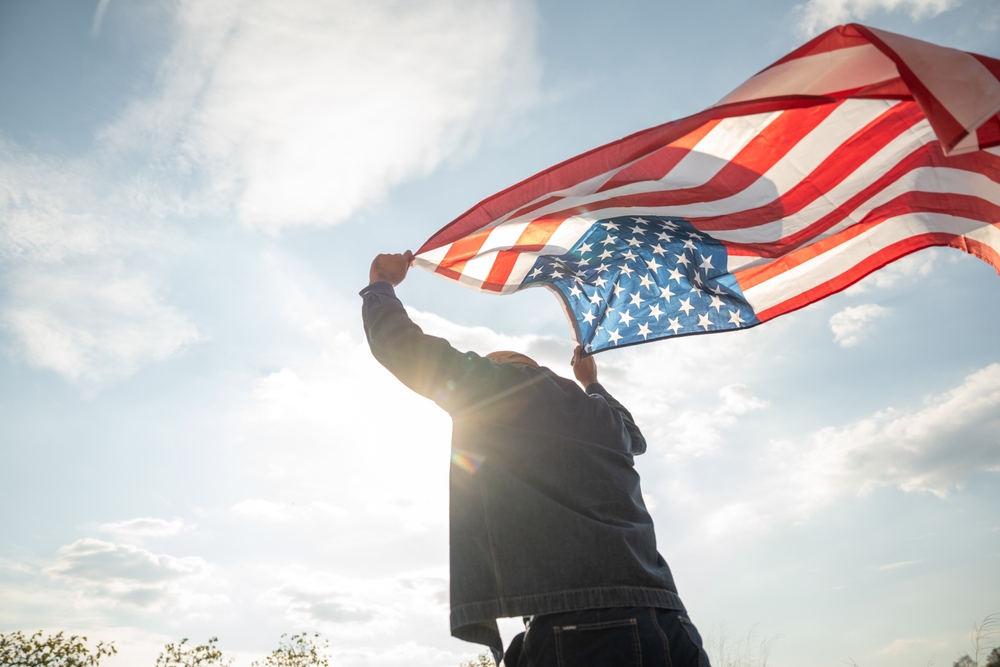

Nobody asks you to define what “American” means until someone does, usually at the worst possible moment, usually at a family gathering, usually after someone has had one too many. The question hangs in the air and everyone goes quiet, because the honest answer is not a paragraph. It is a collection of moments – specific, oddly ordinary, embarrassingly emotional – that sneak up on you when you are not expecting to feel anything at all.
That is the strange thing about this particular kind of feeling. It rarely arrives when it is supposed to. It does not wait for a speech or a ceremony or a sanctioned patriotic occasion. It turns up in a diner booth at eleven on a Tuesday night, or at the top of a canyon with wind in your ears, or in a gymnasium in November with a cardboard voting booth in front of you. You can be someone who debates this country loudly and regularly, who is not naive about its history and not satisfied with its present, and still get completely undone by the sight of something small and true.
The 13 moments below are not political positions. They are human ones. Some of them are grand and some are absolutely ridiculous, and all of them, according to the people who shared them, made them feel – for a moment, in a bone-deep and slightly inconvenient way – unmistakably American.
1. Casting Your First Vote
The moment you walk up to that cardboard booth with your pencil or your pen or your stylus, something changes. It doesn’t matter if you had strong opinions going in or if you spent three weeks agonizing over a down-ballot race nobody else seemed to care about. The act of physically marking a ballot and feeding it into a machine – and then getting that sticker – hits you in a way that no civics class ever warned you it would.
People who vote in person consistently report higher satisfaction with the experience than those who vote by other means. In a 2024 post-election survey, polling-place voters were the most satisfied of any voting group, with 87.2 percent indicating they were “very satisfied” or “satisfied” with their experience. That number tracks with something the U.S. Vote Foundation has noted directly: many voters prefer to vote in-person – they like the feeling of walking into a polling place, physically submitting or scanning a ballot, and getting an “I Voted!” sticker, which you can be proud to wear.
The sticker, for the record, is doing a lot of work. It is a silly little oval of paper and yet people wear it all day, photograph it, show it to their kids. Because the act of being counted – of walking through those doors and saying yes, I am here, I am participating in this – is not a small thing. The first time you do it especially, it does not feel abstract at all.
2. Watching Fireworks on the Fourth of July
You can think fireworks are loud and overpriced and environmentally questionable (and you would not be wrong on any of those counts) and still find yourself craning your neck at the sky with your mouth slightly open, completely forgetting everything you were worried about ten minutes ago. This is involuntary. Do not fight it.
The Fourth of July is the one holiday Americans have always celebrated with fire in the sky. Even the very first celebrations in 1776 included cannons and gunpowder. During the first Independence Day celebration in 1776, concerts and cannons were fired, and today the tradition continues with fireworks lighting up the sky. What has not changed is the particular sensation of watching something explode into color over a crowd of strangers who are all, for approximately ninety seconds, feeling exactly the same thing.
It doesn’t have to be a big municipal display. Some of the most affecting versions happen in backyards in small towns, or in parking lots where someone drove an hour to find a clear view. The location is almost beside the point. What stays is the moment the first bloom of light opens above you and your chest does that thing. You know the thing.
3. Being Present at a Naturalization Ceremony
If you have ever stumbled into one of these – or been invited by a friend or family member about to take the Oath of Allegiance – you already know that nothing in a high school civics textbook prepares you for the reality of the room. Dozens of people from dozens of countries, some of whom have waited years and navigated processes most citizens could not pass themselves, raising their right hands together. You will not remain unmoved. Nobody does.
Every July 4, U.S. Citizenship and Immigration Services celebrates by welcoming new citizens in naturalization ceremonies throughout the country, with these ceremonies demonstrating a commitment to ensuring the naturalization process promotes a unified American identity and allegiance to the Constitution. The National Park Service partners with USCIS to host many of these ceremonies in spectacular settings, with the two agencies maintaining a formal partnership that encourages both to co-host naturalization ceremonies in national parks – places set aside for public enjoyment and historical commemoration. At the Grand Canyon, for example, a 2025 ceremony welcomed 29 new citizens who received their certificates surrounded by the grandeur of the canyon itself.
The people who report feeling most American in these moments are often people who were born here. There is something about watching someone choose this country – after earning it through a process that demands real dedication – that reframes what citizenship actually costs and what it means. The people in that room are not taking anything for granted. Being in the same room as that depth of intentionality is its own education.
4. Standing Inside a National Park
There is a particular moment in the national parks – it happens at the rim of the Grand Canyon, or at the base of a sequoia that was old when the country was founded, or at the edge of a geyser in Yellowstone doing its improbable and spectacular thing – where you feel the scale of the place and your relationship to it simultaneously. You belong to this. Or rather, it belongs to everyone, which is a stranger and better arrangement.
The national park system is one of the country’s more radical ideas: the most stunning pieces of American landscape, collectively owned, accessible to anyone with a day and a car and an eight-dollar entrance fee. The NPS and USCIS formal partnership to enhance citizenship ceremonies by holding them in national parks throughout the country helps introduce new citizens to some of the nation’s most significant natural resources and cultural heritage sites. The fact that these two things – citizenship and landscape – are linked on purpose says something about what the parks are understood to represent.
People come back from the parks changed in ways they struggle to articulate, usually involving something about perspective, often involving slightly sore legs. But underneath the awe there is something else: the recognition that this particular wilderness was set aside, protected, held in common. That someone decided it was worth doing. That is not nothing.
5. Cheering for Team USA at the Olympics
You can be deeply ambivalent about nationalism. You can believe that borders are largely invented and that athletic talent is distributed across the entire human species without regard for geography. You can hold all of these correct and sophisticated views and then, the moment that relay team touches the wall or that gymnast sticks the landing, find yourself on your feet in the middle of your living room making a sound you did not plan to make.
The Olympics has a specific power to produce this. It concentrates the whole question of national identity into a single race, a single routine, a single score. And the people competing under the American flag come from everywhere – immigrants, children of immigrants, people whose families have been here for generations and people who arrived last decade – which is its own kind of argument about what the country is. The team, taken whole, looks like the country at its most varied and most capable, and that combination will get you every time.
The moment is also genuinely shared. You might not agree with the person next to you on a single political question, but when the anthem plays after a gold medal, something registers in the room that is larger than any of that. It does not solve anything. But it is real.
6. Driving Across State Lines on a Road Trip
The road trip is one of the few rituals that Americans still practice with something approaching reverence. Not because the highways are particularly beautiful or the rest stops are worth celebrating (they are not) but because the act of crossing the continent by car – state line by state line, landscape changing under you – makes the scale of the place legible in a way that flying never does.
You cross into a new state and the sign goes up and the landscape does or does not change and you keep going. At some point in a long drive, somewhere in the middle of the country where the sky is enormous and the road goes straight to the horizon, the size of the country becomes something you feel rather than know. The range of it. The fact that all of it is the same country. That is the moment several readers describe as quietly, unexpectedly American – not the monuments, not the landmarks, but the long flat stretch between them.
For more on how family heritage and American history intersect in ways we don’t always expect, the 25 Most Influential American Women piece is worth a read – because the road that got us here was built by all kinds of people.
7. Ordering at a Diner at Midnight
The all-night diner is a specific American institution and the feeling it produces is not easily exported. You are there because you wanted to be, because you could be, because the doors are open and the coffee is hot and nobody is asking you to leave. You order the thing that is too much food, because that is also available, and then you sit in a vinyl booth under fluorescent light and feel, in some inarticulate way, like everything is fine.
The diner at midnight is not glamorous. That is exactly the point. It is ordinary in a way that turns out to be extraordinary when you consider how many places in the world do not have it – the 24-hour option, the bottomless cup, the freedom to just be somewhere late and unremarkable and entirely unbothered. Americans take this for granted, which is itself something to notice. The mundane ease of it is its own kind of abundance.
Several readers named this one without being able to fully explain why it moved them so completely. One described stopping at a roadside diner outside Amarillo at 1 a.m. on a solo drive and eating pancakes alone at the counter and feeling, of all things, grateful. Not for anything in particular. Just for the fact of being there, in that place, at that hour, entirely free to be doing exactly that.
8. A Neighborhood Block Party in Summer

There is an annual moment in summer, usually signaled by someone dragging a folding table into a driveway and setting out a cooler, where the neighborhood briefly becomes a community. The kids know each other from the school bus. The adults know each other from waving over the fence. For one afternoon, everyone is actually together, and the thing being celebrated is just: this, here, us.
The block party is American in the specific way that informal public space is American – the cookout and the lawn and the sidewalk and the neighbor who brings a dish you’ve never tried because their family is from somewhere your family is not. The cultural mixing that happens over a folding table in a cul-de-sac is not organized or documented or particularly efficient. It is just what happens when people live next to each other long enough.
The people who mention this moment tend to be people who moved a lot and then finally stayed somewhere, or people who grew up somewhere and came back. The block party is the moment the neighborhood stops being a place you happen to live and starts being a place you are from. That transition is quiet and then sudden, and it usually happens when someone hands you a plate of something.
9. Hearing a Military Homecoming Story
You do not have to be related to anyone in the military for one of these videos to completely undo you. A soldier walks through the door of a school gymnasium, or appears behind the bleachers at a game, and a child turns and freezes and then runs. Every time. It gets every time.
What these moments tap into is something older than the specific politics of any particular conflict: the cost of service, the weight of time apart, the love that holds across distance. The reunion is the proof. The child running is the proof. The parent standing in the doorway in uniform with that particular expression – the one that is trying to stay composed and not quite managing – that is the proof of something that is hard to name and impossible to argue with.
These moments travel across political lines because the grief and the relief in them are pre-political. Whatever you think about military policy, the homecoming is a human thing. It is also a specifically American thing in that we have been collectively watching these moments in public for a very long time, and they still work. They do not get less true with repetition.
10. Watching the Super Bowl with Strangers
The Super Bowl is not really about football for roughly half the people watching it. It is about the occasion itself: the collective agreement to gather, to eat unreasonable amounts of food at an unreasonable hour on a Sunday, to argue about commercials, and to spend time in a room full of people who are all experiencing the same cultural moment in real time.
What readers describe feeling in these moments is not exactly pride. It is more like belonging. The Super Bowl is the one day a year when everyone is doing the same thing, and doing it together, and talking about the same halftime show the next morning. The shared reference is the point. The chip dip is just infrastructure.
The person you watch it with matters less than the fact of watching it together. People describe Super Bowl Sundays at sports bars where they did not know a single person in the room, and still left feeling like they had been part of something. That is a strange and specific thing this country occasionally manages: the collective shrug and laugh that is also, somehow, the collective hug.
11. A Small-Town Fourth of July Parade
The big-city Fourth of July has its version, but the moment readers keep returning to is the small-town one: the parade down the main street, the firetrucks with the kids waving from the back, the high school marching band that is doing its best, the candy thrown into the crowd, the folding chairs set up on the sidewalk the night before because someone always takes the good spots.
Marching bands, firetrucks, and people tossing candy are the universal currency of the Fourth of July – and just about every small town in America hosts a parade, so finding one nearby is rarely a problem. What they are describing is not spectacle. It is the parade as proof of something: that the town exists, that people live here, that there is enough collective will to drag the firetruck out and play “Stars and Stripes Forever” for the people in the folding chairs who will be back next year.
The small-town parade is unpretentious in a way that the grander celebrations often aren’t. Nobody is performing for a camera. The pageantry is sincere. That sincerity is the thing that gets people – the local hardware store float, the mayor in a convertible, the veterans in the back of a pickup truck who are waving and getting waved at. The entire ceremony is just: we are here, we are together, we remember.
12. Eating a Recipe That Crossed an Ocean
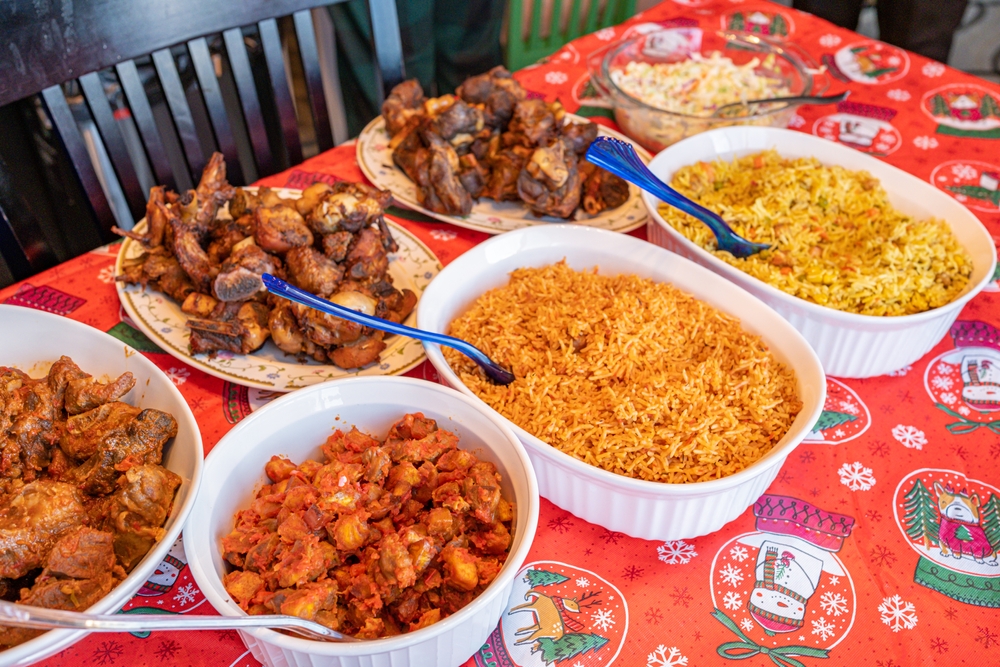
This one tends to arrive unexpectedly. You are making your grandmother’s pierogies, or your aunt’s tamales, or the soup your parents made every Sunday that came from a country they left before you were born. You are following the recipe from memory or from a stained index card, and at some point the smell fills the kitchen and something happens that is not quite sadness and not quite joy but is absolutely both.
The food is the archive. It carries the whole story of how someone got here, what they brought, what survived the crossing, what got adapted to ingredients available at the A&P in 1962. The fact that the recipe made it across an ocean and a generation and is now being made in a kitchen in a country that person crossed the world to reach is the whole American story in miniature. Not the triumphant version. The real version, which is complicated and hard and also, in the end, this: the smell of the thing cooking, and someone remembering where it came from.
Read More: 13 Things Women Couldn’t Do 100+ Years Ago: A Look into Women’s Rights History
13. When a Stranger Does Something Kind for No Reason
A woman in line at the hardware store notices you struggling with a bag and takes it without asking. A man at the gas station sees you looking at a flat tire with that particular expression and walks over to help without being asked. A teenager on the subway gives up a seat and does not make a performance of it. Nothing is required of any of these people and they do it anyway.
This one surprises people when they say it out loud, because it doesn’t announce itself as patriotic. But several readers named it, unprompted, in almost exactly these terms: the stranger who helped me with something they didn’t have to, and I remember thinking, that’s America. Not the America of the arguments and the headlines and the things that are broken. The other one. The one you find in the hardware store parking lot, or at the side of a road, or in the middle of a city where nobody had any reason to stop.
The kindness of strangers has always been one of the country’s more stubborn qualities, and it is not always visible and it is not always available and it is not evenly distributed. But it exists. The people who have experienced it – especially people who came from somewhere else, who did not know what to expect – describe it with a specificity that says it was not a small thing to receive.
The Moments Nobody Plans For
American identity has always been a contested subject, and the contestation is not going away. A country built on a set of principles it has not always honored is going to spend a lot of time arguing about what it actually is. That argument is not a bug. It is a feature, or at least it can be, when people are still willing to have it in good faith.
But underneath the argument, there are these moments. They are not arguments. They are experiences that arrive before you can think your way around them, in parking lots and parade routes and diner booths and the hallways of civic buildings. They do not settle the debate. They are just the reason the debate still matters – the proof that there is something here worth arguing about, worth getting right, worth passing on to whoever comes next.
You don’t have to love every version of this country to feel what these readers felt. You can hold both things at once: the frustration and the flash of unexpected pride, the knowledge of what it isn’t yet and the stubborn recognition of what it can be. That combination is not comfortable. It is, however, honest. And honest is a decent place to start.
AI Disclaimer: This article was created with the assistance of AI tools and reviewed by a human editor.