
Every dinner table has a hierarchy, and everyone at it knows exactly where they stand. The guest of honor gets the good chair, the best wine poured first, the cut of meat that wasn’t set aside for anyone else. The kids get the folding table in the hallway. The neighbor who arrived without warning gets a plate assembled from whatever’s left. Nobody announces the rules. Nobody has to.
Which is why the image that came out of Beijing this week is so perfectly, specifically human, even when the humans involved include a sitting American president, the world’s most powerful authoritarian leader, and a parking lot full of embassy workers eating out of paper bags. On one side of a wall inside Zhongnanhai – the ancient, walled seat of Chinese Communist Party power – Donald Trump sat across from Xi Jinping at a private lunch that no amount of press access could get a camera near. On the other side of that wall, in the parking lot, his own staff unwrapped their McDonald’s.
The Parking Lot Table
Outside Xi’s residence, U.S. Embassy and White House staff ate their McDonald’s lunches in the parking lot. Bags of McDonald’s food were also delivered to members of the White House press pool as they waited in vans for Trump to depart for the airport. No room at the inn, or rather, no room inside one of the most historically significant compounds in the world. These are people who work for the President of the United States, people who boarded Air Force One and crossed an ocean and presumably hold security clearances that would make most of us dizzy – and their lunch situation was identical to a Tuesday afternoon in a strip mall parking lot in suburban Ohio.
There is something almost meditative about it. The golden arches, a universal symbol of convenience and accessibility, delivered to the vicinity of one of the most inaccessible places on earth. Beijing Roast Duck on one side of a 700-year-old wall. A Quarter Pounder on the other. The gap between those two meals is, depending on your perspective, either the entire story of power or the funniest thing that has happened in geopolitics in years.
What Was Actually on the Table Inside
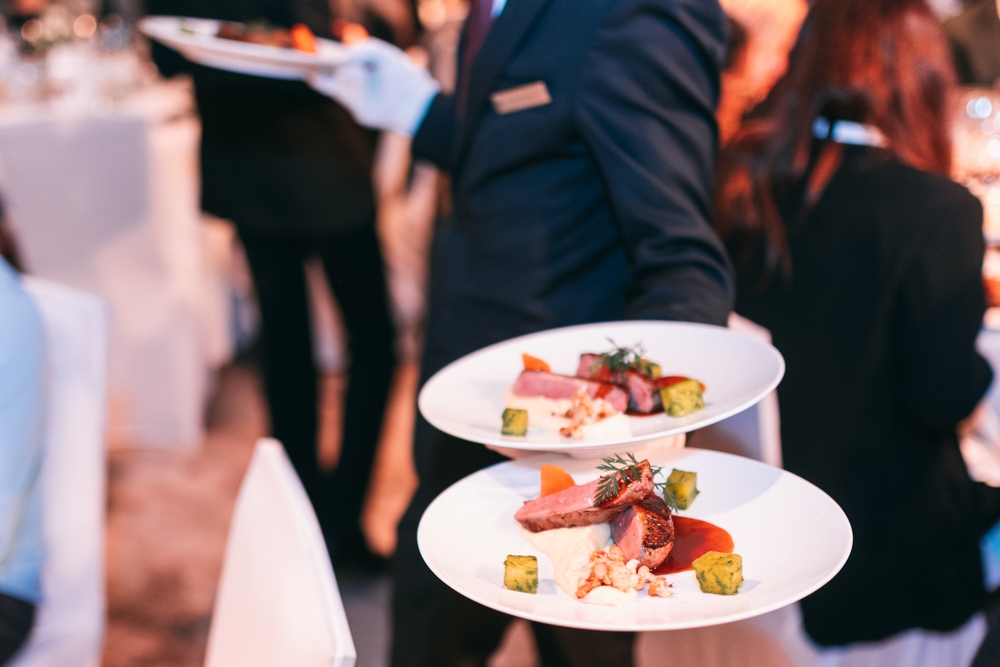
The menu for Trump and Xi was considerably more formal than what their staff ate outside. According to the White House, the two leaders had minced codfish in seafood soup, crispy and stir-fried lobster balls, and pan-seared beef fillet stuffed with morel mushrooms. They also ate kung pao chicken and scallops, braised seasonal greens, bamboo shoots, mushrooms and beans, stewed beef in a bun, and steamed pork and shrimp dumplings. Dessert was chocolate brownies, fruits, and ice cream.
That is a lot of food for a closed-door lunch that the White House described with minimal detail. The night before, at the formal state banquet in the Great Hall of the People, things were even more deliberate. When Trump and Xi sat down to the lavish state banquet in Beijing on Thursday, the menu itself read like a work of diplomacy. Chinese state dinners traditionally draw on Huaiyang cuisine, from the region surrounding Shanghai, known for its mild flavors, refined knife-work, and emphasis on seasonal dishes. Menu planners appeared to add a note of culinary flexibility, including Beijing roast duck, China’s national dish, and beef ribs, in an apparent nod to Trump’s preference for a well-done steak.
As Shanghai-based food writer Christopher St. Cavish described Huaiyang cuisine for diplomatic settings: “It’s great for banquets because it’s lighter than the food of Shandong in China’s north, not spicy like the foods of the southwest (like Sichuanese), and more approachable and less reliant on exotic ingredients than Cantonese, the big cuisine of the south. In the most basic description, it’s ‘safe’. It’s the equivalent of serving chicken at a banquet in Washington, D.C. No one is going to get offended or find it too hot to eat or too exotic to try.”
Safe food for an unsafe geopolitical moment. Every dish a considered gesture. Every course a sentence in a very long, very expensive diplomatic conversation. Meanwhile, outside: a bag, a paper wrapper, probably some cold fries.
The Man, The Myth, The McDouble
Here is where it gets genuinely odd, because this is not a story about Trump being treated like royalty while his staff ate fast food. This is also a story about Trump’s specific, well-documented, almost defiant relationship with that exact fast food. White House Chief of Staff Susie Wiles has previously said Trump eats McDonald’s every day, and the president has embraced that image. On the 2024 campaign trail, he briefly worked a drive-thru window at one of the chain’s outlets. More recently, he had a McDonald’s order delivered directly to the Oval Office during an event touting his elimination of taxes on tips for service workers.
So the staff outside Zhongnanhai, eating their McDonald’s in the parking lot, were technically eating what the President himself eats on a regular Tuesday. The man they work for reportedly eats this every single day. He had it brought to the Oval Office. He literally worked the drive-thru window as a campaign move. And yet when you picture “the McDonald’s lunch in the Beijing parking lot,” it does not read as a treat. It reads as a consolation.
That is the entire architecture of status, right there, compressed into a paper bag. The thing that is perfectly fine when you choose it becomes something else entirely when it is what you get.
This dynamic is one every mother – every person who has ever sat at a table, set a table, or been noticeably absent from one – understands at a bone-deep level. The table, and who gets to sit at it, has always said more than the food ever does.
The Entourage and the Guest List
The contrast inside the building was its own kind of spectacle. Xi held an elaborate state banquet at the Great Hall of the People in Beijing on Thursday. Among those who joined Trump were key cabinet members: Secretary of State Marco Rubio, Treasury Secretary Scott Bessent, Defense Secretary Pete Hegseth, and Trump’s deputy chief of staff Stephen Miller. The entourage also included Apple CEO Tim Cook and Elon Musk of Tesla and SpaceX. Nvidia’s Jensen Huang arrived after a last-minute invitation from the president. Trump’s son Eric and his wife Lara Trump also attended the dinner.
Musk brought his six-year-old son, who wore a tiger-head crossbody bag handcrafted by a Chinese artisan brand, which promptly went viral on Chinese social media and sold out in hours. So: one child in artisan accessories inside the banquet, and a few dozen adults with security clearances eating in a parking lot. The optics of access were working at full speed that night, and they were not being subtle about it.
What Food Has Always Done in a Room Like That
China has understood food as diplomatic language for longer than the United States has existed as a country. China has even named dishes after visiting figures, including a chicken recipe created for Henry Kissinger during his secret 1971 trip, and banquet menus are often later replicated by local restaurants. A chicken recipe named for a man who traveled in secret. A banquet menu that becomes a restaurant menu. The food outlasts the politics, usually. It definitely outlasts the press release.
The choice of Huaiyang cuisine for the Trump-Xi banquet was not accidental. It has appeared at China’s most important state occasions across decades: the 1949 founding banquet when the People’s Republic was established, and again at George W. Bush’s state dinner in 2002. Serving it to Trump placed this dinner in a very specific lineage, and Beijing knew exactly what it was doing. Every dish was a quiet argument that this meeting mattered, that China was treating it with full seriousness, that the man across the table was worth the good china.
The people in the parking lot were not part of that argument.
The Thing It Actually Is
There is a version of this story that is simply funny – and it is funny, it is genuinely, specifically, laugh-out-loud funny that the image coming out of a historic state visit to Beijing is a bunch of Americans eating McDonald’s in a parking lot while their boss eats morel-stuffed beef fillet twenty yards away. If you needed a single image to explain how power works in 2026, this is probably it.
But underneath the joke is something that has nothing to do with Trump or Xi or the geopolitical implications of a private lunch. It’s the oldest social experience there is: the feeling of being on the wrong side of a door. Of being necessary to the whole operation and still not quite making the list. Of being handed the bag instead of the seat.
Most of us have been there in some version of it. Not in Beijing, not with Secret Service detail, but at a table somewhere – a holiday dinner, a work event, a wedding seating chart – where the arrangement of chairs told you something about where you stood that nobody was going to say out loud. The staff outside Zhongnanhai will go back to Washington and tell this story at dinner parties for years. It will be a great story. It will probably get funnier every time. And somewhere in the back of the room, someone will laugh a little too hard because they know exactly what it felt like to eat in the parking lot.
AI Disclaimer: This article was created with the assistance of AI tools and reviewed by a human editor.