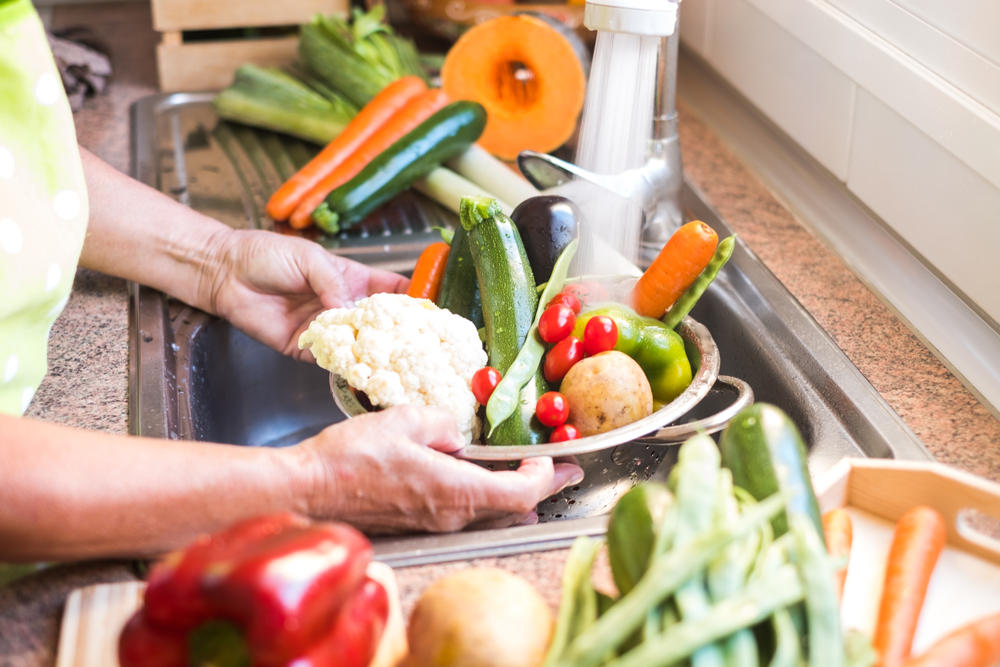

Most of us rinse produce under the tap and call it done. Quick splash, a shake off, back on the cutting board. It’s become one of those habits that feels responsible without ever really being questioned. But lately, a wave of new research has been pressing on exactly that assumption, and what it found is worth paying attention to, especially if you’re the person in your household deciding what goes on the kids’ plates.
The produce washing methods most of us rely on by default aren’t doing the job we think they’re doing. Produce carries pesticide residues from field to store to your kitchen, and water alone, while helpful, leaves quite a lot behind. The gap between what water removes and what a few simple alternatives can remove is wider than most people realize.
The good news is that the most effective options involve things you probably already have. No specialty equipment. No complex prep. Just a clearer picture of what actually works when you’re trying to get those apples and spinach leaves as clean as possible before dinner.
Does Washing Produce Actually Remove Pesticides?
Short answer: yes, but only partially. Washing does not remove pesticides entirely, but controlled studies show that unwashed produce contains higher pesticide levels than washed produce. So the habit is worth keeping. The question is just whether you’re getting the most out of it.
The scale of the problem is bigger than most people expect. Before the USDA examines each sample, the fruit or vegetable is peeled, scrubbed, and thoroughly washed to mimic what consumers do at home. Even after taking those steps, testing found traces of 264 pesticides. That’s not a reason to panic or stop eating produce. Experts consistently say fruits and vegetables are essential, and regulatory agencies set maximum pesticide residue limits designed to protect human health. But it is a good reason to wash more deliberately.
Children are especially susceptible to contaminants such as pesticides, according to the American Academy of Pediatrics, which notes that pesticide exposure during pregnancy may lead to increased risk of birth defects, low birth weight, and fetal death. For parents packing lunchboxes and loading dinner plates, that context matters.
What the FDA Recommends for Washing Fruits and Vegetables
The FDA’s official guidance on food safety produce cleaning is more modest than you might expect. As a rule of thumb, washing with water reduces dirt, germs, and pesticide residues remaining on fresh fruit and vegetable surfaces, and washing and rubbing produce under running water is better than dunking it. Running water over produce while rubbing it creates friction and flow that a static soak can’t match.
What the FDA does not recommend might surprise you. The FDA does not recommend washing fruits and vegetables with soap, detergent, or commercial produce wash, as these have not been proven to be any more effective than water alone. That guidance was issued before the newer wave of independent research comparing specific methods head to head. For firm produce like melons and potatoes, the FDA does recommend scrubbing with a clean brush.
There’s also one tip that often gets skipped: wash produce even if you don’t eat the peel, such as with citrus. Otherwise, chemicals or bacteria from the outside can get to the inside when you cut or peel it.
What Actually Removes More Pesticides Than Water
Plain water, rinsed properly, does something. Recent research has pinned down exactly how much.
A 2026 peer-reviewed study found that rinsing produce with water achieved a median pesticide reduction of 30.2%, with reductions ranging from 0% to 94% depending on the pesticide and produce type. That wide range tells you something important: how much a rinse helps depends heavily on the specific chemical and the specific crop. Some pesticides practically fall off. Others barely budge. The 30.2 percent median is a reasonable average expectation, not a guarantee.
But several alternatives consistently outperformed plain water. Here’s what the evidence actually supports.
Vinegar Soaking
If you’re looking for the single most effective produce washing method you can do at home with everyday ingredients, vinegar is the answer backed by the most recent data.
Vinegar soaking was identified as the most effective method overall in a 2026 peer-reviewed study, with a median pesticide reduction of 54.2% and reductions ranging from 8.6% to over 99%. That kind of result from a bottle of white vinegar and a bowl of water is striking. The acetic acid in vinegar (essentially what makes vinegar sharp and sour) appears to break down or dislodge a wide range of pesticide compounds. A simple ratio of one part vinegar to three parts water, soaked for 10 to 15 minutes, is the approach most often cited for the best way to wash produce.
Baking Soda Soaking
Baking soda is close behind vinegar, and it may actually be the better choice for certain types of produce.
Baking soda soaking achieved a median pesticide reduction of 50.9%, outperforming plain water rinsing or soaking by more than 15 percentage points, likely because certain pesticides break down in alkaline environments. Alkaline means the opposite of acidic on the pH scale, baking soda raises the pH of the water it’s dissolved in, and that environment appears to degrade certain pesticide molecules more effectively.

For anyone who keeps a box of baking soda in the cabinet, this is a straightforward upgrade. A small amount dissolved in a bowl of water, with produce soaked for a few minutes, is all it takes.
The Baking Soda and Corn Starch Combo
A 2025 study in Foods pushed things further, testing a two-step homemade approach. Researchers found that soaking produce in a 2% corn starch solution followed by a 5% baking soda soak was the most effective homemade strategy, removing 94.13% of the pesticide thiabendazole (a common fungicide used on apples) with a surfactant added, and 91.78% without. Thiabendazole is a fungicide often applied to apples and other waxed produce after harvest to prevent mold during shipping, which is part of why it can be stubborn to remove. The corn starch appears to work as a mild abrasive that grabs residue from the waxy surface, while the baking soda soak that follows does the chemical work.
This two-step process is a little more involved than a single soak, but if you’re prepping a large batch of apples or stone fruit, it’s worth the extra bowl. Families who routinely buy conventional produce and want to reduce pesticide exposure without switching entirely to organic may find this approach genuinely useful.
Commercial Produce Washes
Commercial produce wash products present a more complicated picture. Among four commercial produce wash products tested in the same 2025 study, the top performer removed between 95.3% and 95.99% of thiabendazole residues. Those numbers are impressive. But there’s a catch.
The top-performing commercial wash raised safety concerns because it contained lauryl glucoside, an ingredient that lacks FDA approval for use in food or agricultural practices. That’s the kind of thing worth reading on a label before you buy. Not all commercial washes have the same formulation, and the most effective one in this study came with a regulatory asterisk. For now, the homemade alternatives appear to be both safer and nearly as effective.
The UBC Natural Wash
Lab science is starting to offer something even further along. UBC researchers developed a natural wash that removed between 86% and 96% of pesticide residues from apples in lab tests, substantially outperforming tap water, baking soda, or plain starch washes, which typically remove less than half. The wash is made from plant-derived compounds and was designed specifically to address the limitation of existing household methods.
What makes it particularly interesting is what else it does. The UBC wash also functioned as an edible coating after application, slowing browning and moisture loss in fresh-cut apples and keeping whole grapes plump for 15 days at room temperature compared to noticeable shriveling in untreated grapes. For parents who regularly deal with the disappointment of grapes that go soft before the week is out, that’s a side benefit worth noting.
Early cost estimates from the research team suggest the treatment would add approximately three cents per apple, comparable to existing commercial coatings. It’s not on store shelves yet, but it’s the direction the science is moving.
Running Water, Done Right
The most accessible food safety produce cleaning method is still the simplest, but technique matters more than most people realize. Running water with friction outperforms passive soaking in plain water in almost every study. Hold produce under a steady stream and use your hands or a brush to actively rub the surface. Don’t just hold it under the faucet and wait. That friction is doing real work.
For leafy greens, which can trap residue in their layers, rinsing each leaf individually or using a salad spinner with multiple water changes makes a measurable difference.
Using a Produce Brush
For firm-skinned vegetables, think carrots, potatoes, beets, cucumbers, a dedicated produce brush is a legitimate upgrade to rinsing alone. Scrubbing firm produce with a clean brush is a practice explicitly recommended by the FDA for produce with thicker skins. The mechanical action of bristles removes not only surface residues but also soil, bacteria, and any waxy coatings that can trap chemicals. It’s a $5 purchase that earns its spot in the kitchen drawer.
Peeling When You Can
It’s almost too obvious to say, but peeling is among the most effective single actions for reducing pesticide exposure on produce where the skin isn’t the point nutritionally. For leafy vegetables such as lettuce, discarding the outer leaves and rinsing the inner part is a practical step that reduces exposure. The same logic applies to conventional apples if you’re serving them to young children and haven’t done a vinegar or baking soda soak.
What to Do Now
The science on the best way to wash produce has moved well ahead of the habit most of us actually have. Water alone achieves a median pesticide reduction of 30.2 percent. That’s worth something. But for produce that ends up on children’s plates regularly, especially conventional apples, strawberries, spinach, and grapes (the produce types that consistently carry higher pesticide loads), a vinegar soak or a baking soda soak is an easy, low-cost upgrade that roughly doubles that reduction.
The practical routine is simpler than the research makes it sound. Keep a large bowl next to your sink. When you bring produce home, run a vinegar-to-water soak for the stuff you’ll eat skin-on within the next day or two. For waxier produce like apples, the corn starch followed by baking soda approach from the 2025 research gets you into the 90-plus percent removal range. Rinse thoroughly with running water afterward, pat dry, and store. Wash produce when you’re ready to use it, since washing before storing can degrade the quality of most fruits and vegetables. That’s the one timing detail worth keeping in mind. Not every meal needs a ceremony. But a slightly better soak, a few times a week, on the produce your family eats most, is genuinely worth doing.
A.I. Disclaimer: This article was created with AI assistance and edited by a human for accuracy and clarity.