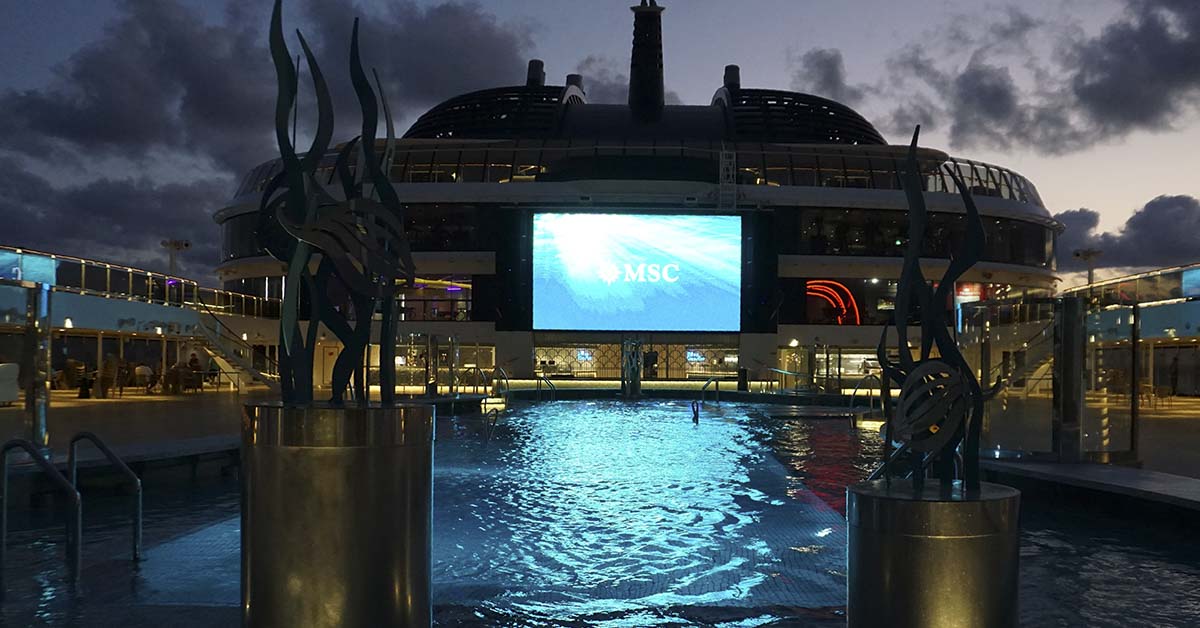

A TikTok posted by cruise content creator @victorias.way has been viewed more than 23 million times, and it’s easy to see why. She filmed from the deck of a cruise ship at night, looking out past the railing while the words “How dark the ocean is…” sat across the screen. The ship’s lights caught the water closest to the hull, but everything beyond it was gone. No horizon, no shape, no depth, just black.
@victorias.way If you look closely you can see the North Star⭐️🛳️ #cruise #cruiselife #princesscruises #cruisetok #darkocean ♬ Hoist The Colours – Bass Singers Version – The Wellermen & Bobby Bass & Eric Hollaway
The video pulled more than 2.1 million likes, and the comments are mostly about the Titanic, about people going overboard, about how the darkness past that railing didn’t look like water anymore. It looked like nothing, and that turned out to be worse. That’s the thing about cruise ships at night that most people never think about until someone films it.
You’re on a floating city surrounded by thousands of people, but the second you look past the railing, none of that matters. The ship ends, and the dark starts, and the dark doesn’t stop.
What the Comments Keep Saying
The Titanic comes up constantly. People went straight to the image of passengers in that water, in that kind of darkness. One commenter wrote, “Just imagine how afraid the passengers from the Titanic were while being in the water, while it’s pitch black outside.” These aren’t history buffs. They’re people watching a 30-second video on their phones and immediately thinking about the worst thing that ever happened on a ship like that one.
From there, the comments turned personal. One person said they went on a cruise and would pray for it to always be daytime because they hated the ocean at night so much they cried. Others described staring at the water from their balcony and not being able to look away, even though it made their chest tight, a reaction that kept repeating in different words across hundreds of replies.
Someone wrote that they’d never go on a cruise again after watching the video, not because of anything that happened on the ship, but because they couldn’t stop thinking about what was under it. And then the same word started surfacing over and over again. Thalassophobia.
The Fear With a Name
One comment reads, “I think we all can agree that Thalassophobia is the most understandable fear a human ever has.” It pulled more than 54,000 likes, making it one of the most engaged reactions on the entire post.
Image by: Unsplash
Thalassophobia is the persistent fear of deep bodies of water. It’s not the same thing as being afraid of water itself. Someone with thalassophobia can swim in a pool without a second thought. But the idea of floating above open ocean sets off something deeper because the fear isn’t about drowning. It’s about the vastness, the depth, and the complete inability to know what’s around you.
The word comes from the Greek thalassa, meaning sea, and phobos, meaning fear, and it falls under the clinical category of specific phobias. According to the National Institute of Mental Health, an estimated 9.1% of U.S. adults experience a specific phobia in any given year. And researchers have argued that fear of the ocean might be among the most rational of them.
The ocean checks every box the human brain reads as a threat. You can’t see the bottom, you can’t track what’s moving beneath the surface, and you have no way of knowing what happens next. There’s nothing irrational about being afraid of something that gives you absolutely nothing to work with. The fact that enough people experience this for it to carry a clinical name tells you it doesn’t need defending.
Why It Runs Deeper Than You Think
A 2013 meta-analysis in the Journal of Anxiety Disorders reviewed 15 twin studies on fears and specific phobias. They found that both are moderately heritable, with estimates ranging from 25% to 45% depending on the type. What gets passed down isn’t the phobia itself but a vulnerability to it. A nervous system that’s more likely to tip into fear when the right trigger shows up. And deep water is one of the oldest triggers there is.
Your brain wants edges, boundaries, things it can measure and categorize, and the open ocean refuses all of it. That gap between what your nervous system needs and what the water provides is what makes thalassophobia feel instinctive rather than learned. You don’t develop this fear over time. It was already there. The dark just brings it forward.
Someone standing on a shore 10,000 years ago would have felt the same thing looking at the same black water, and the response would have been identical because the threat hadn’t changed. The ocean still moves on its own terms, still offers no foothold and no shelter. We’ve since built ships, sonar, and submarines, and none of it has dulled the response. We just learned to float on top of what still terrifies us.
When the Lights Go Out
During the day, the horizon gives your brain something to anchor to. The color of the water tells you it’s there, the movement of the waves tells you it’s behaving the way you expect, and the sky gives you a sense of scale. At night, all of that disappears. You’re standing on a lit structure surrounded by something your eyes can’t confirm exists anymore. Your nervous system doesn’t care that the ship weighs 200,000 tons. The railing is the last thing between the world you understand and the one you don’t, and once you look past it, there’s nothing left.
A study that appeared in the Psi Chi Journal of Psychological Research found that more than half of participants ranked darkness among their top five fears, and the researchers noted that evolutionary fear tends to override the brain’s ability to reason through it. You can know you’re safe and still feel your pulse climb the moment you look over the side and see nothing.
Because your brain processes the threat before it registers the safety. The ocean at night puts two of humanity’s oldest fears in the same place at the same time. Deep water and total darkness. Your body responds before your rational mind gets a say. That’s why Victoria’s video landed harder than any daytime ocean clip ever could.
What’s Underneath You Right Now
According to the National Oceanic and Atmospheric Administration, the average depth of the ocean is about 12,080 feet. A cruise ship’s hull sits roughly 30 feet below the waterline. Which means while you’re sleeping in your cabin or standing at the buffet, there are about 12,050 feet of water beneath you that no one on that ship will ever see.
The deepest point on Earth, the Mariana Trench, drops to over 36,000 feet. Deep enough to swallow Mount Everest with more than a mile of water still above the peak. Light disappears almost entirely below 100 feet, and oceanographers classify anything below 650 feet as ‘deep ocean’. More than 90% of the ocean’s volume sits below that line.
The deepest zones carry names borrowed straight from mythology. “Abyssal” refers to a bottomless chasm. “Hadal,” the term for anything below 20,000 feet, comes directly from Hades, the Greek god of the underworld. These aren’t poetic labels from centuries ago. Marine scientists came up with them, and they use them every day. Because even people with PhDs in oceanography reached for mythology when it came time to name what’s down there.
NOAA also reports that more than 80% of the ocean remains unmapped, unobserved, and unexplored. Scientists estimate that somewhere between 700,000 and one million species live in it. That’s roughly two-thirds of which haven’t been formally described yet. NASA oceanographer Gene Carl Feldman has said that in many ways it’s easier to send people into space than to the bottom of the sea.
Miles From Anywhere
On a full sea day, a cruise ship covers 400 to 500 nautical miles, and on a transatlantic crossing, you can spend days without a coastline in any direction. Even a standard Caribbean itinerary has stretches where the nearest land is hundreds of miles away.
There is no legal limit on how far from shore a cruise ship can sail. During the day, none of that registers because the ship keeps you busy and the horizon keeps you calm. But at night, after the bars thin out, the cruise ship is the only source of light in every direction, you could look north, south, east, or west and see the same thing, which is nothing at all.
The sun has never reached most of the ocean, and it never will. What people forget when they think of the ocean as a vacation backdrop is that the water beneath them hasn’t seen light in thousands of years, and the nearest solid ground might be straight down.
One commenter put it plainly. “People who say they can swim may I ask where are you swimming to?” Another wrote, “Wonder how many people know the darkest place on earth is the middle of the ocean.” They’re not wrong, and nobody on the pool deck is thinking about any of it until somebody like Victoria points a camera at it.
@chasingthedream.hj Cruises are great until you realise #cruise #cruises #cruisetiktok #cruisetok ♬ original sound – Chasing the Dream
What the Cruise Lines Don’t Put in the Brochure
Amy Bradley was 23 years old when she vanished from a Royal Caribbean cruise in March 1998 while her family slept in the cabin with her. According to FBI records, her father saw her on the balcony around 5:30 in the morning. She was gone by six. No one has ever found her body. A three-part Netflix docuseries called Amy Bradley Is Missing premiered in July 2025 and pulled more than 81 million hours watched across its first 6 months on the platform, according to Collider. The series almost certainly explains why her name keeps surfacing in the comments on Victoria’s video. One commenter wrote that the Amy Bradley case is their “immediate thought” every time they see the ocean at night from a ship.
The Cruise Vessel Security and Safety Act was signed into law in 2010 after years of lobbying by the families of passengers who went missing at sea. It requires ship railings to be at least 42 inches high, mandates security cameras along outer decks, and compels cruise lines to report missing passengers directly to the FBI. Regardless of where the ship is at the time. Between 2009 and 2019, the Cruise Lines International Association recorded 212 overboard incidents involving both passengers and crew. Only 48 of those people were rescued alive, according to U.S. News & World Report.
That’s a survival rate of roughly 23%. Alcohol is a factor in up to 60% of those incidents. And according to a 2024 study cited by BoardingArea, close to half of all overboard cases happen at night. The darkness Victoria filmed isn’t just unsettling to look at. It’s the same darkness that makes falling in almost impossible to survive.
Read More: Reasons Why People Get Left Behind By Cruise Ships At The Port
The Railing at 2 AM
Millions of people cruise every year, and most of them have the time of their lives. The food is good, the drinks are strong, the entertainment runs late. The whole experience is designed to make sure you never have to think about where you actually are. But at some point on almost every cruise ship, somebody walks out on deck at night and stands at the railing, and looking out for a few seconds, they feel something they didn’t expect. Something that was there long before the ship was built, long before anyone thought to sell tickets for it.
The ocean doesn’t know you’re on vacation. It was dark before the ship arrived, and it’ll be dark long after it leaves. And 23 million people stopped scrolling long enough to sit with that. Not because they learned something new. But because somebody finally pointed a camera at the thing most people spend the whole cruise trying not to look at. 2.1 million of them hit the heart button, not because it was beautiful, but because they recognized it.