

You have probably seen those viral images floating around social media, the ones that promise to tell you something about your personality based on what you notice first. Most of them are nonsense dressed up in psychology-sounding language and designed more for engagement than enlightenment. This personality quiz is different, though not in the way you might expect.
The image below contains multiple instances of the number 3 hidden throughout a cozy soup scene, and your task is simple. Count how many you can find. The interesting part comes afterward when we explore what your answer might say about how your brain processes visual information. Before we get into the psychology, a disclaimer. This quiz is meant to be fun and not a diagnostic tool, and anyone claiming they can determine your personality from a single image is selling you something. What this exercise can do is offer a lighthearted window into the world of visual perception.
How This Quiz Works
The premise is straightforward. You will look at an image of a steaming bowl of soup surrounded by bread, condiments, and table settings. Hidden within this scene are several number 3’s, some obvious and some cleverly camouflaged. Give yourself about 30 seconds to scan the image and count as many as you can find without overthinking it, because your first instinct matters more than a forensic examination.
Once you have your number, scroll down to see what different ranges might suggest about your observational style. The keyword there is suggest. Your brain is far too sophisticated for any single test to capture its full character, so think of this more like a conversation starter than a verdict.
Take the Quiz

Counted them all? Good. Now, let us see what it might mean.
Your Results
The number of 3’s you spotted falls into one of 3 general categories, each associated with different observational tendencies.
You Found One to Three
If you spotted only a handful of 3’s, you likely have what researchers call a global processing style. Your brain tends to take in the whole scene first and absorb the overall view before drilling down into specifics. This is not a deficiency and can actually be a serious strength in many situations.
People with global processing tendencies often excel at understanding context and grasping the emotional tone of a situation. You might be the person who walks into a room and immediately senses the mood, even if you cannot pinpoint exactly why. In professional settings, this translates to strong strategic thinking and an ability to see how individual pieces fit into larger systems.
The potential downside is that details can slip past you. You might miss the fine print or overlook a small error that someone else would catch immediately. But in a world drowning in information, the ability to filter noise and focus on what matters has real value.
You Found Four to Six
Landing in the middle range suggests a balanced way of processing visual information. Your brain appears comfortable switching between the forest and the trees, zooming in and out as needed. This cognitive flexibility serves you well in situations that require both attention to detail and holistic awareness.
People in this category often make effective problem-solvers because they can identify specific issues without losing sight of larger goals. You might be equally comfortable editing a document for typos and evaluating whether the overall argument makes sense. This adaptability is particularly valuable in collaborative environments where different tasks demand different mindsets.
The challenge for balanced processors is knowing when to shift gears. Sometimes a situation calls for laser focus, and sometimes it needs a wide-angle view. Recognising which mode fits the moment is a skill worth developing.
You Found Seven or More
Spotting most or all of the hidden 3’s indicates a detail-oriented processing style. Your brain naturally gravitates toward the specific and scans for anomalies and hidden elements that others might miss. This is the cognitive style associated with excellent proofreaders, quality control specialists, and investigative researchers.
Detail-oriented processors often notice things that escape general attention. You might be the first to spot a continuity error in a film or catch a discrepancy in a financial report. This vigilance can be professionally valuable and personally satisfying, especially in fields that reward precision.
The trade-off is you might lean toward perfectionism or get stuck in the weeds. When every detail feels important, prioritisation becomes difficult, and learning to distinguish between details that matter and details that do not is an ongoing process for many detail-oriented thinkers.
The Psychology Behind How We See
The way we process visual information involves multiple brain regions working together. The primary visual cortex handles basic features like edges and contrast, while higher-order areas integrate these features into recognisable objects and scenes. The interplay between these regions determines whether we tend toward global or local processing.
Research in cognitive psychology has shown that processing style can be influenced by culture, mood, and even recent experiences. Positive moods appear to promote global processing, while negative moods or stress can narrow attention to specific details. This means your quiz result might reflect your state of mind as much as any stable trait, and if you took the quiz while stressed or distracted, you might score differently than you would on a relaxed Sunday morning. Context shapes perception more than we typically realise.
A Brief History of Optical Illusions
If you want more proof that your visual system is not the objective recorder you might think it is, consider that humans have been fascinated by optical illusions for centuries. The ancient Greeks, including Plato, discussed them as tricks played on us by our senses and minds. But the scientific study of illusions took off in the mid-1800s. When physiologists started documenting how easily simple images could fool the eye.
The term geometrical optical illusions was coined by Johann Joseph Oppel in 1855, and researchers quickly began cataloguing different types. Poggendorff described his famous misalignment illusion in 1860. Hering followed with his bending lines illusion in 1861. Franz Carl Müller-Lyer published his arrow illusion in 1889, and Mario Ponzo showed his converging lines illusion in 1911. Each of these scientists noticed the same thing. Our appreciation of size, length, and continuity can be distorted by the context surrounding what we are looking at.
It Is Not Just Humans
Here is the part that might unsettle you. These illusions do not just fool humans. The Müller-Lyer illusion, those two lines with arrows pointing in different directions that appear to be different lengths even when they are identical, fools fish, pigeons, parakeets, horses, capuchin monkeys, bearded dragons, and even ants. Researchers have documented susceptibility to this illusion across species with vastly different visual systems and evolutionary histories.
This suggests that the illusion involves something fundamental about how visual systems evolved to process information rather than anything specific to human culture or cognition.
Two Classic Examples
The two images below show just how powerful these effects can be. The first shows two grey squares, one placed on a black circle and one on a light grey circle.

Most people see the square on the black background as lighter than the square on the grey background. They are identical. Your brain adjusts perceived brightness based on the surrounding context. Which is useful for recognising objects in different lighting conditions but makes you easy to fool with carefully arranged shapes.
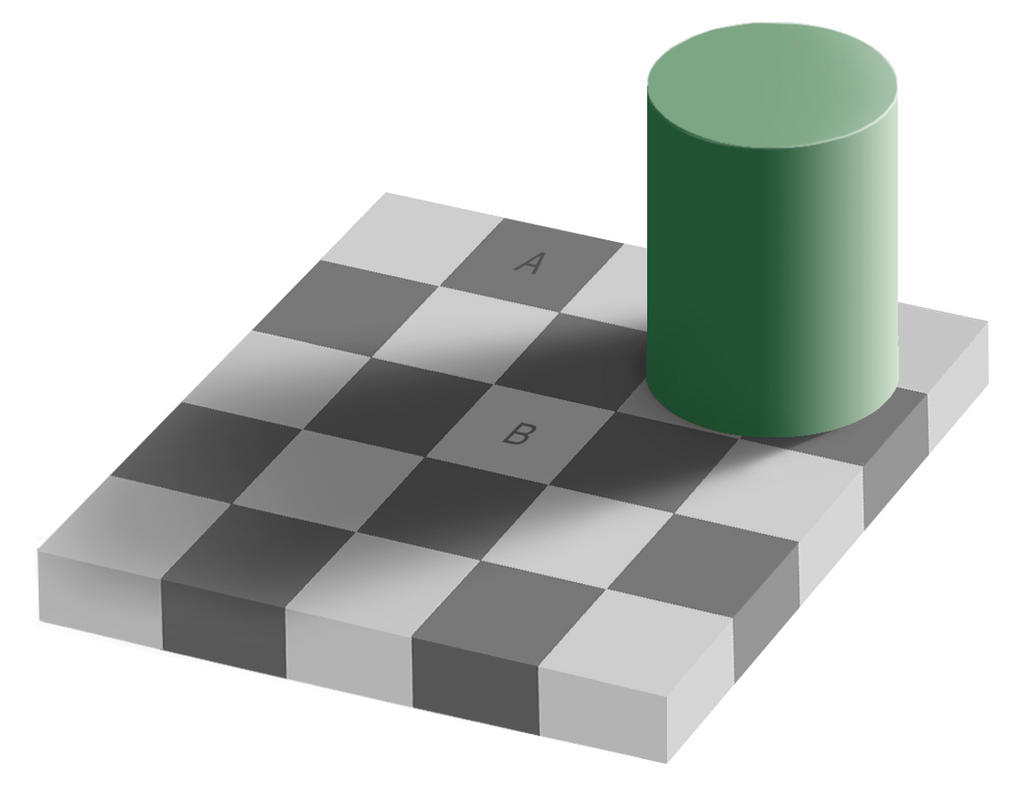
The second image is even more dramatic. Look at the squares labelled A and B on the checkerboard. Square A appears dark, and Square B appears light, yet they are exactly the same colour. The shadow cast by the green cylinder tricks your brain into compensating for lighting that is not actually there. You can verify this by covering the surrounding squares with your fingers or using a colour picker tool, and even after you know the truth, you still cannot make yourself see them as the same.
Why Your Brain Works This Way
Your brain processes visual information with a slight delay of about one-tenth of a second. Some researchers suggest the brain compensates by predicting what will happen next. Essentially generating images of what the world will look like a fraction of a second into the future. This foresight helps you catch a ball or dodge an obstacle, but it can also create illusions when those predictions do not match reality.
These illusions are not bugs in your visual system. They are features. Your brain evolved to interpret the world rather than measure it precisely, and most of the time that interpretation serves you well. But it does mean that what you see is always a construction. A best guess based on incomplete information and millions of years of evolutionary shortcuts.
Not Everyone Sees the Same Thing
One of the most interesting findings in perception research is that people from different cultures do not experience optical illusions the same way.
In 1963, psychologists Marshall Segall, Donald Campbell, and Melville Herskovits published research in Science testing people from 15 different societies, and they found substantial differences in how susceptible each group was to geometric illusions. People raised in environments full of straight lines, right angles, and rectangular buildings learn to interpret certain visual cues as depth indicators, and this learned interpretation makes them more vulnerable to illusions that exploit those cues.
The Müller-Lyer illusion provides the clearest example. People from rural African communities with round buildings and fewer straight-edged structures were far less susceptible to the illusion than people from Western industrialised societies. Follow-up studies with the Inuit of Baffin Island, the Temne of Sierra Leone, and communities in Zambia and Ghana found similar results. The more carpentered the environment, the stronger the illusion.
The Himba Exception
A recent study led by Ivan Kroupin and colleagues at the London School of Economics pushed this finding even further by working with Himba people from rural Namibia. They found participants could see right through illusions that completely fool Americans and British participants.
When shown something called the Coffer illusion, which appears to most Westerners as a grid of rectangles, Himba participants easily spotted circles that WEIRD populations could not see at all. WEIRD is an acronym researchers use for Western, Educated, Industrialised, Rich, and Democratic. It describes the narrow slice of humanity that makes up most psychology research subjects.
When one Himba woman was told that Westerners struggle to see the circles in the image, she responded through an interpreter with genuine confusion. She said she could not understand how others could not see the round ones and wondered how that was possible.
Her visual environment, dominated by circular structures and natural forms rather than rectangular buildings, had shaped her perception in ways that made her immune to an illusion that tricks nearly everyone from London or New York.
Culture Shapes What We See
Cross-cultural differences also appear in how people attend to visual information more generally. East Asian participants tend to focus holistically on entire scenes and relationships between objects, while North American participants tend to focus selectively on central targets. This difference shows up in eye-tracking studies and correlates with different susceptibility to illusions like the Ebbinghaus illusion, where surrounding circles make a central circle appear larger or smaller than it actually is.
Research by Danai Dima and colleagues at Hannover Medical School and UCL found that people with schizophrenia are often less susceptible to certain optical illusions, particularly the hollow face illusion, where a concave mask appears to bulge outward.
Their 2009 study, published in NeuroImage, suggests this relates to differences in how their brains combine sensory input with prior expectations. Where most people’s brains override what their eyes are actually seeing in favour of what they expect to see, people with schizophrenia appear to weigh the raw sensory information more heavily.
All of this research points to the same conclusion. What you see is not simply a readout of what is in front of you. It is a construction shaped by your biology, your culture, your experiences, and even your mental state in the moment. Two people looking at the same image can genuinely perceive different things, and neither of them is wrong in any meaningful sense.
Why We Love These Visual Games
Hidden object games have been popular for centuries. Renaissance paintings hid symbolic elements for viewers to find, Victorian-era books challenged readers to spot figures concealed in illustrations, and now social media has turned this ancient pastime into viral content. The appeal comes from the satisfaction of finding something, that small dopamine hit when you notice what was previously invisible, and there’s a competitive edge to it too because we want to know how our perception stacks up against everyone else’s.
These games also tap into our desire for self-knowledge. We are endlessly curious about our own personalities, and any quiz that promises insight, however superficial, attracts attention. The popularity of personality quizzes, horoscopes, and similar content reflects a deep human need to understand ourselves and feel understood.
The danger comes when we take these entertainments too seriously. A fun quiz becomes problematic when people use it to make real decisions or judge themselves harshly based on the results. That is why maintaining perspective matters.
A Word of Caution
You may have noticed similar quizzes circulating online with far bolder claims. Some suggest that spotting many details indicates narcissism or that missing them signals low intelligence. These interpretations are not supported by any credible research. They exist to generate clicks and shares rather than to provide genuine insight.
Actual psychological assessment requires trained professionals using validated instruments in controlled settings. A single image cannot diagnose a personality disorder, measure intelligence, or predict behaviour. Anyone suggesting otherwise is either misinformed or deliberately misleading you.
If you are genuinely concerned about your cognitive function or mental health, speak with a qualified professional. Internet quizzes, no matter how cleverly designed, are no substitute for proper evaluation.
The Real Answer
The image contains 8 hidden 3’s. You can find them in the steam rising from the soup, on the olive oil bottle, printed on the pepper shaker, floating in the soup itself, shaped into a piece of bread, formed by two carrot slices in the foreground, and woven into the fabric on the napkin. If you found all eight on your first try, congratulations on your sharp eyes. If you found fewer, you now have an excuse to look again.
Some people report seeing additional 3’s in ambiguous shapes or shadows, and this is not wrong exactly. Perception is subjective, and our brains are wired to find forms even where none were intended. If you saw nine or ten, you might simply have a particularly active recognition system, or you might be seeing what you expected to see. Both are valid ways of interacting with visual information.
So What Does This Mean
This personality quiz was designed to be a bit of fun with a side of genuine cognitive science. Your result does not define you, but it might offer a small window into how your particular brain handles visual information. Whether you are a holistic thinker, a detail hunter, or somewhere in between, there is value in understanding your tendencies.
The next time you encounter one of these viral personality quizzes, treat it with appropriate scepticism. Enjoy the challenge and appreciate what it might suggest, but do not let a social media post convince you that it knows your soul. Your mind is far more interesting than any single test could capture, shaped by your genes, your culture, your experiences, and a hundred million years of evolutionary tinkering that science is only beginning to understand.
Now, if you will excuse me, all this talk of soup has made me hungry.
Read More: The Flower You Choose in This Quiz Unveils a Hidden Truth About Your Personality