

You’re telling him about your day, and it wasn’t a good one. Your boss dismissed your idea in front of the whole team, or a coworker took credit for something you built, or someone talked over you for the third time that week. You’re not asking him to fix it. You just want to talk about it because talking helps you process, and you thought he’d want to know what’s going on with you. You’re sharing something real because this is how women show interest, by trusting someone with the moments they don’t want to lose.
Then he says it. “Calm down.”
Two words and something shifts. You weren’t even that worked up, but now you feel it in your chest. You stop talking, maybe say “I am calm” through your teeth, maybe just go quiet. Either way, whatever warmth you felt toward him five minutes ago has cooled. You’re not sure why those two words hit so hard, but they did. If you’ve been dating for a while, this moment probably feels familiar. Your interest drops after conversations like this, and something about that phrase makes you want to pull back before you even decide to.
Why Those Words Land the Way They Do
Dr. John Gottman, a clinical psychologist and professor emeritus at the University of Washington, spent more than 40 years studying what makes relationships work and why women lose interest in partners who once felt right. He founded what the media dubbed “The Love Lab,” where his team tracked thousands of couples over time, watching how they communicated during conflict and following up years later to see who stayed together and who didn’t. His work earned him a spot on Psychotherapy Networker’s list of the ten most influential therapists of the past quarter century. The research wasn’t about who fought more or who fought less. It was about how couples treated each other when disagreements happened.

He found that dismissive responses, the kind that minimize or reject a partner’s emotions, fall under what he calls contempt. And contempt is the number one predictor of divorce, according to The Gottman Institute. That’s how Gottman achieved 94% accuracy in identifying which couples would split. He could watch a couple argue for fifteen minutes and tell you with near certainty whether they’d still be married in six years. The determining factor wasn’t anger or frustration. It was whether partners made each other feel heard or dismissed.
“Calm down” lands in this territory because it carries a message you can feel even if you can’t articulate it. The message is that your reaction is wrong, excessive, and irrational. It positions him as the reasonable one and you as the person who needs correcting. Even if he doesn’t mean it that way, that’s what registers. And once that dynamic takes hold, connection erodes because it requires feeling understood. You can’t feel close to someone who consistently signals that your emotions are a problem.
What’s Actually Happening in Your Body
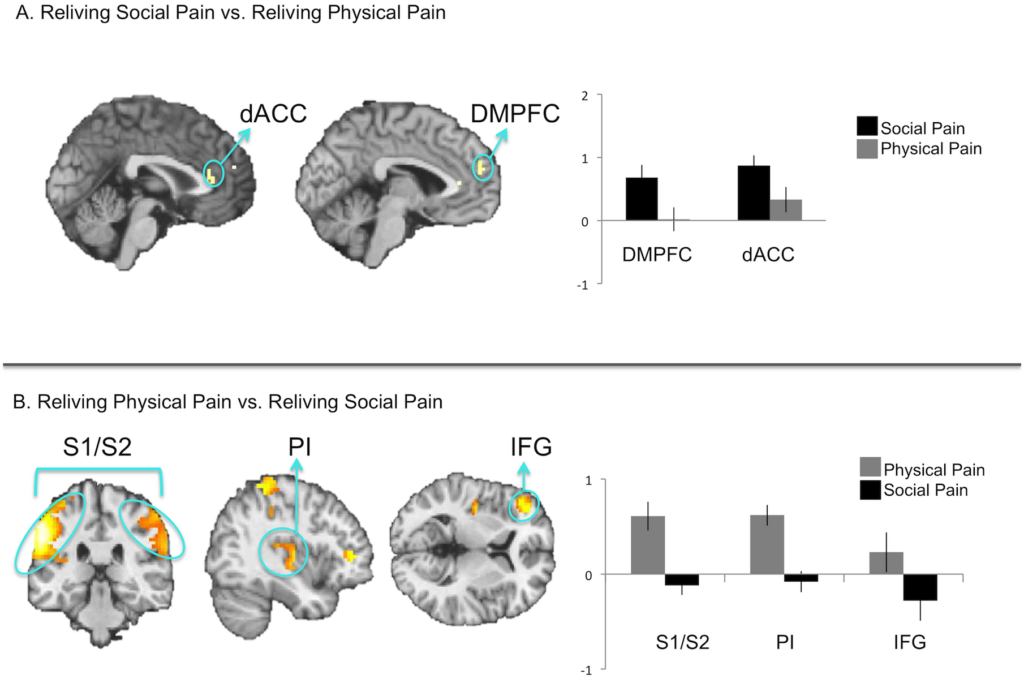
Brain imaging reveals the neural pathways activated when reliving social rejection, showing why emotional pain can feel as raw years later as it did in the moment. Image by: Meyer ML, Williams KD, Eisenberger NI, CC BY 4.0, via PLOS ONE
Your reaction isn’t oversensitivity. It’s biology working exactly as it should. When your brain perceives emotional rejection, it activates the same neural pathways as physical pain. A 2011 study published in the Proceedings of the National Academy of Sciences used fMRI imaging to show that social rejection and physical pain share overlapping brain regions. The researchers found that reliving intense social rejection activated the same areas of the brain as touching a hot stove. Your brain doesn’t distinguish between someone dismissing your feelings and someone causing you physical harm, and both register as threats.
This explains why you shut down so fast. Your nervous system received a signal that this person isn’t safe to be vulnerable with, and it shifted from connection into self-protection. You didn’t decide to lose interest; your brain just processed information about how he handles your emotions and made an automatic adjustment. The warmth disappeared because your body responded to his words as a small threat, and your system pulled back before you consciously chose to.
That’s also why you can’t talk yourself out of it. You’re not being unreasonable or holding a grudge. Your body learned something and filed it away for future reference. The next time you consider being vulnerable with him, that feeling will inform how open you feel. This isn’t a character flaw or an overreaction. It’s your nervous system doing exactly what it evolved to do: protecting you from people who don’t handle your inner world with care.
He’s Probably Not Trying to Hurt You
Most men who say “calm down” aren’t trying to be dismissive, they’re trying to help. The intention is usually to de-escalate, to bring the temperature down, to move things toward resolution. The problem is that this treats your emotions as obstacles rather than information. He sees that you’re upset and wants to make the upset stop, because to him, that feels like the helpful thing to do.
Many men grew up hearing that feelings are problems to solve quickly. Someone told them to toughen up when they cried and to be brave when they felt afraid. They absorbed the message that negative emotions are weaknesses to overcome, not experiences to feel. When those boys become men and see someone they care about in distress, their instinct is to make the distress stop as fast as possible. Sitting with someone’s pain feels uncomfortable, even wrong, because they learned that pain should be fixed or escaped. Saying “calm down” feels to him like offering a solution, like he’s doing something useful instead of just watching you struggle.
But you can’t see his intention, you can only hear his words and feel their effect. And the effect is that the person you wanted to share with just dismissed you. Whatever he meant to communicate never made it from his brain to your ears, and what landed instead was a message that your feelings are inconvenient. That’s the gap that causes so much damage in relationships. He thinks he’s helping. You feel like he told you to shut up.
The Other Phrases That Do the Same Thing
“Calm down” isn’t the only phrase that triggers this response. Several variations carry the same weight because they all send the same underlying message: that your emotional experience is somehow incorrect.
“You’re overreacting.”
He’s telling you your emotional gauge is broken, and his is the accurate one. But he doesn’t have access to some objective standard of how upset a person should be about a given situation, and neither does anyone else. Your history and experience shape your emotional responses. What feels like a small thing to him might connect to a lifetime of similar experiences for you, moments when people dismissed you or overlooked you or made you feel like your feelings didn’t count. He doesn’t have that context, and claiming you’re overreacting presumes he does.
“It’s not that big a deal.”
He’s measuring your experience against his scale instead of acknowledging yours. What feels minor to him might connect to something much larger for you, something you’ve noticed before, or a wound from earlier in your life that never fully healed. When he decides how big a deal something should be, he’s telling you that his assessment of the situation matters more than your lived experience of it. And once you hear that, it’s hard to keep talking.
“I’m sorry you feel that way.”
It sounds like an apology, but sit with it for a second, and you’ll notice what’s missing. He’s expressing regret about your emotional state without taking any responsibility for contributing to it. The problem, according to this phrase, is that you feel bad, not that he did something that made you feel bad. You can hear the difference between this and a real apology, even if you can’t explain it. A real apology acknowledges what happened. This one just acknowledges that you’re upset about it, as if your upset is the only problem in the room.
“Why are you still upset about that?”
He’s saying you should process emotions on his timeline. But grief and frustration and hurt don’t follow schedules, and they don’t care that he’s ready to move on. Asking this question tells you that your pace of healing is inconvenient for him. He’s finished with the conversation, and you’re the one holding things up. What you hear is that your feelings have become a burden.
Why It Makes You Pull Back
Each of these phrases treats your feelings as something to be managed rather than understood. And once you learn that sharing your inner world with someone comes with judgment attached, you stop sharing. Not to punish him, but because it no longer feels worth the risk. Vulnerability requires safety, and dismissive language destroys that safety one comment at a time.
It’s not just you feeling this way. When researchers at the University of Göttingen surveyed more than 68,000 women across 180 countries about what they want in a long-term partner, kindness and supportiveness ranked at the top, more important than attractiveness, wealth, or status. People want partners who can sit with emotions rather than rushing to fix or minimize them, and that tracks with what you’re actually looking for. You want someone who makes you feel heard, and when that doesn’t happen, interest fades because you’re learning something about what life with this person would feel like. Dismissive responses give you information you can’t ignore.
The phrases might seem small in isolation, but they add up. They teach you that vulnerability isn’t safe with him, and once that lesson takes hold, the relationship has a ceiling it can’t exceed. You might stay, might even be happy some of the time. But you’ll stop bringing him the real stuff, the fears and frustrations and hopes that make up your actual inner life. And a relationship where you can’t share those things isn’t really intimacy. It’s just proximity.
What You’re Actually Looking For
Gottman’s research points to something simple. Feeling heard matters more than agreeing on everything.

Validation doesn’t mean he has to agree with everything you say. It means he acknowledges that your feelings make sense given your experience, even if he would feel differently in the same situation. Validation isn’t capitulation. When someone says “I understand why you’re upset,” they’re not admitting fault or giving up their own perspective. They’re recognizing your reality before offering theirs, saying your experience counts even if they see things differently.
This is what you’re responding to when a man makes you feel heard. It’s not that he said the perfect thing or solved your problem. It’s that he let you know your experience registered with him, that what you feel matters to him because you matter to him. That’s what builds trust and makes you want to stay. You can disagree with someone and still feel connected to them, as long as they make space for your feelings before making space for their own opinion.
Read More: Why Women’s Buttons Are on the Left and Men’s on the Right: The Surprising History
Why This Matters Beyond the Moment
When “calm down” slips out while you’re stressed about work, you file that away, not as a single incident, but as a preview. You imagine the greater stresses that come later, the job losses and health scares and family conflicts that are part of any long life together, and you wonder if this is how he’ll respond to those, too. The small moment becomes a window into a possible future, and what you see through it shapes whether you want to keep walking in that direction.
This is why your interest drops so fast after conversations like this. You’re not being petty or looking for reasons to be upset. You’re learning what being with this person would actually feel like, and dismissive language teaches you something you can’t unlearn. If he can’t sit with your frustration about a bad day at work, how will he handle the really hard stuff? You’re not testing him. You’re paying attention.
The frustrating part is that he probably has no idea this is happening. He said two words, meant nothing by them, and moved on. Meanwhile, you’re recalibrating your sense of what’s possible with this person. The asymmetry is part of what makes it so hard. He doesn’t know the weight his words carried, so he doesn’t know there’s anything to fix. And if you try to explain it, you risk hearing another dismissive response, which only confirms what you were already feeling.
The Good News
Emotional intelligence isn’t fixed. People can develop stronger emotional abilities through awareness and practice, and men who learn to recognize and sit with emotions, their own and others’, build stronger relationships over time because women don’t lose interest in someone who’s willing to grow. The skill is learnable, even if it wasn’t taught in childhood. It just requires someone willing to learn it.

This means the right person can grow. A man who dismisses your feelings today isn’t necessarily someone who will dismiss them forever, especially if he’s willing to hear that it’s happening and work on it. The question is whether he’s open to that conversation, and whether he responds to feedback with curiosity or defensiveness. His reaction when you tell him this bothers you is data too. If he gets defensive or tells you you’re overreacting to his overreacting comment, you have your answer. If he gets curious and wants to understand, that tells you something different.
But it also means you’re not wrong to notice when someone consistently makes you feel unheard. Your reaction to “calm down” isn’t a flaw in your wiring; it’s your system telling you something worth listening to. Two words can tell you a lot about what a relationship would feel like, and paying attention to your response is how you protect yourself from investing in someone who won’t meet you where you are. Trust that response. It’s not oversensitivity, it’s your body doing its job.
You’re not asking for perfection. You’re asking to be heard. And the right person will understand that hearing you is the whole point.
Read More: Honest to a Fault: 10 Reasons Older Women Say They’re Finished with Dating