

Sometimes, it’s the smallest things that make people stop and smile. One little girl reminded everyone that good manners and kindness aren’t gone yet when she left a handwritten note for her neighbor. The neighbor’s sweet reply melted hearts online and joined other heartwarming stories that show how tiny gestures can mean a lot more than we realize.
A Reddit user named u/lakeyoung posted a picture of the letter, and it blew up fast. The note came from a young girl named Emma, who lived across the street at 1659. In her neat handwriting, she explained she had knocked on the neighbor’s door a few times but no one answered.
It read, “Dear Neighbor, My name is Emma and I live across the street on 1659. Would it be okay if I shot some hoops on your basketball hoop after school some days?” She even made little boxes for “Yes” and “No,” left a spot for “Comments,” and added a cheerful smiley face at the bottom. She politely asked if they could pop it back in her mailbox once they’d answered.
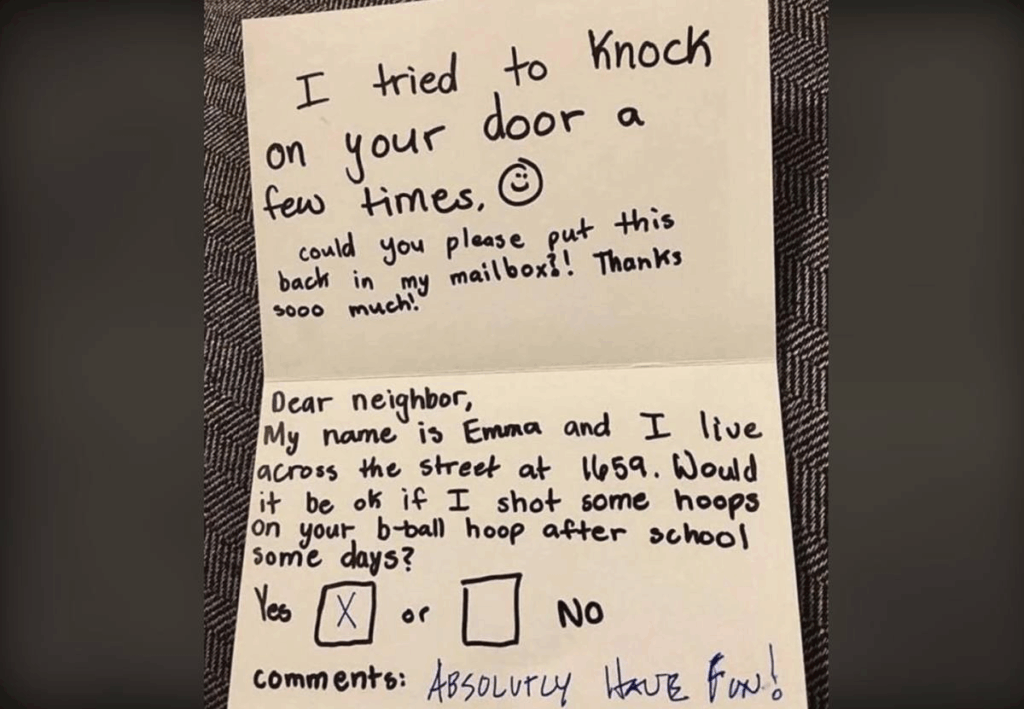
The neighbor didn’t hesitate. They ticked “Yes” and wrote back, “Absolutely, have fun.” It was short, but honestly, it said everything. When the post hit Reddit, people couldn’t stop talking about it. Many shared their own heartwarming stories about kind neighbors, respectful kids, and moments that reminded them what community really feels like.
Remembering the Lost Art of Politeness
Handwritten notes feel almost like something from another time now. In a world filled with screens and instant replies, Emma’s letter stood out for being so personal. No emojis, no autocorrect, just a pencil and a whole lot of thought.
Her note caught people off guard because it was simple, polite, and real. These days, most people just text or send a quick message. But this little girl took the time to write, fold, and deliver her message herself. That’s not something you see much anymore.
It reminded people that being polite isn’t old-fashioned, it’s human. The internet might be fast, but kindness like this moves slower, and maybe that’s why it matters more. Her heartwarming story became another example of those quiet random acts of kindness that restore people’s faith in humanity, one smile at a time.
Childhood Manners and Why They Still Matter
Manners can seem like a small thing, but they shape everything. Words like “please,” “thank you,” and “may I” might sound basic, but they build the foundation for empathy and respect. When kids learn to be polite, they’re not just memorizing phrases, they’re learning how to think about others.
Psychologists say manners are more than rules. They’re emotional habits. When a child like Emma asks for something the right way, she’s showing patience and awareness, two traits that can carry through a lifetime.
Parents and teachers have a lot to do with that. Kids absorb what they see. If adults treat people kindly, children copy that. Emma’s polite tone probably didn’t appear out of nowhere, it was learned at home, from someone who values respect.
And in a world where kids often get labeled as rude or careless, it’s a good reminder that they’re watching us. When they see adults yelling online or interrupting each other, they learn that too. So maybe, Emma’s note isn’t just about manners, but about what we’re teaching the next generation.
How the Digital World Is Changing Politeness
Technology has made communication fast, but maybe too fast. Kids grow up texting before they learn how to hold a real conversation. Screens have replaced eye contact. It’s convenient, sure, but something gets lost along the way.
Politeness takes effort. A handwritten note makes you think. You stop and decide what to say and how to say it. Emma’s letter forced that kind of thoughtfulness. Compare that to a quick “can I use your hoop?” text, different energy entirely.
Experts say this shift is affecting how kids talk and connect. Online, you don’t have to wait or think as much. You type, hit send, and move on. That’s great for speed, but not for empathy. Over time, it’s easy to forget there’s a real person reading what you wrote.
Still, not all hope is lost. Parents can balance screen time with real interactions. They can ask kids to make thank-you cards, introduce themselves to neighbors, or share their own heartwarming stories at dinner. These things sound small, but they teach kids that kindness isn’t just about saying the right words, it’s about meaning them.
Why This Moment Hit So Deep
Emma’s story hit home because it was pure. She didn’t expect anything, she just asked nicely. Her neighbor didn’t owe her anything, yet they replied with warmth. That mix of respect and kindness was enough to touch millions.
People online started sharing more kindness that went viral, and the thread became a chain of memories. One person remembered a neighbor who replaced a broken basketball hoop for all the kids on the street. Another told how a stranger let them skateboard on their driveway when theirs was too cracked. A mail carrier said they once gave baseballs to kids who were using a doll’s head as a ball.
Reading those replies felt like stepping back in time. Before everyone hid behind phones, neighbors actually knew each other. Kids played outside, and adults cared. It’s sad how rare that feels now, but stories like Emma’s remind us it’s still possible.
Read More: Neighbors are in Awe as they Watch a Little Girl Approach her Favorite Garbage Man
Image credit: Shutterstock.
Teaching Courtesy in a Busy World
Teaching manners shouldn’t feel like a chore. It’s not about forcing kids to behave, it’s about helping them see the value in respect. Saying “please” or holding the door isn’t just polite, it’s a small way of saying, “I see you.”
Life is fast, everyone’s tired, and being kind takes time. But even five seconds of kindness can change someone’s mood. Schools can help too, with things like group projects, sharing, listening, all teach teamwork and understanding.
Most of all, adults have to model it. If kids see grown-ups apologizing when they’re wrong, thanking people, or showing gratitude, they learn to do the same. It’s a ripple effect. A polite child often starts with a kind adult. That’s how random acts of kindness spread, quietly, one person at a time.
Closing Thought
Politeness isn’t a lost art, but it’s one that needs a bit of care. Every time someone chooses to be kind or respectful, it adds to a chain of goodness that travels further than they’ll ever know.
So next time you come across some kindness that went viral, remember Emma’s letter. It’s proof that good manners and good hearts still exist, and they’re often found in the simplest places, like a kid’s note left on a neighbor’s door.
Read More: 10 Things About Your House That Might Be Annoying Your Neighbors