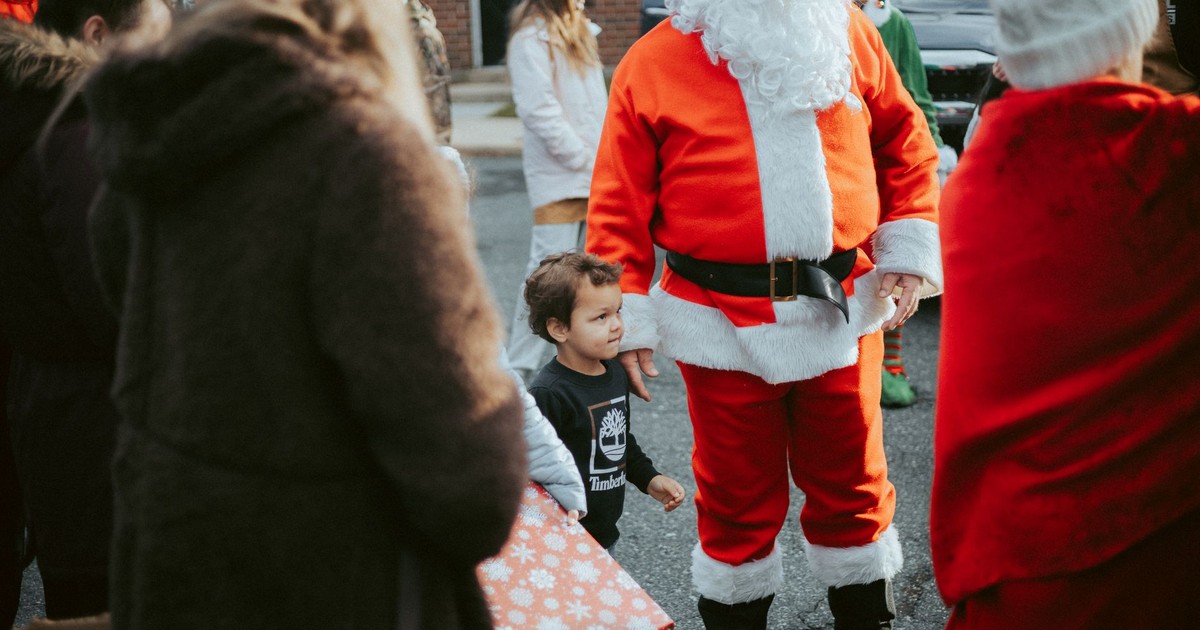

The question comes up every December, usually around the second week. When a parent notices something has shifted. The letters to Santa are less specific. The questions at bedtime are more pointed. And there is a particular look on a child’s face, not the pure, uncomplicated wonder of a five-year-old, but something more careful, more watchful. They are starting to do the math.
Most parents can feel it happening before they can name it. The window is closing. The question is when, and what to do when it arrives.
The short answer, backed by more research than you might expect: age 8. Across studies conducted over different years, in different countries, with different methodologies, the same number keeps appearing. Eight is roughly when children stop believing, though a meaningful number hold on longer. And some figure it out considerably earlier.
The Number That Keeps Coming Up?
Professor Chris Boyle, a psychologist at theUniversity of Adelaide, surveyed people around the world to find out how they changed their minds about Santa. And whether discovering the truth had affected their trust in their parents. The average age when children stopped believing was 8, according tothe Exeter Santa Survey, which drew 1,200 responses from adults reflecting on their childhood memories.
The survey found that 65 percent of people played along with the Santa myth as children even though they knew it wasn’t true. Two-thirds of kids, upon discovering that the whole thing was a construction, chose not to blow it up. They kept going, writing the letters, leaving out the cookies, performing belief for the adults in the room. Fifteen percent of people felt betrayed by their parents and 10 percent were angry when they found out Santa wasn’t real.
Professor Boyle noted that people had been getting in touch to say they were affected by the lack of trust involved when they discovered Santa wasn’t real. One participant had found their letters to Santa in their parent’s room. Another noticed that Santa and their father had the same handwriting. The discovery is rarely a single moment. It is usually a gradual process, with children quietly piecing together inconsistencies over time. Until the case becomes impossible to dismiss.
What the Research Actually Found?
Dr. Candice Mills, a professor of psychology at theUniversity of Texas at Dallas, led a two-part study published in 2023 examining how children lose their belief in Santa and whether any emotional aftermath lingers. In one study, 48 children ages 6 to 15 answered questions about how they discovered Santa was not real and how the discovery made them feel. In the second study, 383 adults reflected on their childhood experiences when learning the truth about Santa.
In both studies, the average age of disbelief was around 8, but with significant variability. Some children start doubting around 6 or 7, piecing together the logical gaps, the chimney physics, the impossibility of one night. The fact that Santa’s handwriting looks suspiciously familiar, well before they reach a firm conclusion. Others hold on past 10, particularly when parents invest heavily in the rituals. The recollection of adults matched the age of discovery in childhood, and in both cases, that age was higher if the parents had promoted the myth more intensely, through stockings, songs. This leaves a carrot for the reindeer, and similar traditions.
About a third of children and half of adults reported some negative emotions upon discovering the truth. Experiences of negative emotions were generally short-lived. And most both children and adults reported they would celebrate Santa with their own children or were already doing so. The generation that felt some sadness about finding out still, by an overwhelming margin, chose to pass the whole thing on.
The children who felt least unsettled by their discovery were those who reached their conclusion gradually. Testing theories and accumulating evidence in stages until a gentle confirmation, typically from a parent, settled what they had already largely worked out. A slow unraveling, it turns out, is considerably kinder than a sudden one.
Read More:15 Parenting Trends to End Now, According to Everyone.
How They Find Out?
The unexpected questions children ask, the ones that catch parents completely off guard, are often the first real signal that the Santa truth age has arrived. The questions get more logical, more pointed, and harder to deflect with a smile and a redirect.
Among people who ever believed in Santa, 41 percent say they figured it out for themselves. 15 percent found out from a friend or classmate, 11 percent found out from a parent. And 11 percent found out from a sibling. Most children do not need to be told. They work it out, the way they work out other things that don’t add up, not all at once, but steadily, until the logic becomes impossible to ignore.
Most Americans, 80 percent, say they believed in Santa as children. And 11 percent say they personally stopped believing when they were 10 years old, according toYouGov’s December 2025 holiday survey. The age spread is real: some children stop believing at 6, some at 15. And the variation has less to do with intelligence or skepticism than with how thoroughly the adults around them maintained the myth.
Professor Boyle described one nine-year-old who wrote a secret letter to Lapland without telling their parents, and nothing from that list arrived from Santa on Christmas morning. Other children pointed to simpler inconsistencies: reindeer cannot fly, and Santa would get hurt coming down a chimney when a fire was lit. Children are, in fact, running experiments. They are watching what happens. They are testing the story against reality with considerable precision, and eventually reality wins.
What Happens to the Kids Who Figure It Out?
The emotional aftermath of finding out is more varied than the collective memory of “devastated kid at Christmas” might suggest. A key finding of the Mills research: negative emotions were generally short-lived. The sadness was real, but for most children it was brief. The more complicated feelings tended to cluster around trust, not only in parents. It is also in the information they had been given about how the world works.
Mills and her co-scientists suggest that parents who are inclined to panic-lie when their children corner them with questions about Santa instead try turning the questions back on their kids, encouraging critical reasoning and perhaps a gentler reckoning. This is easier said than done in a kitchen at 7 p.m. when you are outwitted by an eight-year-old, but the principle is sound.
In Mills’s study, some children admitted to pretending they had believed in Santa to protect their parents’ feelings. Read that again. The children, once they knew, performed belief anyway, not for themselves, but for the adults in the room. The same instinct that made the parents keep the story going was mirrored back at them from the other side. Everyone was protecting everyone else, and nobody was quite ready to say so.
When Your Child Starts Asking Harder Questions?
There is no single correct way to handle the conversation when it arrives. What the research does suggest, fairly consistently, is that the approach matters as much as the timing.
Children who reach their own conclusion gradually, testing theories, asking questions, getting answers that acknowledge their growing skepticism without fully deflating the magic, tend to come through the transition more comfortably than those who find out abruptly. Through an older child at school, a sibling who felt like being truthful. Or an adult who underestimated what they were ready to hear.
If your child is seven or eight and asking more pointed questions. You do not have to volunteer the full picture unprompted. But leaning into their reasoning rather than away from it tends to serve everyone better in the long run. When they ask whether Santa is real, the most effective response is usually a question back: “What do you think?” A child who says “I think it might not be real” and is met with warmth rather than a defensive performance of belief will process that transition very differently from one who is shut down or met with an unconvincing denial.
As Dr. Mills has observed, there is no one-size-fits-all approach to managing the Santa myth. Some families prefer a direct conversation when the child initiates it. Others allow the belief to fade on its own timetable. What matters most, the data suggests, is that the child doesn’t feel blindsided, that there’s enough room in the conversation for the feeling to land without crashing.
One thing worth considering: younger siblings. If your eight-year-old knows, they now hold a kind of power, and they may use it. About 16 percent of Americans say that when they were children. They told someone who believed in Santa Claus that Santa does not exist. Having a quiet conversation with the newly informed child, framing it as a kind of grown-up responsibility, being one of the people who helps keep the magic alive for younger kids. Works more often than you might expect. Children who feel trusted with real information often rise to it.
What This Is Really About?
The Santa conversation is not actually about Santa. It is about one of the first times a child consciously grapples with the fact that the people they trust most have told them something that isn’t literally true. And has to decide what to do with that. Most of them decide to be kind about it. They play along. They protect the feeling in the house. They write the letter and leave out the cookies and wake up on Christmas morning and perform delight with more skill than most adults could manage.
The research on this is surprisingly consistent: the sadness is real and usually brief. The anger is real and usually brief. And the overwhelming majority of people who once felt one or both of those things still recreate the whole ritual for their own children without much ambivalence. The archive of childhood magic, once it closes, apparently leaves enough warmth behind to be worth repeating.
What parents tend to underestimate is that their child is watching them during all of this, during the Santa years, during the transition, during the conversation that finally names the thing. Children are paying attention to how adults handle the moment when a beautiful, agreed-upon fiction meets the edge of reality. They are learning something about how to hold two things at once: the feeling something gave you and the fact that it wasn’t literally true.
AI Disclaimer: This article was created with the assistance of AI tools and reviewed by a human editor.