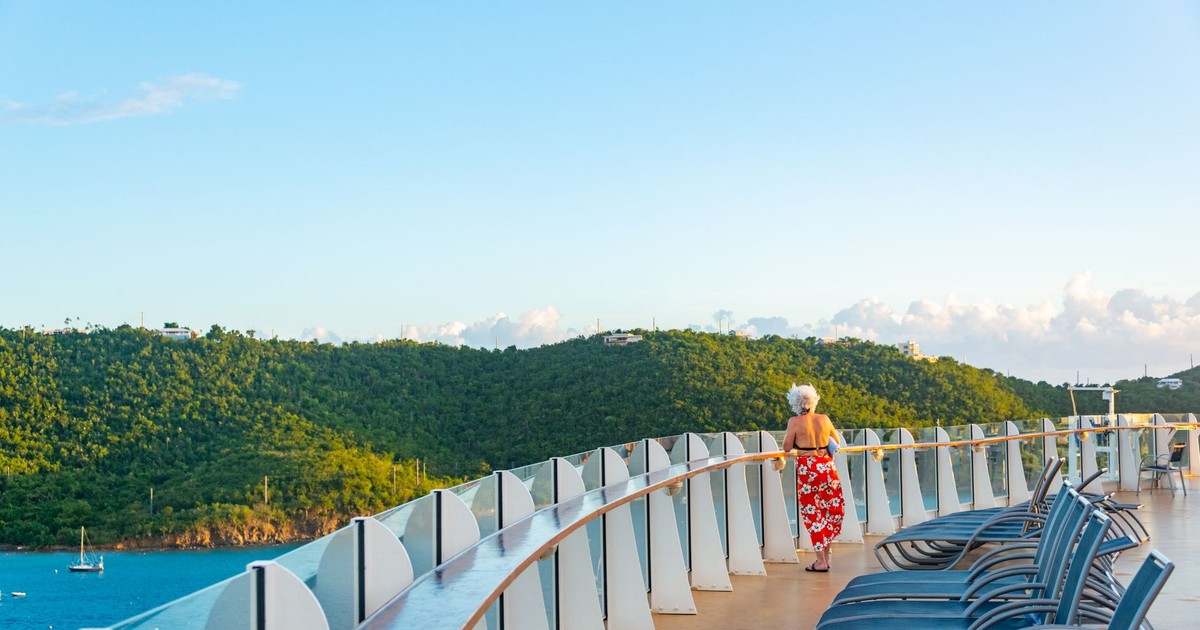

The decision sounds simple when you say it out loud: quit the job, pack a bag, move onto a ship. People have been romanticizing it since the first time they watched their vacation end and thought, why can’t I just stay? The reality of actually doing it, documented in real time by a growing group of people who have made the leap, is considerably more textured than the fantasy. There are weeks that feel like the best decision anyone has ever made, and there are weeks that feel like a very expensive lesson in why vacation environments are not designed to double as offices.
What 2024 and 2025 added to this conversation was a wave of honest first-person reporting from people living the life rather than pitching it. Retirees, remote workers, recently divorced people using a house sale as a launch fund, and partners of shipboard casino employees who finally ran out of reasons to stay ashore: all of them started posting, and the picture they assembled together is more complete and more complicated than anything the cruise industry’s marketing department would have written. Some found it genuinely affordable and surprisingly freeing. Others ran into noise, isolation, and logistical friction that nobody had warned them about. Most found it to be all of those things at once, sometimes in the same afternoon.
The allure is understandable. A lease, a utility bill, a car payment, and a commute all disappear. Every few days, a new port city appears outside the window. Meals are largely handled. Entertainment is always available. What could be hard about that? As it turns out: quite a lot. But also, genuinely, not as much as anxiety imagines. The reality sits somewhere in the middle of what social media glamorizes and what caution fears, and the people actually doing it are the most useful guides to where that middle ground is.
The Scale of the Movement
A record 37.2 million people took cruise vacations in 2025, according to the Cruise Lines International Association (CLIA), as reported by TravelPulse, up from 34.6 million in 2024 and 31.7 million in 2023. Those are passengers on discrete sailings. Tucked within those numbers is a smaller, harder-to-count cohort: people who never disembark for more than a few hours. They are not on vacation. The ship is home.
A growing group of people now plan their entire year around back-to-back sailings or commit to purpose-built residential ships that circle the world, trading yard work and car insurance for port calls and sea days. The appeal is convenience and community, not just luxury. Retirees make up a visible share of full-time cruisers, but younger remote workers have joined in as broadband at sea improves and cabin pricing can be rationalized on a per-month basis.
Emma’s story, shared through her YouTube channel A Broad That Travels, is one of the more detailed first-person accounts of what this transition actually involves. Her partner, Cael, is a professional poker player who works in cruise ship casinos and spent weeks, sometimes months, at sea while Emma stayed home for her corporate tech sales job. The time apart became unsustainable. Emma finally decided to quit, pack what she could, and move aboard.
Two months in, she was posting honestly about how difficult it actually is: the noise, the crowds, the lack of quiet space for her part-time data analytics work and studies, the way a floating vacation environment never quite stops being a vacation environment even when you need it to stop. “While it is fun a lot of the time,” she wrote, “there are also many aspects of living on a cruise ship that are difficult for me.”
That candor cuts against the dominant social media version of ship life, which tends to look like an endless string of balcony sunsets and port-day cocktails. Emma isn’t alone in having made this leap, or in discovering that the reality is more complicated than the idea.
What It Costs: The Full Financial Picture
The cost question is where most people start, and where the numbers spread widest depending on how someone approaches the lifestyle. There is no single answer, because full-time living on cruise ships takes at least two fundamentally different forms: booking back-to-back sailings on mainstream lines, or purchasing or leasing residency on a dedicated floating-residence vessel.
Back-to-Back Sailings
The average person spends approximately $286 per day aboard a cruise ship in 2025, according to Cruise Market Watch, cited via SmartAsset. That figure includes the ticket price as well as onboard spending for food, entertainment, and miscellaneous purchases. Based on that daily average, the cost of living aboard a cruise ship year-round totals just over $104,000 for those taking a nomadic approach.
But that average hides an enormous range, and practiced full-time cruisers routinely operate far below it. Lynnelle, who documents her life at sea on the YouTube channel Poverty to Paradise, is the most cited example of budget-optimized full-time cruising. Since committing to the lifestyle in July 2024, she took 36 cruises and spent 252 days at sea, with total cruise fares of $10,089, working out to just $40 per day. That $40 covers her room, all meals, entertainment, and transport between ports. When averaged out over eleven months, it amounts to the equivalent of spending just $917 a month for housing, food, and fun, according to Mad About Cruises.
Lynnelle achieves those numbers by hopping between cruise lines to score the best deals, rather than staying loyal to one brand for points accumulation. Her preferred lines are Carnival and Royal Caribbean, though she has also sailed with Holland America and Princess.
The gap between $917 a month and $104,000 a year is not a contradiction. It reflects the difference between someone methodically hunting interior cabin deals across multiple lines and someone booking balcony staterooms on a premium brand with a drinks package and daily specialty dining. Both are valid approaches to full-time ship life. They just happen to cost about twelve times as much, one compared to the other.
There are also the costs that never appear in the cabin price. Stocking up on essential prescription medications is one of the hardest practical logistics for full-time cruisers, requiring careful coordination during port breaks to secure 90-day supplies. Health insurance for someone with no fixed address is another layer of complexity. Mail, storage for belongings not aboard, and the occasional land-based expense during embarkation gaps all add up.
Residential Ship Options
There are two ways to become a full-time cruise ship resident. The first is to pay for residency on a ship that caters specifically to permanent residents. Two companies offering this are The World Residences at Sea and Villa Vie Residences, where onboard cabins are designed like floating condos rather than hotel rooms requiring constant rebooking. Villa Vie costs at least $129,000 annually, while residences on The World carry a minimum entry price of $2.5 million, according to Islands.com.
Villa Vie Residences, which launched in 2024, offers not only full ownership of cabins but also seasonal options and rentals. Seasonal ownership starts at $24,999, with full ownership at $129,999 per cabin. Their ship, the Odyssey, is scheduled to visit 147 countries and 425 destinations during its first 3.5-year voyage.
A newer entrant, Victoria Cruise Line, positioned itself as the more accessible residential option. Victoria brands itself as the “world’s first affordable residential ship,” with a 37-month rental contract carrying a monthly per-person fee starting at $2,399, approximately $29,000 per person per year. That is considerably cheaper than The World, though still a very different category from the back-to-back budget approach Lynnelle has refined.
However, Victoria’s launch has faced repeated delays, with its planned July 2025 sailing postponed due to low occupancy, a cautionary note for anyone evaluating a residential cruise concept that has not yet proven its model in operation.
The Reality of Daily Life at Sea
The financial picture is the easy part to interrogate. The psychological and practical texture of life aboard is harder to convey from the outside, which is why the candid accounts from people doing it are worth examining carefully.
Space, Sound, and Overstimulation
A cruise ship is, by design, a dense environment. Entertainment is everywhere. Music, announcements, poolside activity, and the ambient noise of several thousand people living in close proximity never fully disappear. For a week, this registers as festive. For a month or more, it becomes something else. Emma specifically described the constant noise and crowds making it difficult to find quiet spaces for her data analytics work and online studies, a friction that won’t appear in any brochure.
Lynnelle, in earlier documentation of her time at sea, described the cabin size plainly: take your current bedroom, cut it in half, then squeeze a queen-sized bed, a couple of nightstands, and everything you need to live into that half. That’s what a ship cabin looks like. She has also spoken openly about a lack of space, insomnia, sickness, and loneliness as things she experienced during her first year off land.
This matches the pattern across multiple accounts from full-time cruisers. The ship is a stimulating, social, high-density environment, which is precisely its appeal for a vacation and precisely its challenge as a home.
The Internet Problem
For anyone who needs reliable internet to work remotely, the onboard connectivity situation is one of the least-discussed but most consequential realities. Using the internet too often onboard can quickly become costly and frustrating due to slow connections. Cruise ship Wi-Fi typically relies on satellites, making service slow, patchy, and expensive. As a cruise travel guide notes, the practical workaround for many is to treat connectivity as port-dependent, front-loading important online tasks during time ashore.
For someone who only needs to check email and browse, satellite internet has become increasingly workable. For someone running client deliverables, sitting in on video calls, or uploading large files, the variability is a serious operational constraint. Emma’s combination of data analytics work and online studies placed her squarely in the latter category, and it is among the difficulties she named explicitly during her first two months.
Isolation Alongside Constant Company
The paradox most full-time cruisers eventually confront is being surrounded by people while losing access to the relationships that anchor them. One long-time sailor spent 300 days on cruises in 2023 alone and stayed connected with friends through email, social media, and WiFi calls, even joining a book club via Zoom. The biggest ongoing challenge, she noted, was managing the time difference during certain months.
The social dimension of ship life cuts both ways. Emma also encountered it working in the opposite direction: she ran into people she had met on an earlier sailing and spent most of that cruise reconnecting with them, noticing a community of frequent cruisers beginning to form around the people who returned repeatedly to the same itineraries. Unexpected belonging, finding your people at sea rather than onshore, is part of what sustains people through the harder stretches of this lifestyle.
Who Chooses This Life, and Why
The profile of full-time cruisers in 2025 and 2026 is more varied than the retired-couple archetype that dominated the category a decade ago. Emma is in her thirties and working. Lynnelle made the move after a divorce, selling her house and giving away her car in early 2024, using the lifestyle as a full reset, not just a retirement upgrade. Belencia Wallace, a registered nurse profiled by CNN in 2025, sold nearly everything she owned to spend fifteen months straight at sea. Sisters Jo Johnston, 69, and Elaine Durham, 63, both retired and single, have collectively logged more than 1,500 days at sea and approached it as long-term lifestyle architecture rather than an extended vacation.
Living permanently aboard a cruise ship, or any vacation environment, seems appealing to many people, but it is not universally suited to everyone. The lifestyle shift can be jarring, and it can be a significant adjustment. What the people who stick with it tend to share is not a particular financial profile or life stage, but rather a tolerance for transience, a willingness to release the idea of a permanent home base, and some version of a practical anchor, whether that’s a partner who already lives this way, a remote income that functions on patchy internet, or simply a debt-free financial position that makes the math work.
The Emerging Infrastructure Around Full-Time Cruising
As the community of full-time ship residents grows, a supporting infrastructure has started forming around them. Loyalty programs on mainstream cruise lines now have practical significance well beyond free upgrades. They can meaningfully reduce the cost of full-time occupancy through casino offers, status discounts, and preferential cabin pricing. Lynnelle’s strategy of deliberately hopping between lines to find the best deals runs counter to this, and both approaches have merit depending on how much consistency versus value a person is optimizing for.
The residential ship sector is building out a more formal version of the same idea, with longer-term contracts, owned or leased accommodations, and amenities designed for residents rather than vacation guests. Cruise demographics are also shifting broadly, with about one-third of cruise guests now under the age of 40, reflecting growing interest among younger passengers and families, a demographic change that will likely continue pushing cruise lines toward better onboard work-from-ship infrastructure, including faster and more reliable internet packages.
The gap between cruise vacation expectations and the onboard reality is something the industry has long managed with selective marketing. The gap between a cruise vacation and full-time cruise residency is something the industry is only beginning to reckon with, as the people living it make that contrast increasingly impossible to ignore.
What the Water Actually Tells You
Emma’s account, two months in, is honest in a way that the category usually isn’t. She acknowledges the fun, the experience, and the genuine rewards, while also naming the parts that are difficult: the overstimulation, the noise, the challenge of carving out productive working hours inside a machine designed to entertain. That combination of candor is more useful than either the idealized version or the cautionary tale, because the reality genuinely holds both.
Living on cruise ships is not uniformly expensive or uniformly affordable. It is not reliably peaceful or reliably lonely. It does not automatically produce freedom from the pressures of ordinary life, and it does not automatically replicate them either. The cost can be as low as $917 a month for someone disciplined about deal-finding and as high as six figures annually for someone choosing a premium residential experience. The social life can be unexpectedly rich with community or unexpectedly hollow despite constant company, sometimes alternating between those two states on the same sailing.
What the growing body of firsthand accounts makes clear is that this lifestyle punishes vague motivations and rewards practical clarity. The people who report doing it well tend to know exactly what problem they were solving when they stepped aboard, whether that was time with a partner, a complete financial restructuring, a medical reset, or simply the desire for a specific kind of daily freedom. The ones who struggle most are the ones who expected the ship to resolve something that was never going to resolve at sea. The water doesn’t change the thing you brought with you. It just makes it more visible.
AI Disclaimer: This article was created with the assistance of AI tools and reviewed by a human editor.