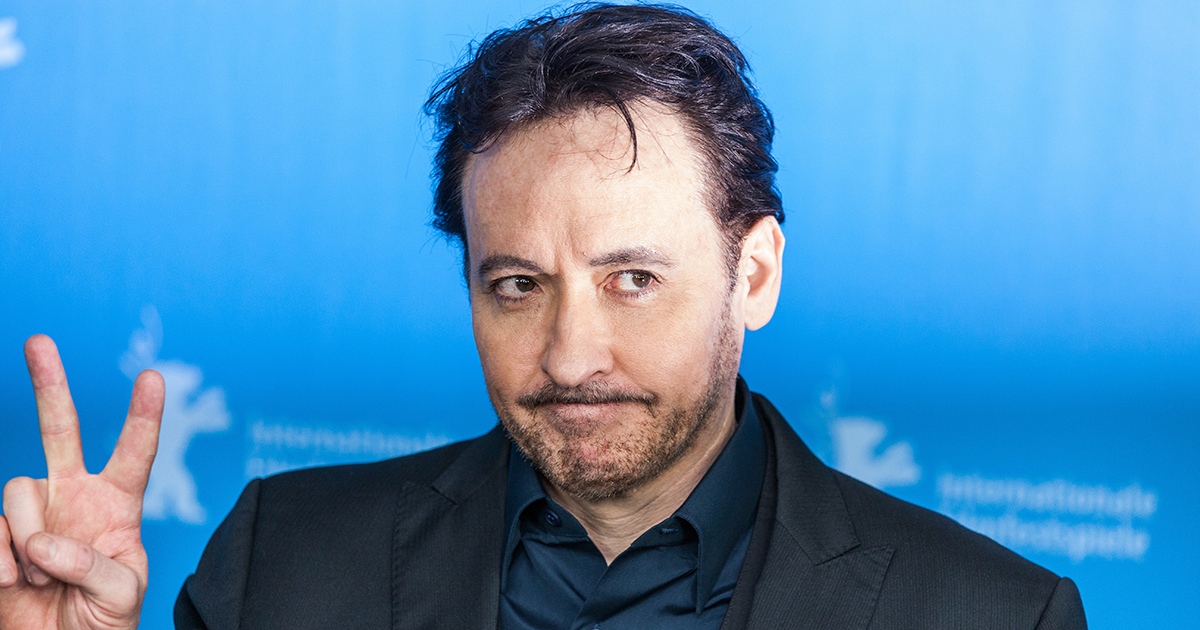

John Cusack spent the better part of four decades becoming precisely the kind of actor Hollywood said it wanted: charismatic, versatile, commercially reliable when the project called for it, and willing to make strange choices when it didn’t. He gave the world the boombox scene in Say Anything, the darkly comic hitman of Grosse Pointe Blank, the emotionally wrung-out record store owner of High Fidelity, and a portal into John Malkovich’s brain. Then, gradually, he stopped. Not with a press release, not with a memoir, not with a dramatic announcement on a late-night couch. He simply appeared in fewer films, kept his head down in Chicago, and waited until he had something worth saying.
In July 2026, he said it. Speaking to Variety ahead of his appearance at San Diego Comic-Con, where he was debuting his first graphic novel, Momo, the 60-year-old actor offered one of the most candid explanations for a Hollywood departure to come from a major star in years. The statement that captured the most attention was deceptively plain: “I wanted to tell a story, but I didn’t want to negotiate telling a story.”
Why Cusack Left Hollywood
John Cusack has revealed that a desire to escape corporate interference and studio committees in Hollywood is the primary reason behind his reduced presence in film in recent years. Now 60, Cusack appears in fewer movies annually than he once did. Rather than framing this as a retirement, Cusack has recast it as a deliberate pivot toward creative independence, most visibly through the publication of his debut graphic novel, Momo, scheduled for release in September 2026. His statements at San Diego Comic-Con 2026 offer a detailed account of how Hollywood’s structural shift toward franchise filmmaking and committee-driven production eroded the conditions that once made his career possible.
A Career Built on Creative Risk
Cusack began acting in films during the 1980s, starring in coming-of-age films such as Sixteen Candles (1984), Better Off Dead (1985), The Sure Thing (1985), Stand by Me (1986), and Say Anything (1989). What distinguished him from the broader Brat Pack wave was a consistent willingness to pursue material that sat outside mainstream commercial formulas. Originally a member of the Brat Pack in the early 1980s, Cusack managed to accomplish the rare feat of flourishing as a dramatic actor beyond the confines of teen comedies.
He then started appearing in independent films and had leading roles in Eight Men Out (1988), The Grifters (1990), Bullets Over Broadway (1994), Con Air (1997), Grosse Pointe Blank (1997), Being John Malkovich (1999), High Fidelity (2000), America’s Sweethearts (2001), Serendipity (2001), Max (2002), and Runaway Jury (2003). The range across those titles alone tells the story: a gritty baseball drama, a dark literary comedy, a blockbuster action film, a surrealist art-house piece, and a romantic comedy, all within fifteen years.
According to CBS News, Cusack received a Golden Globe nomination for best actor in a comedy or musical in 2000 for his starring role in High Fidelity, for which he also helped write the screenplay, and was awarded a star on the Hollywood Walk of Fame in 2012.
The Studio System He Knew and When It Changed
The clearest articulation of Cusack’s disillusionment with Hollywood did not arrive in 2026. It arrived more than a decade earlier.
He complained as long ago as September 2014 about movie-making committees. In an interview with The Hollywood Reporter covering his Guardian interview at the time, Cusack described a Hollywood he once had access to through his relationship with producer Joe Roth, who ran Disney until 2000. “My friend Joe Roth ran Disney,” Cusack told The Guardian. “He made things like The Rock and Con Air to make shareholders happy, but then he also gave six or seven slots to people he liked. I got to make High Fidelity and Grosse Pointe Blank. Spike Lee got to make Summer of Sam. Wes Anderson got to make Rushmore. I had that memory of film and that’s gone.”
That loss of the “one for you, one for them” arrangement was not a personal grievance. It was a structural observation about how the industry had reorganized itself around risk-averse, franchise-driven content. He added that there was once a “one for you, one for them” system that had ended. “Now it’s six for them, with a committee cutting the film who weren’t part of making it, and maybe one for you,” Cusack said.
In that same Guardian interview, Cusack explained that Hollywood was now a place “where the big guys are in control, and they’re making more films based on franchises.” Cusack said studios don’t trust filmmakers to make their own movies the way they used to, and he condemned the lack of respect for older filmmakers and the prioritization of commercial success over originality.
Those 2014 remarks were not the frustrated words of someone whose career was failing. They were the diagnosis of someone whose career was still intact, but who could already see the conditions that had sustained it disappearing.
The Retreat: A Filmography in Decline
Cusack appeared in two films in 2025, the thriller Fog of War and Detective Chinatown 1900, a Mandarin-language film directed by Sicheng Chen and Mo Dai. He appeared in only one movie in 2024, the war drama Decoded. Before that, he did a single movie in 2022, the action film Pursuit, and the 2020 series Utopia for Amazon.
This is not the output of an actor who cannot get work. It is the output of an actor who has made a considered decision about what work is worth doing. The projects Cusack has taken on in this period exist at the margins of the Hollywood studio system, not at its center.
Political Activism as a Parallel Career
Cusack’s withdrawal from mainstream Hollywood has run alongside an increasingly active public presence in political and intellectual life. He is an outspoken liberal commentator on social media, with 1.7 million followers on X. He has criticized Donald Trump and was involved in the 2020 protests in Chicago.
In late 2014, Cusack, Arundhati Roy, and Daniel Ellsberg traveled to Moscow to meet with NSA whistleblower Edward Snowden. The result was a series of essays and dialogues discussing the nature of the state, empire, and surveillance in an era of perpetual war, the meaning of patriotism, and the role of capital versus people in crossing borders. That project, eventually published as the 2016 book Things That Can and Cannot Be Said, is an early indicator of the direction Cusack was heading: toward work he controlled entirely, produced outside institutional frameworks, and shaped by conviction rather than commercial calculation.
Comic-Con 2026: The Moment He Said It Plainly
The 60-year-old actor made a rare appearance at San Diego Comic-Con on July 24, 2026, to introduce his new graphic novel, Momo. The setting was striking: an actor who had spent years avoiding press appearances chose one of the most heavily attended pop-culture events in the world to make his case for why he had walked away from the industry that made him famous.
Speaking to Variety, Cusack explained why he had pivoted away from his acting career to start writing. “Well, I always thought they were the closest things to film, really,” he said. “You know, you’re picking out shots and they’re so cinematic. I wanted to tell a story, but I didn’t want to negotiate telling a story.”
Cusack explained that large film budgets often come with creative interference, saying that once someone invests millions into a movie, “they want to have an opinion and they’re afraid and all that.” The phrase “and they’re afraid” is the most revealing part of that sentence. It reframes studio interference not as greed or control for its own sake, but as a consequence of financial anxiety.
The contrast with his graphic novel project was total. “Nobody edited anything I wrote or that he drew. So it’s really a piece of work that was just done by two people,” Cusack said of himself and illustrator Ignacio Noé. He noted that he appreciated there was “no committee” on the project, saying, “It was just me and Ignacio’s story, and that doesn’t happen today.”
Momo: The Project That Replaced the Film Career
Cusack’s debut graphic novel, Momo, is set for release on September 29, 2026, from Mad Cave Studios. According to a Forbes profile of the book, Cusack calls it a “brand-buster,” blending elements of Don DeLillo and Hunter S. Thompson, illustrated by Argentine artist Ignacio Noé. The story is a 1972-set sci-fi buddy, heist, and road-trip narrative.
The protagonists, “Johnson” and “Tina Louise,” join “Doc” to pursue an alien head held by Nixon’s government, an obsession shared by Jackie Gleason and Antonin Artaud. Cusack claims the story is based on declassified files.
Argentine master illustrator Ignacio Noé’s hyper-detailed art fuses painterly richness with cinematic scope. Noé’s pages carry raw energy, each panel alive with shadow, light, and a hint of menace.
Cusack discussed the book with fellow actor and comic creator David Dastmalchian at Comic-Con 2026, exploring the inspiration behind Momo and what it is like telling stories across mediums including film and comics.
The “No Committee” Principle
The phrase Cusack used most frequently in his July 2026 remarks was “no committee.” It functions as shorthand for everything he has described losing in Hollywood: the ability to make a creative decision and have it stand, unmediated, as the final product. While speaking to Variety ahead of San Diego Comic-Con 2026, the 60-year-old star of High Fidelity and Say Anything explained that funding requirements for modern feature films have stifled creative freedom. Studios providing budgets between $20 million and $30 million inevitably insist on editorial control, leading to stories shaped by executive committees rather than filmmakers.
The graphic novel, by contrast, cost far less to produce, required no institutional backing from a major studio, and allowed two people – Cusack and Noé – to make every creative decision without external review. Cusack described the book as the opposite of a brand-extension project: “It’s not ‘on brand,'” he said. “It’s more like a brand-buster.” Cusack is not describing a strategic pivot designed to maximize his commercial appeal in a new medium. He is describing an escape.
A Rare Public Moment: The 2026 Oscars
The Comic-Con appearance was not Cusack’s only rare public moment of 2026. Earlier in the year, Cusack made another rare public appearance at the 2026 Oscars to help honor his late The Sure Thing director Rob Reiner. The Oscars and Comic-Con appearances reveal the same pattern: Cusack selects his public moments with unusual deliberateness, choosing occasions anchored to something he genuinely cares about rather than to a promotional obligation.
The Broader Pattern: Hollywood’s Creative Exodus
Cusack’s case is a particularly well-articulated instance of a broader shift in how established actors and filmmakers relate to the major studio system. The franchise consolidation that accelerated in the 2010s produced a version of Hollywood in which the space for mid-budget, character-driven, auteur-adjacent projects – precisely the kind of films that defined Cusack’s peak output – shrank significantly. The Grosse Pointe Blank of 2026 does not get made by a major studio. It gets made independently, financed outside the traditional system, and distributed in ways that were not available to filmmakers in 1997.
For Cusack, however, the response has not been to make the independent version of his old films. It has been to move into a medium where the economics of creative control are fundamentally different. He cited a desire for complete creative control, free from the financial pressures and interference of the Hollywood studio system, as his primary motivation.
Read More: Meg Ryan Stopped Acting To Be A “Full Time Mom” – This Is Her Today
As a writer, Cusack co-wrote the 2016 book Things That Can and Cannot Be Said with Arundhati Roy about his conversations with whistleblower Edward Snowden. That book, and now Momo, trace a consistent line in Cusack’s creative life: a preference for work that begins and ends with its authors, without institutional intermediaries shaping it at every stage.
What He Actually Walked Away From
John Cusack’s step back from Hollywood is not a retirement. He has not announced he will never make another film, and his recent credits – two films in 2025, including the Mandarin-language box-office success Detective Chinatown 1900 – show he continues to work selectively. What he has done is something more deliberate: he has reorganized his creative priorities around a principle rather than a career strategy.
That principle, stated plainly at Comic-Con in July 2026, is that creative work produced without institutional interference is worth more to him than the prestige, the budget, or the distribution scale that major studio films can offer. The committee-driven model of modern Hollywood filmmaking, in which a budget of $20 to $30 million purchases not only production infrastructure but also the opinions of every executive who signed the check, represents for Cusack a fundamental incompatibility with the kind of storytelling he wants to do.
The graphic novel Momo – surrealist, politically inflected, deliberately uncategorizable, and produced by exactly two people – is the most complete statement Cusack has made about what he values. It is also, in its own way, a rebuke: proof that the stories he wants to tell are possible without the system he walked away from. Whether Momo reaches an audience large enough to matter commercially is, by the logic Cusack has been applying for years, somewhat beside the point. Nobody edited it. There was no committee. That, for him, appears to be enough.
AI Disclaimer: This article was created with the assistance of AI tools and reviewed by a human editor.