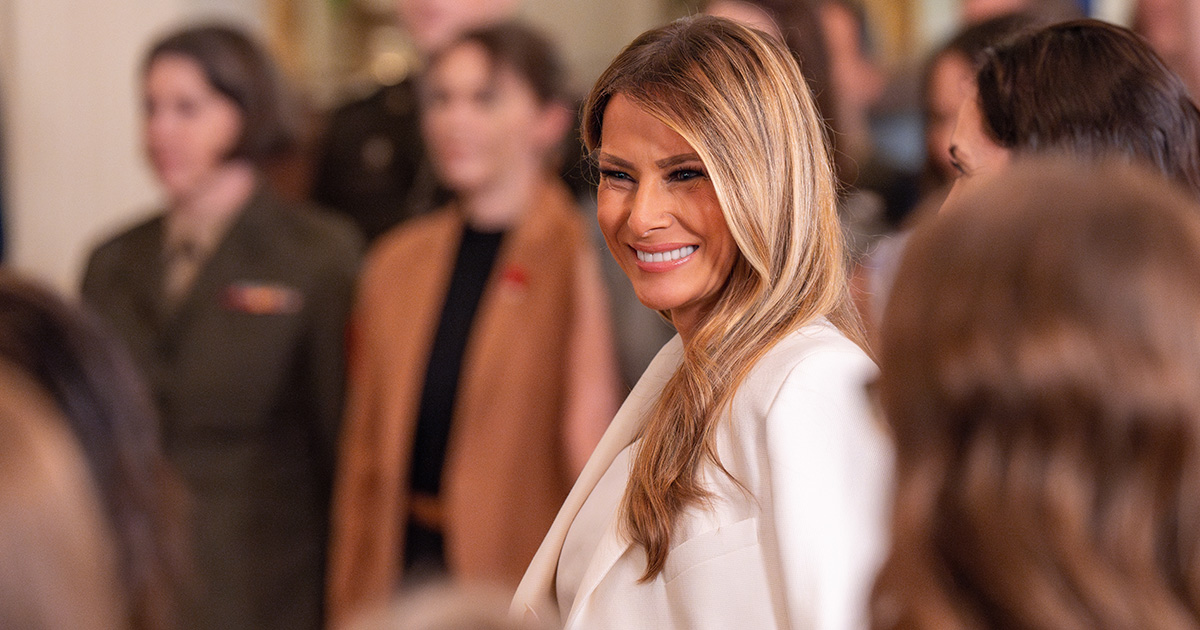

A journalist sits across from a 26-year-old woman he has already decided he understands. His job, as he sees it, is to get her to confirm what the room already assumes: that a Slovenian model on the arm of a 53-year-old American billionaire must have done the math before she did anything else. The answer she gives in December 1999 ends up being more revealing than anyone in that room probably expected.
Was she with him for the money?
The question has followed Melania Trump for 25 years. She answered it once, directly, in 1999, and the answer has been replayed and reanalyzed ever since, not because it was evasive, but because it was specific enough to be interesting and incomplete enough to invite argument. The prenuptial renegotiations, the financial disclosures, the memoir, the documentary deal only add detail to a picture most people had already decided they understood.
What She Actually Said
On December 3, 1999, Melania Knauss, then 26 years old and publicly coupled with Donald Trump since the previous year, sat down for an interview with ABC News correspondent Don Dahler following a photo shoot in New York City. Dahler told her plainly that you don’t see many 26-year-old supermodels on the arm of a 53-year-old businessman. The inference was unmistakable.
Melania shot back directly. “You know what, you can’t.. sleep or to hug or to talk with beautiful things, with beautiful apartments, beautiful clothes, beautiful cars, beautiful houses, you can’t do that,” she said. “You could feel very empty.” When Dahler pressed further, she did not flinch. She described Donald Trump as “very kind” and “very charming” and made her logic plain: wealth provides comfort but not connection. You cannot hold a conversation with a private jet. You cannot be comforted by a penthouse at 3 a.m.
Dahler also asked her in 1999 if she could see herself being First Lady to Trump as president of the United States. “Yes, I would be very traditional like Jackie Kennedy. I will support him, I will do a lot of social obligations,” she said. When Dahler noted that a First Lady role would likely end her modeling career, Melania responded that she would “stand by my man” and confirmed she would give up modeling.
The interview resurfaced in 2024 and went viral for the second time in as many years, amplified by renewed public interest in the couple’s dynamic ahead of Donald Trump’s return to the presidency. It became one of the most-watched clips in Melania’s public archive, not because it revealed something new, but because it revealed something consistent.
From Slovenia to the White House
Melanija Knavs, later Melania Knauss, was born on April 26, 1970, in Novo Mesto, Slovenia, then part of the former Yugoslavia, to parents Viktor and Amalija Knavs. As a young woman, Melania studied design before pausing her studies to pursue a modeling career abroad, eventually becoming a successful fashion model appearing in television advertisements, fashion magazines, and billboards, before coming to the United States during the 1990s.
She arrived in New York in 1996, building her career from photo shoots and magazine covers before meeting Trump at a Fashion Week party in 1998. He was 52, recently divorced from his second wife, Marla Maples, and already a tabloid institution. From the start, the pairing of a Slovenian model and a New York property mogul invited a familiar narrative: that she was there for the lifestyle, not the man.
That narrative stuck partly because it was easy, and partly because it mapped onto a story the public already knew how to tell about young women and wealthy older men. It did not much matter that Melania had built her own career before she ever met Trump. The 24-year age difference and the fortune were too stark to resist.
She married Donald J. Trump on January 22, 2005, at the Church of Bethesda-by-the-Sea in Palm Beach, Florida. The following year, the couple welcomed their son, Barron. When Donald J. Trump was elected president in 2016, Melania Trump became the second First Lady born outside of the United States, the first being Louisa Catherine Adams, and the only First Lady in American history to become a naturalized U.S. citizen. Less frequently noted is that it also represents the completion of a 20-year arc that began with a teenager from a small Slovenian town who started modeling at 16 and ended with her standing at a White House podium.
The Prenuptial Agreement: A Record of Leverage
The money question never went away. It simply found new forms. The most legally concrete version has been the recurring, reported renegotiation of the Trumps’ prenuptial agreement, a pattern that, to critics, seemed to confirm the transactional reading of the marriage, and to defenders, demonstrated Melania protecting herself and her son with the tools available to any woman in her position.
According to NBC News, reporting on Washington Post reporter Mary Jordan’s book The Art of Her Deal, Melania Trump favorably renegotiated her prenuptial agreement after Donald Trump won the White House. Jordan’s reporting indicated the initial prenup had not been particularly generous. Mrs. Trump used her marriage, the president’s longest relationship, and her newfound standing as First Lady to rework those terms. She referred to the renegotiation as “taking care of Barron,” and sought written assurances that her only child with the president would be treated like his oldest three children when it came to inheritance and financial opportunities.
The renegotiation did not stop there. Reports indicate that Melania has renegotiated the terms of her marital agreement at least three times in total. While updated contracts have offered more financial security for herself in terms of both cash and real estate, the chief motivation for changes was reportedly to better protect Barron; “Melania is most concerned about maintaining and increasing a substantial trust for their son,” one source told Page Six.
To read the prenup renegotiations purely as evidence of a transactional marriage is to ignore what they actually document: a mother securing her child’s financial future, and a woman protecting her own interests inside a marriage to one of the most litigious and financially volatile figures in American public life. Those motivations are not mutually exclusive, but neither are they identical to “she married him for the money.”
A Financial Portfolio Built Before and Beyond the Marriage
The Melania Trump money question has always carried an implicit assumption: that her wealth is inseparable from his. The financial record tells a more complicated story.
In 2010, Melania launched “Melania Timepieces & Jewelry” through QVC and also developed the Melania Skin Care Collection. Her business activity later shifted toward publishing, licensing, and digital products. She published her memoir and became involved in NFTs and other collectibles through MKT World LLC, an entity that became central to her financial disclosure.
In 2024, she released her self-titled memoir, which debuted at number one on the Publishers Weekly bestseller chart. According to federal financial disclosures reported by AOL News, Melania reported approximately $10.7 million from a licensing deal tied to her Amazon MGM Studios documentary project, roughly $6 million from NFT and collectibles sales, and approximately $521,000 from her memoir, putting her total personal income for 2025 in the range of $17 million.
Her relationship with Donald Trump has long been the lens through which everything else is filtered. The public fascination with Melania Trump money questions persists in part because the answer remains genuinely unclear to outside observers, and in part because the question itself touches something older and more persistent than this particular marriage: the assumption that a beautiful woman from a modest background who marries a very wealthy older man must have done so for material reasons, regardless of what she says or demonstrates to the contrary.
These are not the financial footprints of someone whose economic identity begins and ends with her husband. They represent a decade and a half of brand building, deal-making, and independent revenue generation. Whether one admires the specific vehicles, NFTs and meme coins generate their own controversies, the financial independence they represent is real.
The Memoir and the Narrative She Chose
When Melania published her memoir in October 2024, critics and readers alike noted what was absent. The New York Times‘s Alexandra Jacobs characterized the writing as barely grappling with the mysteries of the marriage, while The Independent observed an unmistakable formality in how the relationship was described. Her relationship with Donald Trump received far less candid treatment than the details of her Slovenian upbringing or modeling career.
That reticence is consistent with a pattern stretching back to 1999. In the ABC interview, Melania volunteered her emotional philosophy, you can’t hug a beautiful plane, but offered nothing about the specific texture of her relationship with Trump. In the memoir, 25 years later, the pattern held. What she was willing to put on record was her case for herself as an independent person. What she was not willing to put on record was the marriage as the public imagines it.
Whether that is privacy, discipline, or something else entirely is a question the record cannot answer. If the resurfaced 1999 clip shows anything, it is that the tension between who Melania says she is and who the public insists she must be has been present since the very beginning of her life with Trump.
The First Lady’s Public Role and Independent Identity
Through her years as First Lady, Melania has faced criticism for a relatively low public profile and limited involvement in politics. “I give him my advice, and sometimes he listens, and sometimes he doesn’t. And that’s okay,” she said of her dynamic with Trump in an interview on Fox & Friends.
The BE BEST initiative she launched in 2018, focused on children’s well-being, online safety, and opioid abuse, was her most visible policy effort during her first term. Her second term has included policy-adjacent work: in late 2025, Melania Trump and Treasury Secretary Scott Bessent announced the launch of “Fostering the Future Accounts” at the Treasury Department, a program extending investment funds to children in foster care, with Melania stating that the new federal guidance would give child welfare agencies the ability to act as guardian for children in foster care for the purposes of opening an account.
That work exists separately from Donald Trump’s political orbit. It is hers. So, increasingly, is her financial profile. With personal income of approximately $17 million in 2025 alone, drawn from a documentary deal, NFT sales, and book royalties, Melania’s earnings reflect a brand she has built on her own terms, one that predates the White House and appears to extend well beyond it.
What the Question Has Always Really Been About
The 1999 interview has been viewed millions of times since it resurfaced. People watch it expecting confirmation of one narrative or the other, the calculating social climber, or the misunderstood woman wrongly reduced to her husband’s net worth. What they actually see is a young woman doing something more specific and more interesting than confirming either: she is articulating a personal philosophy about wealth and intimacy, and she is doing it with composure and clarity in front of a journalist whose question was explicitly designed to corner her.
Whether that philosophy reflects her private reality is not something anyone outside the marriage can know. What the record does show is this: Melania Trump arrived in the United States from a modest Slovenian background, built an independent modeling career before she ever met Donald Trump, renegotiated her financial agreements from a position of leverage rather than desperation, and has declined, consistently and across multiple decades, to give the public the access to her interior life that would allow the question to be settled once and for all.
The gold-digger narrative persists not because it is proven, but because it is plausible-sounding and resistant to disproof. Melania has never successfully disproven it, in part because she has never tried very hard to, and in part because no one can disprove anything from the inside of a marriage they haven’t lived. For someone allegedly motivated purely by financial gain, she has shown a remarkable indifference to performing the kind of warmth and transparency that would have made her far more commercially valuable as a public figure. She has never particularly tried to be liked. She has tried, repeatedly, to be understood on her own terms. What she said in 1999 remains the closest thing to her public answer: you can’t hug a beautiful house. Whether you believe that answer has always been, ultimately, your own choice to make.
AI Disclaimer: This article was created with the assistance of AI tools and reviewed by a human editor.