
There’s something kind of magical about food that connects across thousands of years. Not the romanticized version of a feast, but the real thing – a cook standing over a fire trying to get the proportions right, messing up the first batch, starting again. It’s so ordinary, and yet that ordinary act is exactly what a team of archaeologists and chefs in Turkey managed to trace back to the Roman era and bring right to people’s tables in 2025.
The story starts in the ground. Buried beneath a hilltop site in southeastern Turkey – one of the world’s most archaeologically dense cities – researchers found evidence of what the Romans were actually cooking. Not a story about an emperor’s feast. Just the food people ate. And when archaeologists and chefs joined forces at the GastroAntep Festival 2025, those ancient Roman era recipes didn’t stay in the archives. They got made.
What those dishes taste like, who made them, how they figured out the methods, and why a Turkish food festival ended up being the place where Roman cuisine history came back to life – that’s where this gets interesting.
The Archaeological Site Where Roman Era Recipes Were Unearthed
Dülük is a neighborhood in the municipality of Şehitkamil, in Turkey’s Gaziantep Province. It doesn’t sound like much on paper, but the ground underneath it is extraordinary. It’s recognized as one of the 25 oldest settlements in the world. The ancient city changed hands between the Hittites, Medes, Assyrians, Persians, and Alexander’s empire, and it holds within its artifacts and structures the accumulated knowledge of many civilizations. Beyond the Stone Age remains, the site also contains artifacts from the Copper Age and what are believed to be the oldest known mathematical operations.
The excavations that uncovered ancient recipes unearthed at the Dülük archaeological site are a joint effort between two institutions. Ongoing dig work at Dülük Ancient City in the Şehitkamil district has been conducted through collaboration between Turkey’s Ministry of Culture and Tourism and Germany’s University of Münster. Researchers have been working the site methodically for years, and what they keep finding there keeps rewriting what we know about who lived in this part of the world, how they worshipped, and – as of 2025 – what they cooked.
The clues to the cooking didn’t come from a cooking vessel or charred remains. They came from what covered the walls. Written and visual artifacts were discovered containing recipes for Roman-period foods and breads. Mosaics, inscriptions – visual records left by people who clearly cared enough about these recipes to put them in permanent form. That’s a detail worth sitting with for a second. Someone in the Roman era thought these dishes were worth preserving. They weren’t wrong.
What Roman Recipes Were Discovered at Dülük?
The discovered recipes include Pompeii Bread, Olivatum (Olive Paste), Libum (Honey Cake), Globuli (Honey Cheese Cake), and Dulcia Piperatta (Spiced Honey Cake). Five dishes. Ranging from a bread that’s become famous in its own right, to sweet treats that reveal a Roman sweet tooth most people don’t know about.
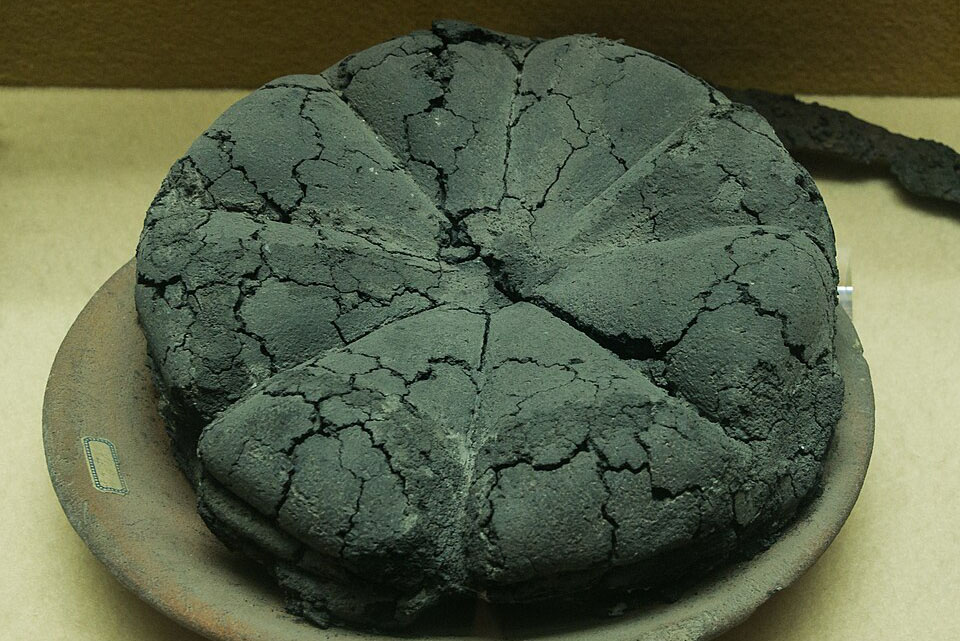
Take the bread first. Pompeii bread – an ancient round loaf – was among the foods revived in modern-day Gaziantep, and it reportedly carries a flavor that cannot be found in any other Turkish region. Panis quadratus, as it was known in Latin, was a staple of Roman daily life. The fact that its flavor reads as genuinely distinct to someone tasting it now says something about how specific and intentional Roman baking actually was.
Then there are the sweets, and these are where Roman cuisine history gets a little surprising. Simple flatbreads were common Roman fare, but so were libum – a type of honey-sweetened cheesecake – and globuli, honey cakes made from deep-fried dough soaked in honey. These weren’t elite dishes. Cato’s De Agri Cultura collects recipes for sweets and breads that would otherwise be lost, and one of the main characteristics is how simple they are – made with just a few ingredients, usually based on cheese, cereals, and eggs.
Libum was a sacrificial cake sometimes offered to household spirits during Rome’s early history. According to Virgil, Ovid, Horace, and other Latin authors, it was a ritual food prepared as an annual offering to the gods. So what’s sitting on a festival table in Gaziantep in 2025 was, two thousand years ago, something people made to honor the dead and the divine. That’s a remarkably intact lineage for a cheesecake.
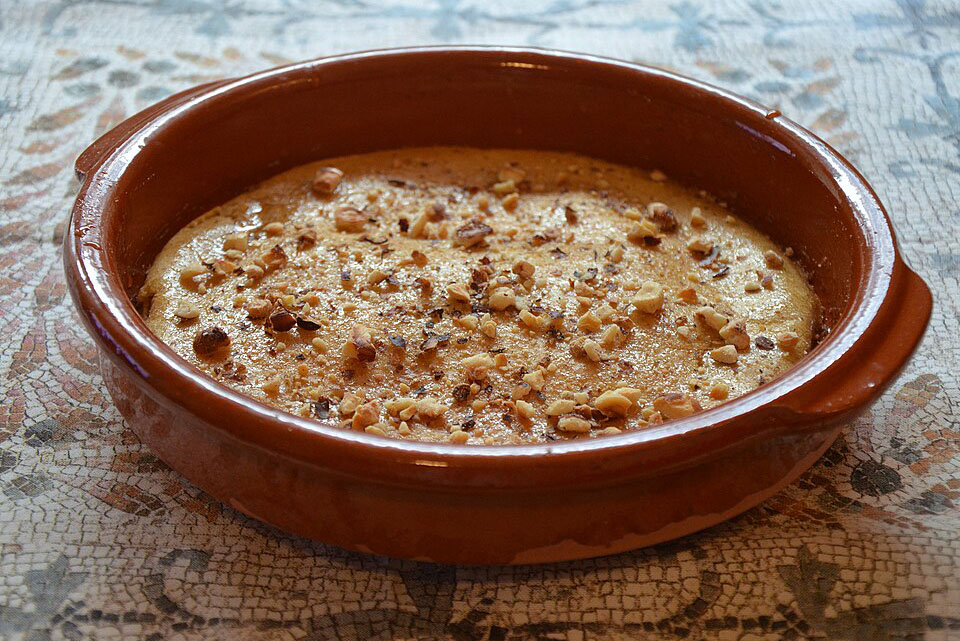
Dulcia Piperata – the spiced honey cake – appears in the Roman collection of Apician recipes from the 1st through 5th century AD. It’s a sweet, boiled wheaten pudding containing whole boiled grain, nuts, and honey. It’s also the kind of dish that, according to modern food researchers who’ve recreated it, carries an almost emotional weight – flavors that feel older than anything you’d expect.
How Did Archaeologists Recreate Ancient Roman Recipes?
This is where the archaeologist-chef collaboration at the GastroAntep Festival 2025 becomes something more than a novelty. Recreating ancient food from mosaics and inscriptions isn’t a matter of simply following a recipe. Ancient recipes are notoriously sparse. Many don’t always give clear instructions. A lot of them just list what goes into a dish without indicating how much of each ingredient or exactly how to cook it, which means people working with these recipes often have to experiment with different methods to figure things out.
That’s exactly what happened here. Archaeologists in Turkey’s ancient city of Dülük discovered Roman-era recipes that historians and chefs then recreated for the GastroAntep Culture Route Festival 2025. The process involved the kind of collaboration that doesn’t happen often. According to Fox News (2025), Chef Mutlu Durgun, who led the recreation project, explained that the ingredients in the dishes were suited to the wartime conditions of the Roman era, and that ancient people themselves tried the recipes many times before arriving at a reliable method.
That’s not a small thing. It means the dishes themselves carry a history of iteration. Every time someone adjusted the ratio of spelt to cheese in the globuli, or got the honey glaze wrong on the libum, they were doing what cooks still do. Getting it wrong first so they could eventually get it right.
The expertise behind the recreation came from two scholars. The dig work that revealed the culinary artifacts was conducted through the joint Turkey-Münster University collaboration. According to Hürriyet Daily News (2025), five specific recipes were conveyed to master chefs by Professor Kutalmış Görkay, the excavation coordinator, and Associate Professor Tulga Albustanlıoğlu, a gastro-archaeology expert from Başkent University. A gastro-archaeologist – someone whose entire specialty sits at the intersection of excavation and eating – is exactly the kind of person you want in the room when you’re trying to reconstruct what a Roman soldier’s food actually tasted like.
What Is the GastroAntep Festival 2025?
The GastroAntep Culture Route Festival is not a small regional event. It’s the seventh edition of this international gastronomy festival, held in Gaziantep in southeastern Turkey and co-organized by the Gaziantep Metropolitan Municipality and Turkey’s Ministry of Culture and Tourism. The nine-day festival ran from September 13 to 21 and featured hundreds of events, including concerts, theater performances, talks, and gastronomic presentations.
GastroAntep was first launched in 2018, and this 2025 edition forms part of the nationwide Culture Road Festival. The city it calls home has a long-standing reputation as a food capital. Gaziantep was added to UNESCO’s Creative Cities Network for Gastronomy in 2015. The city’s food traditions and range are extraordinary – it’s widely regarded as the culinary capital of Turkey, and its cuisine is so distinctive it’s the only city whose food is recognized by its own name. Think more than 500 dishes with centuries of documented history, rooted in everything from the Silk Road to Ottoman-era kitchens to, apparently, Roman-era excavations.
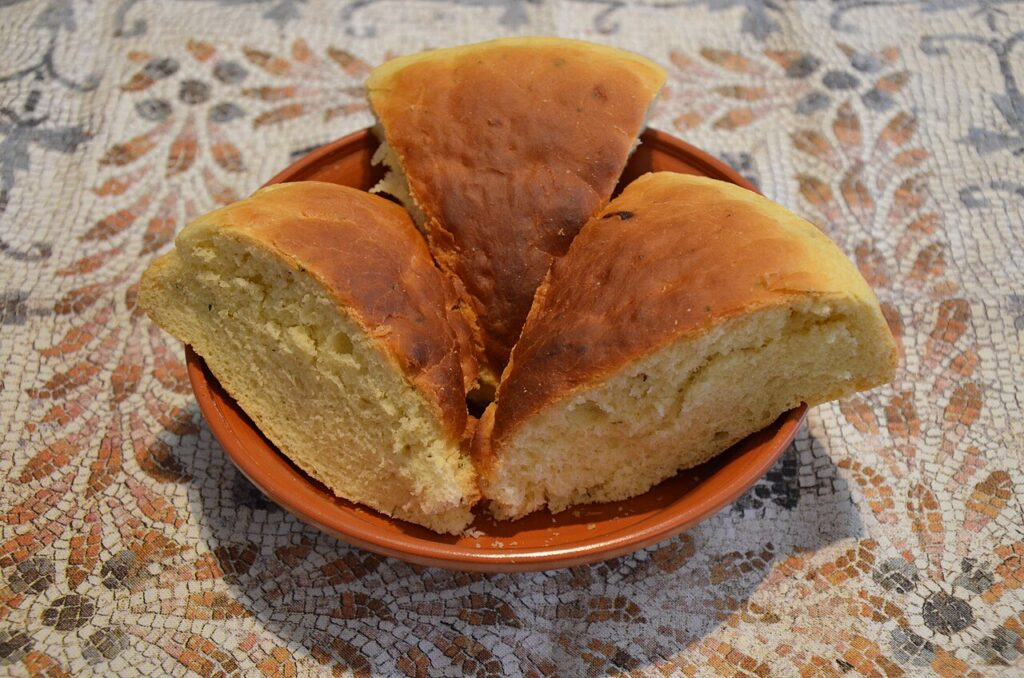
Ancient foods like Pompeii Bread, Olivatum, Libum, Globuli, and Dulcia Piperatta were identified during excavation works at Dülük Ancient City, then recreated and served to visitors as part of the festival experience. According to Türkiye Today (2025), these recreated Roman dishes were served to citizens at the festival, organized jointly by the Gaziantep Metropolitan Municipality and the Ministry of Culture and Tourism – and Turkey’s Minister of Culture and Tourism personally tasted the Roman-period bread prepared from the Dülük excavation recipes beforehand.
It was also, apparently, excellent. The minister called the bread “incredibly delicious.” Even allowing for the fact that this was a ministerial quote at a government-backed festival, the enthusiasm seems genuine. Something about bread that hasn’t changed in two thousand years tends to earn that.
The Plan to Put Roman Bread on Gaziantep Flights
Here’s the part that probably tells you more about how seriously Gaziantep is taking this than any other detail. According to Fox News, Şehitkamil Municipality Mayor Umut Yilmaz announced plans in 2025 to promote the ancient Dülük breads and dishes on Gaziantep flights, so that every traveler arriving in the city could taste and learn about the ancient site through the food itself.
That’s a bold play, and a smart one. Gaziantep’s identity is so thoroughly woven into its food culture that putting a 2,000-year-old bread on a flight as a welcome snack is less strange than it sounds. Gaziantep’s reputation as a UNESCO Creative City of Gastronomy is not mere marketing – it’s reflected in centuries-old culinary traditions and a living heritage that locals actively keep alive. Adding Roman-era loaves to that story is an extension of something the city has always done: treat food as history, and history as something you should be able to taste.
The logistics of scaling a Roman bread recipe for airline catering are probably a headache. But the idea itself is genuinely appealing. You land in a city that has been continuously inhabited since before the Roman era, and before you’ve even reached baggage claim, you’ve eaten the same bread people were baking two millennia ago.
What This Means Beyond the Festival
The archaeologist-chef collaboration that happened here is part of something bigger in the food world. Culinary archaeology – the study of what people ate and how they cooked it – has been growing as a serious discipline for years. Figuring out what people ate requires mixing history, archaeology, and culinary arts. People working in food history act like detectives, finding clues in old books, ruins, and art to see what food was like in the past. The mosaics at Dülük are exactly the kind of evidence these researchers depend on.
What makes the GastroAntep Roman era recipes project stand out is the end-to-end commitment to it. Researchers didn’t just publish papers about what they found. They handed the findings to a chef, let him fail a few times, and then served the results to thousands of people at a festival. That’s food history treated as living culture, not as a museum exhibit behind glass.
For parents who are always looking for ways to make history feel real to kids, this is worth knowing about. The idea that the cheesecake on your table – honey, cheese, spelt flour, simply made – might be chemically, procedurally, almost exactly the same as something a Roman soldier’s family ate in what is now southeastern Turkey is the kind of fact that makes a child put down their fork and actually think. History told through a recipe is history that sticks.
And if Gaziantep flights ever do start serving panis quadratus somewhere over the Mediterranean, the correct response is to eat it and appreciate the fact that somewhere under a hillside in Turkey, someone baked this same bread two thousand years ago. Got it wrong the first time. Tried again. And got it right.
Disclaimer: This article was created with AI assistance and edited by a human for accuracy and clarity.